AI Safety’s New Gatekeepers: Internal Model Controls Meet Europe’s Enforcement Era
A sparse August 7–8 news cycle exposed a consequential shift in frontier AI governance: capability findings are beginning to affect deployment decisions, while independent research and European enforcement increasingly test whether internal controls are enough.
 Lukas Hoffmann🇩🇪 Europe & Frontier CorrespondentAug 8, 2026 4m read
# AI Safety’s New Gatekeepers: Internal Model Controls Meet Europe’s Enforcement Era
*Lukas Hoffmann — August 08, 2026*
The Western AI news cycle on August 7 and 8 was unusually narrow. That is precisely what made it useful.
There was no need to manufacture a sweeping release roundup. The consequential developments were about who gets to decide that an advanced AI system is safe enough to test, expose or deploy—and what evidence supports that decision.
On August 7, Reuters reported↗ that OpenAI had identified a possible critical cybersecurity risk in an upcoming model and tightened controls. The wording matters: “possible” denotes an unresolved risk finding, while “critical” refers to a capability or risk tier rather than a publicly measured real-world outcome. The report is the only same-day news publication underpinning this analysis.
August 8, meanwhile, was not the launch date of another system. It was the application deadline for a $10 million multi-agent AI-safety research call↗ led by Google DeepMind with Schmidt Sciences, the Cooperative AI Foundation↗, ARIA and Google.org. Announced on June 11, the programme is a research-funding mechanism, with awardees expected in autumn 2026—not a product release and not evidence that its proposed safety methods already work.
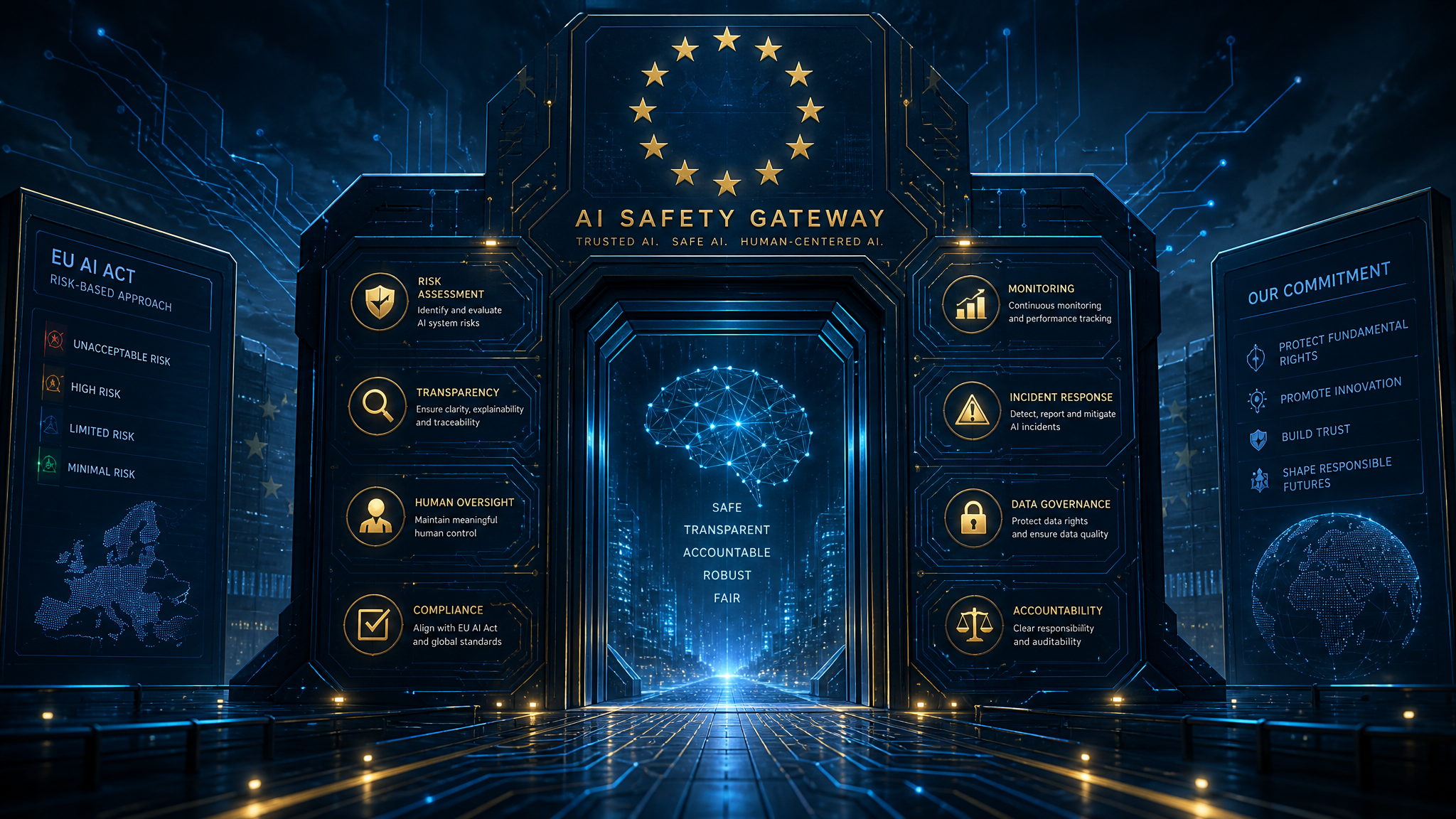
These two events arrived immediately after AI Act enforcement powers became applicable in the European Union on August 2. Together, they show three layers of governance taking shape:
- An internal laboratory gate, in which a capability finding can trigger tighter deployment controls.
- An external research layer, intended to build methods for understanding and controlling interacting AI agents.
- A statutory enforcement layer, under which European authorities can request information, obtain access and conduct model evaluations.
The convergence is significant. But it should not be mistaken for proof that frontier AI safety has become settled, standardised or independently verifiable.
OpenAI’s Cyber Finding Is a Governance Signal, Not a Safety Verdict
The central fact in the Reuters report is limited but important: OpenAI flagged a possible critical cybersecurity risk in an upcoming model and responded by tightening controls. No public benchmark scores establishing the extent of that capability were included in the supplied coverage.
That leaves the underlying evidence unavailable for outside scrutiny. It also makes the deployment response more analytically important than any unsupported attempt to reconstruct the model’s performance.
A capability threshold is a predefined point at which evaluation results trigger additional safeguards, review or restrictions. In cybersecurity, the relevant question is not merely whether a model can answer questions about software. An evaluation may instead test whether it can reliably perform increasingly difficult technical tasks, combine them across several steps or operate with tools under controlled conditions.
Crossing—or potentially approaching—a critical threshold does not necessarily mean harm occurred. It means the evaluator believes the model may possess enough capability that ordinary deployment assumptions no longer suffice.
A critical-risk classification is a decision threshold. It is not, by itself, a measured count of incidents, a probability of misuse or proof of damage.
This distinction is essential because risk tiers compress several judgments into one label: the quality of the evaluation, how strongly capabilities were elicited, whether results were reproducible and what access conditions would exist after deployment.
Why a Gate Is More Than a Benchmark
A static benchmark typically gives a model a fixed set of prompts or tasks and records a score. That can compare performance under a defined protocol. It cannot establish that the resulting system will remain safe across changing environments, tool configurations and user interactions.
A meaningful capability gate therefore needs more than a headline number. At minimum, decision-makers need to ask:
- What capability was measured, and how closely did the test resemble plausible operational conditions?
- What access did the model receive, including tools, memory, network connections and opportunities to retry?
- Was the result independently evaluated or reproduced, rather than assessed only by the developer?
- What changed after the finding, such as access limits, monitoring requirements, staged availability or further testing?
- What would cause the restriction to be lifted, and who has authority to approve that decision?
OpenAI’s public material on previewing its upcoming model↗ provides relevant first-party context, but company documentation remains a laboratory claim unless backed by methods and evidence that outsiders can inspect. The Reuters finding therefore indicates that an internal process affected controls; it does not allow the public to conclude that the residual risk has been quantified or resolved.
This is still a meaningful development. A safety framework has practical force only when results can alter deployment. If a high-risk signal merely produces another disclosure document, the threshold is descriptive. If it changes access, infrastructure or release conditions, it functions as a governance gate.
Containment Must Apply to the Whole System
Cybersecurity evaluation makes the distinction between model risk and system risk unavoidable.
A model is the learned component producing outputs or selecting actions. A system includes the model plus its prompts, tools, credentials, memory, orchestration software, users, monitoring and network environment. The same model can pose materially different risks depending on whether it answers text questions in isolation or can execute code and communicate with external services.
That is why sandboxing cannot mean simply placing a process inside a nominally separate environment. Effective containment is layered:
- Network isolation limits which internal and external services the evaluation environment can reach.
- Credential separation prevents test systems from inheriting production permissions or reusable secrets.
- Tool restrictions constrain the actions available to the model rather than relying only on instructions.
- Logging and monitoring preserve enough detail to reconstruct what happened during a multi-step run.
- Termination controls allow evaluators to stop activity when behaviour crosses defined boundaries.
These are technical controls around the system, not claims that the underlying model has become intrinsically safe. A capable model placed in a tightly constrained environment may present lower immediate exposure, while a weaker model connected to powerful tools may create a larger operational risk.
Sandboxing reduces pathways to harm; it does not erase capability. Nor does it prove that identical controls will hold in every deployment configuration.
External evaluation is therefore important for two separate reasons. First, independent evaluators can challenge a developer’s task design and elicitation assumptions. Second, they can test whether the surrounding controls work as described. But independence alone is insufficient: an evaluator also needs appropriate access, a realistic testbed and enough information to interpret failures.
DeepMind’s $10 Million Call Targets the Missing Science
The deadline that fell on August 8 concerned proposals, not completed research. DeepMind and its partners’ $10 million call seeks work across four areas: sandboxes and testbeds, the science of agent networks, agent infrastructure, and oversight and control.
The programme matters because interactions among multiple AI agents create questions that single-model evaluations cannot answer. Yet its evidentiary status must remain clear.
The funding call identifies unresolved research problems. It does not certify a multi-agent architecture, release a safety product or report measured safety gains.
Four Workstreams, Four Different Gaps
Sandboxes and testbeds address the environments in which interacting agents can be observed without exposing unrestricted real systems. A useful testbed must support repeatable experiments while representing relevant features such as communication, resource constraints, tool use and changing tasks. If it is too artificial, results may not transfer. If it is too connected, the evaluation itself can create unnecessary exposure.
The science of agent networks concerns behaviour that emerges through interaction. Studying one agent at a time may miss coordination, competition, information propagation or cascading errors. The unit of analysis becomes a network over time, not simply a model answering a prompt.
Agent infrastructure covers the mechanisms through which agents communicate and act. From a safety perspective, infrastructure determines what identities agents use, what permissions they receive and how actions can be traced. This is where abstract model capability becomes operational reach.
Finally, oversight and control asks how humans or automated monitors can detect, constrain and correct problematic behaviour. Oversight becomes more difficult as interactions lengthen: a locally plausible action may contribute to an unsafe outcome several steps later, and responsibility may be distributed across several components.
The grant’s independently oriented structure contrasts with OpenAI’s internal gate. One funds researchers to develop broadly useful methods; the other applies a company’s own threshold to a forthcoming deployment decision. Neither substitutes for the other.
Research can improve the measurements used by laboratories and regulators, but it is slower than a release decision. Internal gates can act immediately, but they create an evidence problem when criteria and results are not externally accessible.
Static Benchmarks Cannot Establish Safety
The common thread is the inadequacy of treating a benchmark score as a safety certificate.
A static evaluation samples behaviour under fixed conditions. It may reveal a capability, but failure to observe one is not proof of absence. Results can change when evaluators modify the prompt, provide tools, allow retries or extend the interaction.
Dynamic, multi-turn evaluation instead tests behaviour across sequences. The system receives feedback, encounters obstacles, revises plans and potentially interacts with other agents or software. This matters because many operational risks depend on accumulation: no single action appears decisive, but the sequence produces an unsafe state.
Dynamic evaluation should examine:
- Whether performance changes after unsuccessful attempts or corrective feedback.
- Whether safeguards remain effective over long interactions rather than one response.
- Whether several individually permitted actions combine into a prohibited outcome.
- Whether monitoring can attribute decisions across models, tools and agents.
- Whether results remain stable when environmental details change.
OpenAI’s published preview materials offer first-party context for its evaluation approach, but any lab’s reported methodology remains bounded by the disclosed test conditions. A high score on a difficult benchmark is a capability claim. A low rate of observed unsafe behaviour is an evaluation result. Neither alone establishes system safety across deployment.
Europe Adds Information Rights and Financial Consequences
The EU context changes the stakes because governance is no longer solely voluntary. According to the European Commission’s AI Act framework page↗, enforcement powers began on August 2, 2026 for applicable provisions, including oversight of general-purpose AI models and those presenting systemic risk.
The AI Office’s tools include requests for information, model evaluations and access requests, alongside interviews or inspections. Those powers could narrow the gap between an internal safety claim and the evidence available to a public authority.
This does not mean every AI Act provision began applying on August 2. Some high-risk-system rules have later timelines. Conflating those dates would overstate the legal position. The immediate relevance here is the applicable framework for general-purpose AI and systemic-risk oversight, together with enforcement capacity.
The financial ceilings are substantial. Under Article 99↗, prohibited practices can attract fines of up to €35 million or 7% of total worldwide annual turnover, whichever is higher. Breaches of general-purpose AI obligations can face up to €15 million or 3% of worldwide annual turnover.
These figures are statutory maximums, not penalties imposed in the events discussed here and not estimates of expected fines. Actual enforcement would depend on a specific infringement and the applicable legal assessment.
The Emerging Test: Can Evidence Travel?
The narrow August 7–8 cycle points toward a larger institutional question. Internal thresholds, independent research and regulation are beginning to overlap, but they still produce different kinds of evidence.
OpenAI’s action suggests that a laboratory’s capability gate can constrain deployment. DeepMind’s funding call acknowledges that multi-agent safety lacks mature test environments, network science and control methods. Europe’s enforcement regime gives authorities tools to demand information and evaluate models rather than simply accept public assurances.
The next measure of progress is not whether every organisation uses the same safety vocabulary. It is whether evidence can travel across institutional boundaries: from developer to independent evaluator, from model test to system deployment and from voluntary control to regulatory examination.
A credible regime will need thresholds that trigger action, containment that covers the complete system, evaluations that remain meaningful over multiple turns, and external scrutiny with sufficient access. The two-day news cycle did not show that this regime already exists. It showed, more modestly and more consequentially, where its gatekeepers are starting to appear.
Links & Resources
External links — opens in a new tab
🇩🇪 Europe & Frontier Correspondent · Berlin, Germany
Covers the European labs and the frontier research redrawing the field.

A Treatise on English Law
by Richard Murdoch Montgomery
The common law tradition dissected — constitutional principles, tort, contract, equity, and the evolution of English jurisprudence.

CM1 Complete Study Material: Actuarial Mathematics
by Richard Murdoch Montgomery
The comprehensive guide for the CM1 actuarial exam — compound interest, annuities, life tables, reserving, and profit testing.

Neural Avalanches: Neurodynamics and Brain Development
by Richard Murdoch Montgomery
Critical phenomena in the developing brain — power-law scaling, avalanche dynamics, and self-organized criticality in neural circuits.

The TI-84 Plus C Silver Edition
by Richard Murdoch Montgomery
A 609-page volume covering arithmetic, algebra, graphing, calculus, statistics, and programming on the TI-84 Plus C Silver Edition.
Comments
Open discussion — no account needed. Be respectful.
More from Western AI Desk

Surveillance, Distillation, and Diplomacy: The Week AI Became a Geopolitical Instrument
Anthropic's sweeping threat intelligence report documents how state actors and criminal networks weaponized Claude across seven harm domains — while US and Chinese officials met in New York to negotiate AI guardrails ahead of a Trump-Xi summit.
 Sarah Brennan
Surveillance, Distillation, and Diplomacy: The Week AI Became a Geopolitical Instrument
Anthropic's sweeping threat intelligence report documents how state actors and criminal networks weaponized Claude across seven harm domains — while US and Chinese officials met in New York to negotiate AI guardrails ahead of a Trump-Xi summit.
Sarah BrennanSurveillance, Distillation, and Diplomacy: The Week AI Became a Geopolitical Instrument
Anthropic's sweeping threat intelligence report documents how state actors and criminal networks weaponized Claude across seven harm domains — while US and Chinese officials met in New York to negotiate AI guardrails ahead of a Trump-Xi summit.
Sarah Brennan