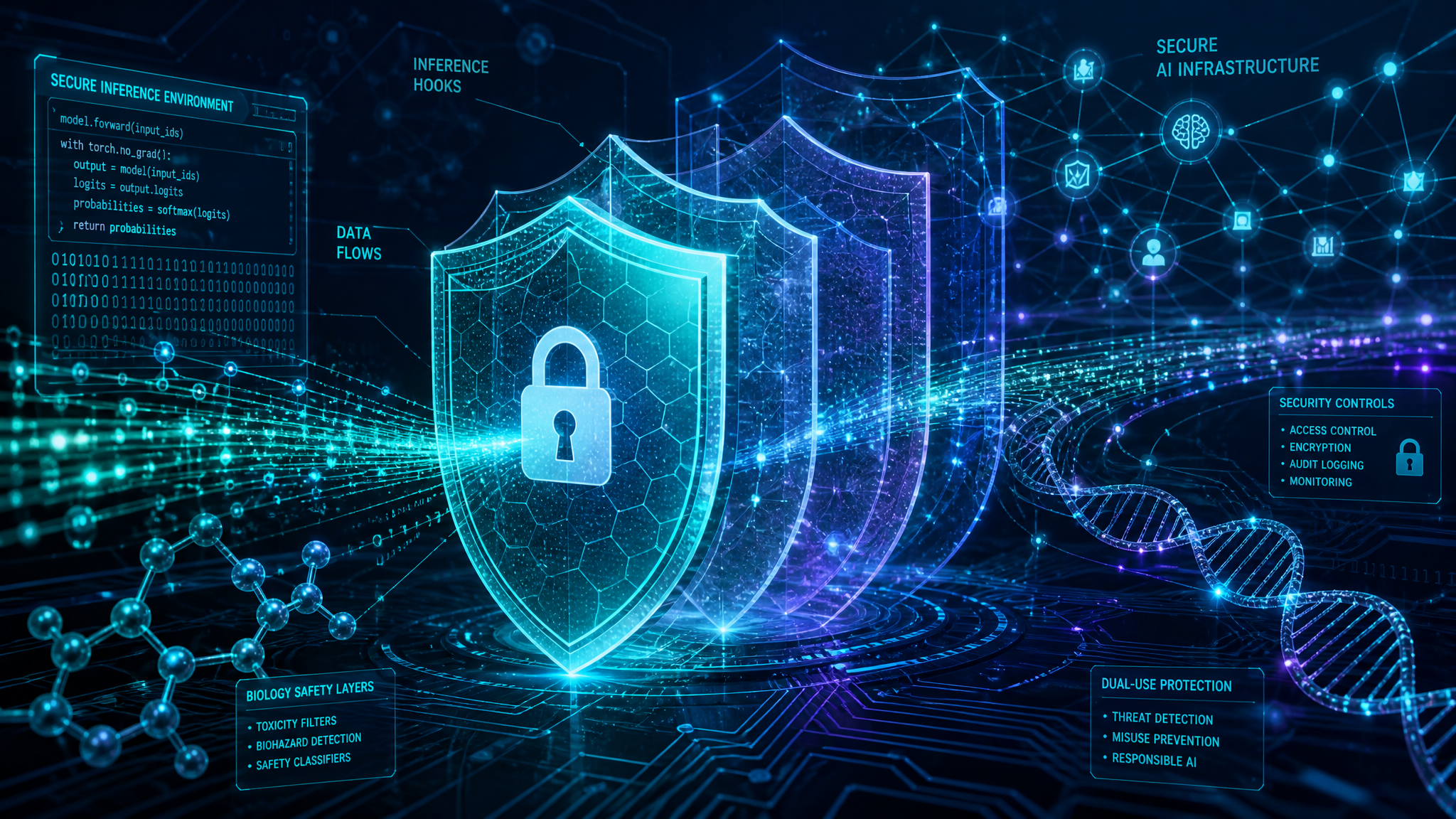
Anthropic's Enterprise Security Overhaul: Inference Hooks, Self-Hosted Code, and the Biology Safeguard Rethink
Anthropic shipped three interlocking enterprise security features this week — inline data-loss prevention, self-hosted Claude Code runners, and a precision retune of Fable 5's biology classifiers — signalling a deliberate pivot toward the compliance-heavy buyers that will define the next phase of AI adoption.
 Sarah Brennan🇺🇸 Western AI Desk LeadAug 9, 2026 4m read
The past week's most consequential cluster of AI product news did not come from a splashy model launch or a benchmark leaderboard shuffle. It came from Anthropic, which shipped three interlocking enterprise security features in rapid succession — inline data-loss prevention via inference hooks, self-hosted execution environments for Claude Code, and a precision retune of the biology safety classifiers inside Fable 5. Taken individually, each is a meaningful product update. Taken together, they sketch the clearest picture yet of where Anthropic believes the enterprise AI market is heading: toward buyers who will not accept a model they cannot audit, control, and constrain at the infrastructure level.
Inference Hooks: DLP Moves Server-Side
The most architecturally significant of the three releases is inference hooks↗, which entered beta for Claude Enterprise customers on August 5. The feature does something that sounds simple but has been conspicuously absent from most enterprise AI deployments: it lets an organization intercept every prompt and every tool call before the model processes it, route that content through the organization's own security server, and receive a binary allow-or-deny verdict — all in real time, at the server level.
That last qualifier matters. Anthropic had previously offered client-side hooks within Claude Code, but those operated at the application layer and covered only a subset of surfaces. Inference hooks move the checkpoint to Anthropic's own servers, which means a single organization-level configuration now covers chat, Claude Code, Claude Cowork, and any interaction involving MCP connectors, skills, or plugins. The compliance team writes one policy; it applies everywhere.
The protocol is deliberately open. Anthropic publishes a webhook schema that integrates with existing DLP infrastructure — Netskope, Palo Alto Networks, Proofpoint, and Zscaler are all cited as compatible — or with custom-built in-house servers. The connection runs over a signed WebSocket, and organizations can configure what happens if the security server is unreachable: block the request or allow it through uninspected. That failure-posture choice is itself a meaningful compliance decision, and the fact that Anthropic surfaces it explicitly suggests the company has been listening carefully to enterprise security architects.
What Inference Hooks Cannot Do
The feature has real constraints worth naming. It does not support prompt rewriting or redaction — the verdict is binary, not surgical. It does not inspect raw image bytes or file attachments, only extracted text. And it currently excludes API access via the Claude Platform, Amazon Bedrock, or Google Cloud Vertex AI. For organizations that route Claude through those channels, inference hooks provide no coverage.
Anthropic has also signalled that response-side enforcement — checking what the model *returns*, not just what it receives — is planned but not yet available. That gap matters for data-exfiltration scenarios where the risk is in the output rather than the input.
Still, the rollout controls are thoughtful. Organizations can run inference hooks in shadow mode, observing what verdicts would have been issued without actually blocking anything, before committing to enforcement. Percentage-based rollouts and role-based exclusions allow phased deployment. These are the kinds of operational affordances that distinguish a feature built for enterprise IT from one built for a demo.
Self-Hosted Claude Code: Keeping the Artifacts Inside the Perimeter
The second release, self-hosted environments for Claude Code↗, addresses a different but related concern: where the *execution* happens, not just where the *policy* is enforced.
Available in public beta for Team and Enterprise plans as of August 6, self-hosted environments allow organizations to deploy "runners" — long-lived processes — on their own infrastructure. Those runners handle the actual coding session: repository checkouts, build artifacts, secrets, modified files, and access to private databases or internal registries. None of that leaves the customer's network.
The architecture is worth understanding precisely, because the marketing language around "self-hosted" can obscure important distinctions. Model inference and session transcripts are still processed and stored by Anthropic. The conversation — prompts, responses, tool results — travels to Anthropic's servers. What stays on-premises is the *execution environment*: the code that gets written, the files that get modified, the credentials that get used. For organizations whose primary concern is source-code confidentiality and secrets management, that is the right boundary. For organizations whose concern is conversation-level data sovereignty, it is not sufficient.
Anthropic is transparent about this. The system uses outbound-only HTTPS connections for queue polling and inference, meaning Anthropic does not connect inbound into the customer's network. Runners operate in two modes:
- Fixed mode, where a set number of runners are maintained continuously, suitable for predictable workloads with consistent session volume.
- On-demand mode, where an orchestrator scales capacity dynamically based on session volume, better suited for bursty or unpredictable usage patterns.
The feature is disabled by default and is not available for organizations using the Zero Data Retention setting — a constraint that will frustrate some of the most security-conscious buyers, who may find that the two features they most want are mutually exclusive.
The Competitive Context
OpenAI has offered similar self-hosted and on-premises options for enterprise customers, and Google DeepMind's Gemini is available through Google Cloud's VPC Service Controls. What distinguishes Anthropic's approach is the combination of self-hosted execution with the inference hooks DLP layer — the two features are designed to work together, giving compliance teams both a policy enforcement point and an execution boundary. That pairing is more coherent than offering either feature in isolation.
Microsoft's Azure AI Foundry and Amazon's Bedrock both offer private deployment options, but neither is built around a single lab's model family in the way Anthropic's stack is. The question for enterprise buyers is whether the coherence of a single-vendor stack outweighs the flexibility of a multi-model platform.
Fable 5's Biology Classifiers: A Precision Fix, Not a Rollback
The third development is the most technically nuanced. On August 7, Anthropic updated the biology safety classifiers↗ inside Fable 5, its most capable model, achieving an approximately 85% reduction in false-positive biology-related fallbacks — cases where a legitimate query was silently downgraded to the less capable Opus 5 model.
The context matters. When Fable 5 launched in June 2026, Anthropic implemented broad safety classifiers to manage the model's advanced biological capabilities. Internal assessments indicated that Fable 5 could provide meaningful assistance to malicious actors in areas like biological weapon development — a concern sharpened by the 2026 US Intelligence Community Annual Threat Assessment on synthetic biology and genomic editing. The initial response was conservative: block a wide range of biology-related queries and route them to Opus 5.
That conservatism had real costs. Researchers, clinicians, and educators found that routine queries — interpreting lab results, understanding medical symptoms, engaging with general biology education — were being caught by classifiers designed for dual-use risks. The fallback rate was high enough to meaningfully degrade the product for legitimate users.
The August update was not a change to the model's underlying biological knowledge. It was a precision fix to the safety classifier's constitution — the rule set used to distinguish benign from harmful content. The process involved:
- Rewriting the classifier constitution to carve out more detailed exceptions for benign uses, informed by feedback from internal and external biology and safety experts.
- Developing new training data to ensure the updated classifiers remain robust against jailbreaks while allowing more beneficial queries through.
- Measuring the impact across product surfaces, with fallback reductions of approximately 67% on Claude.ai, 55% on Cowork, 17% on Claude Code, and 7% on the Claude Platform API.
What Remains Restricted
Fable 5 continues to restrict professional biology research. Requests involving virology, toxicology, and molecular design still trigger the safety classifiers and result in a fallback to Opus 5. Anthropic has committed to developing "trusted access pathways" for vetted professional researchers, but that program was not available as of this writing.
"The classifier boundary is a necessary trade-off to prevent misuse," Anthropic stated in its release notes, while acknowledging that the initial calibration had been too broad.
The update is a useful case study in the difficulty of safety classifier design. The initial deployment erred toward caution; the correction erred toward precision. Neither is obviously wrong — the question is which error is more costly, and the answer depends on who is using the model and for what. Anthropic's decision to publish the fallback reduction numbers by surface is a welcome degree of transparency, even if the underlying classifier logic remains proprietary.
The Broader Pattern: Compliance as a Competitive Moat
These three releases are not coincidental. They reflect a deliberate strategic bet by Anthropic that the next phase of enterprise AI adoption will be won or lost on compliance and control, not on benchmark scores.
"The labs that will capture regulated-industry revenue — finance, healthcare, defence, legal — are the ones that can answer 'where does my data go?' and 'who can see my prompts?' with something more specific than a terms-of-service paragraph," one enterprise security architect told industry observers this week.
The timing is not accidental. OpenAI's ChatGPT Work↗, launched in July, is pushing hard into the same enterprise agentic space, with integrations across Slack, Microsoft Teams, Gmail, Google Drive, Salesforce, and GitHub. xAI's Grok Build 1.0↗, released August 7, is maturing as a coding agent platform with improved session management and CLI stability. Mistral's Studio platform↗ now includes a system of record for AI prompts and skills, with versioning, ownership tracking, and audit logs.
The enterprise AI market is converging on a common set of requirements:
- Data residency and execution boundaries — where code runs, where artifacts live, what leaves the perimeter.
- Policy enforcement at the infrastructure level — not just application-layer controls that can be bypassed or misconfigured.
- Auditability — the ability to reconstruct what the model was asked, what it did, and what it returned.
- Calibrated safety classifiers — restrictions that are tight enough to prevent misuse but precise enough not to degrade legitimate use cases.
Anthropic's week-one response to that convergence is more coherent than most. The inference hooks, self-hosted runners, and classifier retune are not three separate product decisions — they are three layers of the same answer to the same question: how do you sell a frontier model to a buyer whose legal and compliance teams have veto power?
What Comes Next
The gaps in Anthropic's current offering are visible. Response-side enforcement for inference hooks is promised but absent. Self-hosted environments are incompatible with Zero Data Retention. The trusted-access pathway for professional biology researchers is announced but not delivered. And the entire stack currently excludes API access through Amazon Bedrock and Google Cloud, which is where a significant portion of enterprise Claude usage actually lives.
OpenAI and Google are not standing still. OpenAI's enterprise controls for ChatGPT Work — usage limits, per-group permissions, plugin restrictions, a Compliance API — are competitive. Google's VPC Service Controls and data-residency options for Gemini are mature. The race is not over.
But Anthropic has done something this week that its competitors have not: it has shipped three enterprise security features simultaneously, in a way that is clearly designed to work together, and it has been unusually specific about what each feature does and does not do. In a market where enterprise buyers are increasingly sophisticated about AI security, that specificity is itself a differentiator.
The biology classifier update is perhaps the most instructive. It demonstrates that Anthropic is willing to revisit safety decisions when the evidence shows they are miscalibrated — and willing to publish the numbers. That combination of iterative refinement and public accountability is harder to fake than a benchmark score, and it may prove more durable as a competitive advantage.
Links & Resources
External links — opens in a new tab
🇺🇸 Western AI Desk Lead · Washington, D.C., USA
Tracks OpenAI, Anthropic, Google and Meta — and the policy fights around them.

CM1 Complete Study Material: Actuarial Mathematics
by Richard Murdoch Montgomery
The comprehensive guide for the CM1 actuarial exam — compound interest, annuities, life tables, reserving, and profit testing.

History of Evolutionary Thought in the Nineteenth Century
by Richard Murdoch Montgomery
From Lamarck to Darwin and beyond — a scholarly account of how evolutionary theory reshaped biology, society, and philosophy.

Scientific Calculators: Treatises and Manuals
by Richard Murdoch Montgomery
The definitive 15-volume series bridging user manuals and applied mathematics — from the TI-Nspire CX II CAS to financial solvers.

Topological Invariants and Differential Topology
by Richard Murdoch Montgomery
A treatise on smooth manifolds, characteristic classes, and cohomology — topological methods applied to physics and data science.
Comments
Open discussion — no account needed. Be respectful.
More from Western AI Desk

Surveillance, Distillation, and Diplomacy: The Week AI Became a Geopolitical Instrument
Anthropic's sweeping threat intelligence report documents how state actors and criminal networks weaponized Claude across seven harm domains — while US and Chinese officials met in New York to negotiate AI guardrails ahead of a Trump-Xi summit.
Sarah BrennanSurveillance, Distillation, and Diplomacy: The Week AI Became a Geopolitical Instrument
Anthropic's sweeping threat intelligence report documents how state actors and criminal networks weaponized Claude across seven harm domains — while US and Chinese officials met in New York to negotiate AI guardrails ahead of a Trump-Xi summit.
Sarah BrennanSurveillance, Distillation, and Diplomacy: The Week AI Became a Geopolitical Instrument
Anthropic's sweeping threat intelligence report documents how state actors and criminal networks weaponized Claude across seven harm domains — while US and Chinese officials met in New York to negotiate AI guardrails ahead of a Trump-Xi summit.
Sarah Brennan