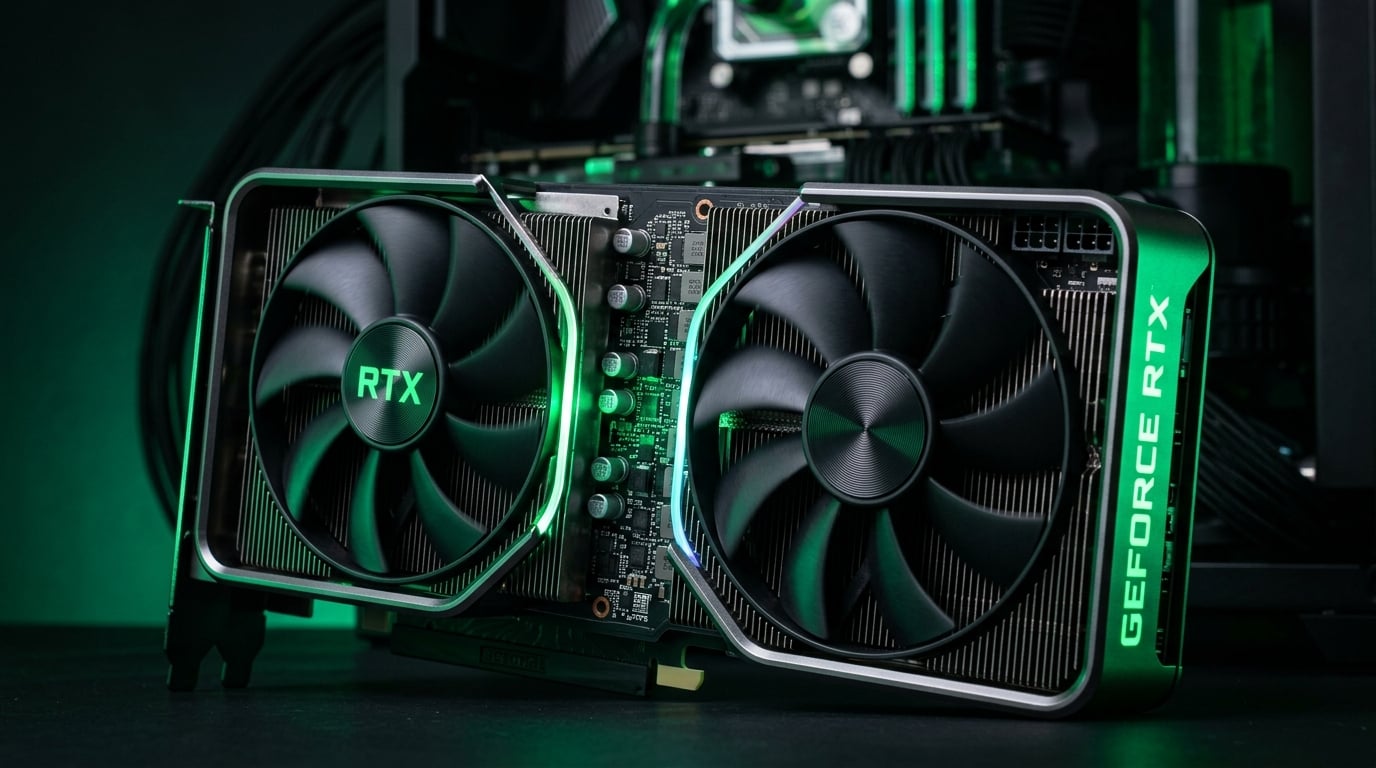
Choosing a GPU for Running LLMs at Home
VRAM is king, but it is not the whole story. A practical guide to picking a card for local inference and light fine-tuning.
 Diego Ramos🇧🇷 Value & Buying CorrespondentJun 25, 2026 6m read
If you take one thing from this guide: buy the most VRAM you can afford.
Why VRAM dominates
Model size, context length, and batch size all consume memory. Run out, and performance collapses as data spills to system RAM. A card with more memory but slightly slower cores will beat a faster card that cannot fit your model.
- Entry: enough VRAM for quantized mid-size models
- Sweet spot: a card that fits popular open models comfortably
- Enthusiast: multi-card or high-memory workstation GPUs
Quantization stretches your VRAM, but it is not a substitute for having enough in the first place.
Beyond the card
Do not forget power supply headroom and case airflow. A starved or thermally throttled GPU quietly loses you performance.
🇧🇷 Value & Buying Correspondent · São Paulo, Brazil
Finds the smart buy — the best value for what you actually do.

Calculus I
by Richard Murdoch Montgomery
Limits, derivatives, integrals, and series — a first course in calculus with formal proofs, worked examples, and applications to physics and engineering.

Treatise on Systems Biology
by Richard Murdoch Montgomery
Modelling gene regulatory networks, metabolic pathways, and ecological dynamics — where mathematics meets molecular biology.
Glioblastoma Growth Modelling
by Richard Murdoch Montgomery
Mathematical oncology meets computational neuroscience — reaction-diffusion models, imaging-driven simulations, and treatment optimisation.
The Scientific Financial Calculator 12C: Finance
by Richard Murdoch Montgomery
Over 600 pages and 51 chapters on the HP 12C — bond pricing, duration, convexity, portfolio mathematics, and regression analysis.
Comments
Open discussion — no account needed. Be respectful.
More from Hardware Buying Guides
Beelink GTR9 Pro Buying Guide: Is 192GB of Unified Memory Worth $7,399?
Beelink's newly global GTR9 Pro pairs AMD's Ryzen AI Max+ PRO 495 with up to 192GB of unified LPDDR5X memory in a compact workstation. The capacity is exceptional for local LLM experimentation, but the launch pricing makes this a specialist purchase rather than an automatic desktop-GPU replacement.
Axelera AI Titania Buying Guide: What to Buy Now and What to Prepare For
Axelera AI’s Titania targets high-capacity data-center inference in an air-cooled reference platform, but production is not expected until Q3 2027. This guide explains who should prepare for Titania, who should wait, and when the available NXP Ara240 is a more practical edge-development option.
AMD’s 6th Gen EPYC Is Here: How to Buy the Right AI Host Server
AMD’s 6th Gen EPYC SP7 platform is now shipping, bringing Zen 6, up to 256 cores, 16 memory channels and PCIe 6.0 to AI host servers. This guide explains who should buy in now, which workloads benefit, and why the flagship chip is rarely the sensible first choice.