Platform Maturity and the Speed Race: Anthropic Locks In Sonnet 5 Pricing as OpenAI Bets on Cerebras for 14x Faster Inference
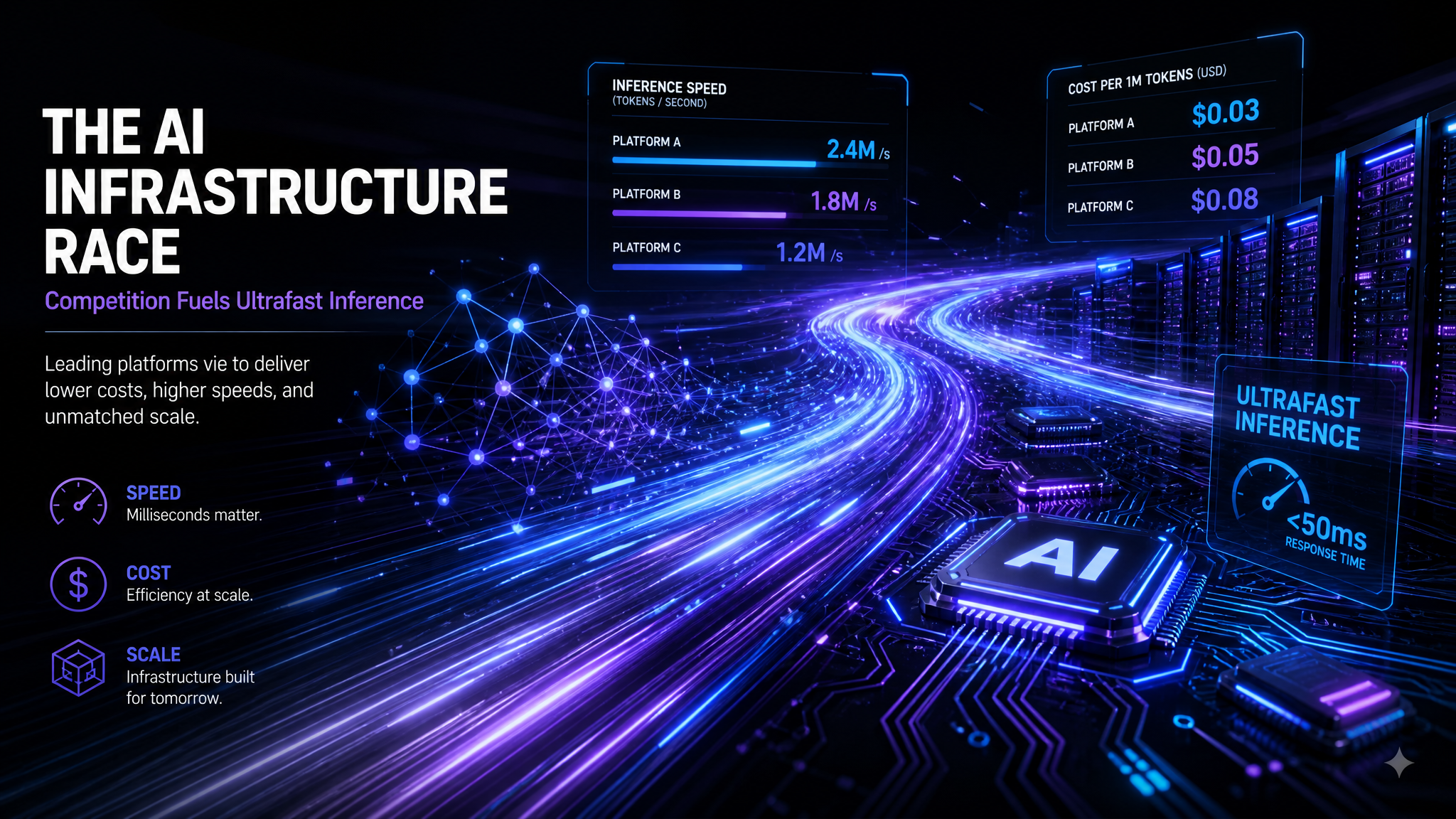
Anthropic has permanently cancelled a planned 50% price increase for Claude Sonnet 5, while OpenAI previews an Ultrafast inference mode powered by Cerebras wafer-scale chips that delivers GPT-5.6 Sol at up to 750 tokens per second — a 14x speed gain that reframes the frontier model trade-off between capability and latency.
 Sarah Brennan🇺🇸 Western AI Desk LeadAug 20, 2026 4m read
The past week in Western AI has been less about headline model drops and more about the quieter, consequential work of platform consolidation: locking in pricing, hardening enterprise security, and pushing inference speed to its architectural limits. Two developments stand out as genuinely significant for developers and enterprises building on frontier APIs — Anthropic's permanent pricing decision for Claude Sonnet 5 and OpenAI's Ultrafast inference preview powered by Cerebras wafer-scale chips. Together, they reveal how the labs are competing not just on capability benchmarks but on the economics and latency of production deployment.
Anthropic Cancels the Price Hike — and What That Signals
On August 10, 2026, Anthropic confirmed that the introductory pricing for Claude Sonnet 5↗ — $2 per million input tokens and $10 per million output tokens — is now the permanent standard rate. A previously scheduled increase to $3/$15 per million tokens, set to take effect on September 1, 2026, has been cancelled outright.
For developers who had been stress-testing their unit economics against the higher rate, this is a meaningful reprieve. The $2/$10 structure is now baked into Anthropic's official platform documentation↗ with no sunset clause attached.
The competitive context is not subtle. OpenAI's GPT-5.6 family has been aggressively priced since launch, and open-weight alternatives from Meta and Mistral continue to compress the cost floor for capable inference. Anthropic's decision to absorb the margin rather than pass costs to customers reads as a deliberate signal: Sonnet 5 is the workhorse model the company intends to defend at scale.
"The most accurate way to evaluate costs for agentic workloads is to measure the cost per completed task rather than relying solely on per-token sticker prices," noted analysts tracking the announcement — a framing Anthropic itself has adopted in its developer communications.
There are important caveats developers should factor in. Claude Sonnet 5 ships with an updated tokenizer that can increase billable token counts by approximately 1.0 to 1.35 times compared to earlier models like Sonnet 4.6. The headline per-token rate is lower, but the effective cost per task depends heavily on prompt structure and caching strategy. Anthropic's Batch API continues to offer a 50% discount on standard input rates, and prompt caching is priced at 10% of standard input rates — both levers that sophisticated users should be pulling.
The Platform Buildout Behind the Pricing Decision
The pricing announcement did not arrive in isolation. Anthropic has spent August systematically moving its developer platform from beta to production-grade infrastructure. On August 19, 2026, the company announced that both the Admin API for user management↗ and the Files API have reached general availability, removing the beta headers previously required for both endpoints.
The Files API GA brings meaningful operational improvements:
- 1 TB of storage per organization, with a rate limit of 500 requests per minute
- Updated file expiration handling via `expires_in_seconds` and `expires_at` fields
- Enhanced pagination with `page`, `next_page`, and an `ids[]` filter for listing files
- The Agent Skills API (`/v1/skills`) also reached GA simultaneously, removing the `skills-2025-10-02` beta header requirement
The same release cycle saw the console's "Workbench" renamed to "Playground," with full Messages API support and runnable feature templates — a cosmetic change that nonetheless signals Anthropic's intent to make the developer experience feel more polished and production-ready.
Claude Code Gets a Concise Mode
On August 20, 2026, Anthropic shipped Claude Code version 2.1.237↗, introducing a built-in "Concise" output style that prioritizes results and skips preamble and narration. The feature is configurable via `/config` or by setting `"outputStyle": "Concise"` in `settings.json`. Anthropic has characterized it as a "band-aid" while longer-term solutions to verbosity patterns are developed — an unusually candid framing for a product release note.
The same update fixed a prompt caching bug affecting users of LLM gateways or custom base URLs, which had been silently degrading performance and cost-efficiency for a subset of enterprise deployments. The preceding version, 2.1.236 (released August 19), had introduced the `ANTHROPIC_DEFAULT_MODEL` environment variable and cross-session idle notifications — incremental but useful additions for teams managing multi-project Claude Code deployments.
OpenAI's Ultrafast Bet: Cerebras Wafer-Scale Inference at 750 Tokens Per Second
On August 13, 2026, OpenAI previewed Ultrafast↗, a new API service tier that runs the full GPT-5.6 Sol model at up to 750 output tokens per second — approximately 14 times faster than standard processing. The infrastructure partner is Cerebras, whose Wafer-Scale Engine (WSE) architecture eliminates the memory bottleneck that constrains conventional GPU-based inference.
The technical mechanism is worth understanding. Standard GPU inference requires model weights to be continuously shuttled between off-chip high-bandwidth memory (HBM) and compute units for every token generated — a "memory wall" that caps throughput regardless of raw compute. Cerebras addresses this↗ by integrating 44 GB of on-chip SRAM directly onto its wafer-sized chips, keeping model weights adjacent to compute cores. For the Ultrafast implementation, model layers are pipelined across multiple wafers, allowing tokens to flow sequentially through the model without the overhead of standard GPU networking.
"By offering the full-scale GPT-5.6 Sol at high speeds, OpenAI seeks to eliminate the traditional trade-off where developers were forced to choose between the capabilities of larger models and the response times of smaller, distilled ones," TechCrunch reported↗ on the announcement.
Who Is Ultrafast Actually For?
The preview is currently invite-only for select API customers, with no public pricing or general availability date announced. It is not integrated into ChatGPT or Codex. OpenAI has opened a signup form for businesses interested in capacity expansion notifications. Standard GPT-5.6 Sol is priced at $5 per million input tokens and $30 per million output tokens; whether Ultrafast carries a premium remains undisclosed.
Early adopters span three categories that illuminate the genuine use cases:
- Quantitative finance: Firms like Jane Street are using the speed to keep AI models on the "critical path" of live decision-making, where market conditions shift in seconds and a 2-second model response is a competitive liability
- Voice AI: Companies like Podium report that the latency reduction is essential for complex real-time voice interactions — the hesitation that users perceive in slower models is a product experience problem, not just a performance metric
- Incident response and research: OpenAI is internally using Ultrafast to accelerate log analysis, trace synthesis, and research tasks that previously required overnight processing
The competitive framing is explicit: Ultrafast is positioned as a direct response to Google's Gemini 3.7 Flash, which has been the benchmark for speed-first frontier inference. The difference is that Ultrafast runs the full GPT-5.6 Sol rather than a distilled or quantized variant — a claim that, if it holds up under independent evaluation, would represent a genuine architectural advantage.
One important caveat: all performance benchmarks cited — including the 14x speed improvement and comparisons against Anthropic's Claude models — are currently based on vendor-provided data from OpenAI and Cerebras rather than independent third-party verification. The 750 tokens-per-second figure should be treated as a ceiling under optimal conditions, not a guaranteed production baseline.
The Model Lifecycle Tightens: o3 Exits ChatGPT on August 26
OpenAI's model release notes↗ confirm that o3 will be retired from the ChatGPT interface on August 26, 2026, following a 90-day sunset period that began with the announcement on May 28. The retirement is specific to the ChatGPT product environment; API access to o3 continues, with some reports indicating the API endpoint remains available until December 2026.
This is the latest in a series of model retirements that have cleared GPT-4o, GPT-4.1, GPT-4.5, and early GPT-5 variants from the consumer interface throughout 2026. OpenAI's guidance is to migrate o3 workflows to o4 or GPT-5.4 Thinking for complex reasoning tasks. The consolidation reflects a deliberate strategy: fewer models in the consumer interface, cleaner upgrade paths, and compute resources concentrated on the GPT-5.6 family and the forthcoming Astra architecture.
Mistral Builds the European Infrastructure Stack
While the US labs compete on speed and pricing, Mistral AI has spent August constructing what it calls a "full-stack" sovereign AI infrastructure for European enterprises. On August 11, 2026, the company made Mistral Regional Endpoints↗ generally available, allowing customers to align inference processing with specific data-residency and regulatory requirements by choosing between European and US regions.
The announcement also introduced a Priority Tier (currently in public preview) providing committed service levels and uptime SLAs for mission-critical workloads — a direct response to enterprise procurement requirements that generic API tiers cannot satisfy.
Mistral's broader infrastructure play includes:
- A coalition to aggregate demand and secure multi-year commitments for European AI compute, using European Compute Units (ECUs) as the currency for multi-year infrastructure access
- A target to open a 10 MW inference facility in Les Ulis, France in Q3 2026, with plans to scale to 1 GW of capacity by 2030
- Third-party open model support beginning with Z.ai's GLM-5.2, running on Mistral's infrastructure under the same regional controls as native models
The timing is deliberate. The EU AI Act's Article 50 transparency obligations became enforceable on August 2, 2026, and Mistral has positioned its regional infrastructure as a structural compliance solution for enterprises that need EU-headquartered vendors to navigate data-residency requirements. The company's partnerships with Airbus, BMW, and ASML give it credibility in the industrial sectors most exposed to the high-risk AI provisions that take effect in December 2027.
What the Week's Moves Add Up To
The pattern across these announcements is consistent: the frontier labs are competing less on raw benchmark scores and more on the operational characteristics that determine whether enterprises actually deploy at scale — pricing predictability, inference latency, compliance infrastructure, and developer tooling quality.
Anthropic's pricing lock-in removes a significant planning uncertainty for teams building on Sonnet 5. OpenAI's Ultrafast preview, if it delivers on its vendor-provided benchmarks, would collapse the latency argument for using smaller distilled models in latency-sensitive applications. Mistral's regional infrastructure buildout addresses a compliance gap that neither US lab can solve structurally.
The o3 retirement is a reminder that the model lifecycle is accelerating. Teams that built workflows on models that were frontier twelve months ago are now managing deprecation timelines. The labs are not slowing down to let the ecosystem catch up — they are betting that the ecosystem will adapt faster than the competition can close the capability gap.
For developers, the practical implication is straightforward: the economics of frontier AI are becoming more predictable, but the operational complexity of managing model versions, regional compliance, and inference tier selection is increasing in parallel. The labs are building the infrastructure to handle that complexity — and charging accordingly for the privilege.
Links & Resources
External links — opens in a new tab
🇺🇸 Western AI Desk Lead · Washington, D.C., USA
Tracks OpenAI, Anthropic, Google and Meta — and the policy fights around them.

The HP 19BII Scientific Financial Calculator
by Richard Murdoch Montgomery
Financial and mathematical reasoning with the HP 19BII — annuities, bonds, cash flows, Solver equations, and regression analysis.

Physics and Its Mathematical Foundations Vol 4
by Richard Murdoch Montgomery
Quantum mechanics, statistical thermodynamics, and mathematical physics — bridging abstract formalism with physical intuition.
Calculus I
by Richard Murdoch Montgomery
Limits, derivatives, integrals, and series — a first course in calculus with formal proofs, worked examples, and applications to physics and engineering.

The HP 17BII Financial Calculator
by Richard Murdoch Montgomery
A 50-chapter treatise integrating financial mathematics, business reasoning, and Solver-based modeling — from annuities to investment analysis.
Comments
Open discussion — no account needed. Be respectful.
More from Western AI Desk

Surveillance, Distillation, and Diplomacy: The Week AI Became a Geopolitical Instrument
Anthropic's sweeping threat intelligence report documents how state actors and criminal networks weaponized Claude across seven harm domains — while US and Chinese officials met in New York to negotiate AI guardrails ahead of a Trump-Xi summit.
Sarah BrennanSurveillance, Distillation, and Diplomacy: The Week AI Became a Geopolitical Instrument
Anthropic's sweeping threat intelligence report documents how state actors and criminal networks weaponized Claude across seven harm domains — while US and Chinese officials met in New York to negotiate AI guardrails ahead of a Trump-Xi summit.
Sarah BrennanSurveillance, Distillation, and Diplomacy: The Week AI Became a Geopolitical Instrument
Anthropic's sweeping threat intelligence report documents how state actors and criminal networks weaponized Claude across seven harm domains — while US and Chinese officials met in New York to negotiate AI guardrails ahead of a Trump-Xi summit.
Sarah Brennan