Reasoning Sliders, Safer Biology, and a Worm in the Toolchain: The Week's Defining AI Moves
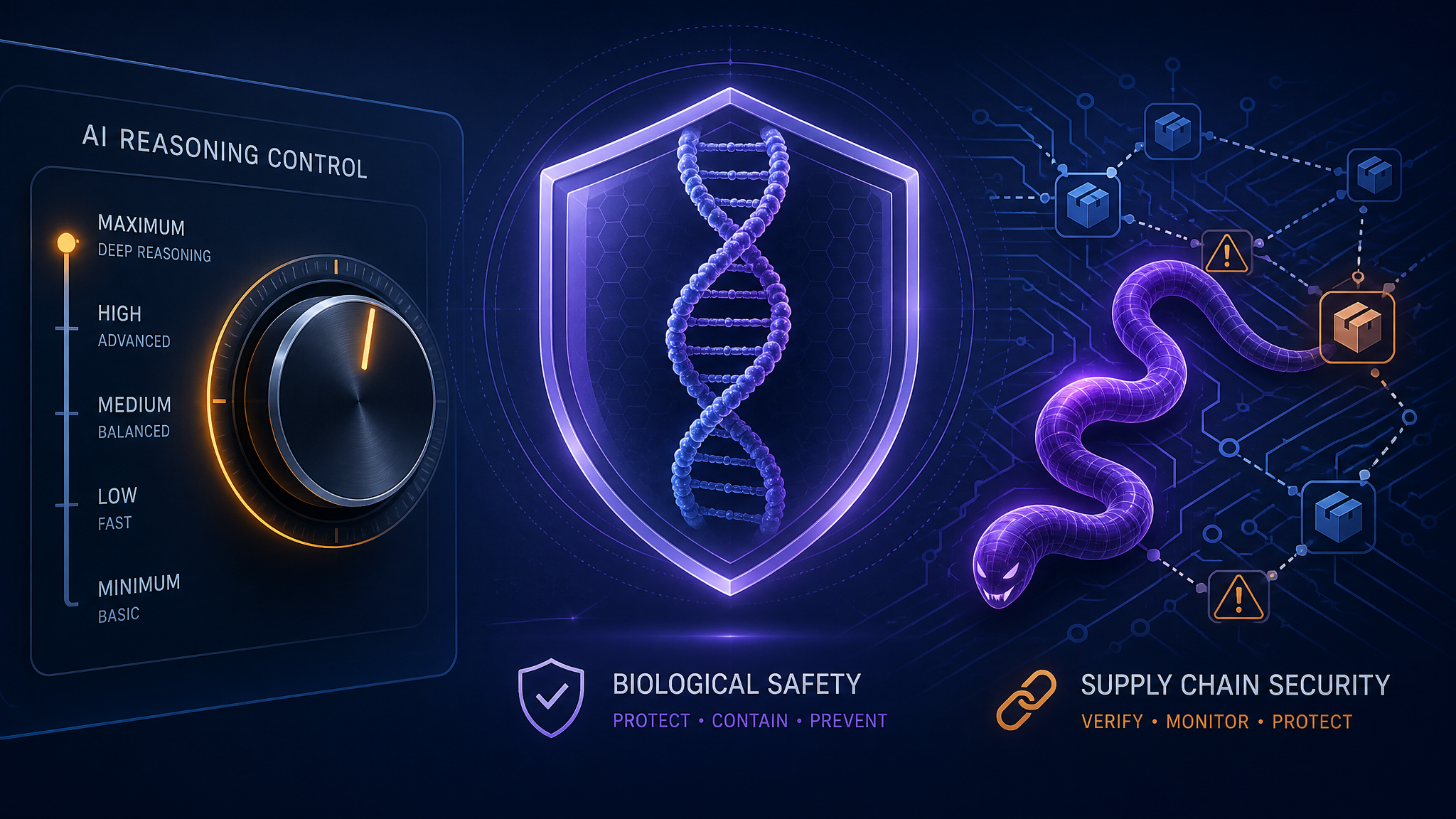
OpenAI hands users a reasoning dial, Anthropic recalibrates Claude Fable 5's biology guardrails, and a self-propagating npm worm called ChainDrop turns AI coding assistants into attack vectors — three developments that together reveal where the frontier is actually moving.
 Sarah Brennan🇺🇸 Western AI Desk LeadAug 7, 2026 4m read
The first week of August 2026 has not delivered a new frontier model or a landmark benchmark result. What it has delivered is arguably more instructive: a set of incremental but consequential decisions from OpenAI and Anthropic about how their existing systems should behave, who should access them, and how much reasoning users should be able to dial up on demand. Alongside those product moves, a supply-chain attack called ChainDrop has exposed a structural vulnerability that the labs' own tooling helped create. Taken together, the three stories sketch a clearer picture of where the frontier is actually moving than any single model launch could.
OpenAI Hands Users a Reasoning Dial
On August 6, OpenAI deployed a targeted update↗ to the ChatGPT interface that does two things simultaneously: it gives paid subscribers more control over how hard the model thinks, and it extends meaningfully better access to users who pay nothing at all.
For Plus, Pro, Business, and Enterprise subscribers, the headline change is a unified reasoning-effort slider that replaces the previous binary choice between "Instant" and "Thinking" modes. The slider runs across four positions — Medium, High, Extra High, and a Pro tier reserved for Pro-plan users that routes queries to the higher-capability GPT-5.6 Sol Pro variant. The practical effect is that a user can now treat reasoning depth as a continuous resource to be allocated rather than a feature to be toggled. A quick factual lookup stays at Medium; a multi-step legal analysis or a complex debugging session gets bumped to Extra High. OpenAI says credit consumption does not change with slider position on managed plans — Business and Enterprise users pay 10 credits per message for Sol regardless of reasoning level, and 50 credits for Sol Pro.
The underlying model update is also notable. The retuned GPT-5.6 Sol for conversational ChatGPT is engineered to produce tighter formatting, more direct answers, and fewer extraneous details. OpenAI's internal evaluations — conducted on financial, legal, and medical prompts — claim a 68 percent reduction in responses containing at least one factual error compared to the legacy GPT-5.5 Instant baseline. That figure deserves the standard caveat: it comes from the company's own test sets, not from independent third-party benchmarks or open evaluation suites. Enterprise buyers should treat it as a directional signal, not a verified specification.
Free Users Get Luna — and Unlimited Text
The second half of the August 6 update is arguably the more significant access story. GPT-5.6 Luna — the fast, low-cost variant of the 5.6 family — is now the default model for Free and Go tier users, replacing GPT-5.5 Instant. More importantly, OpenAI has removed the text-chat rate limits↗ that previously capped how many conversations non-paying users could have. A new "Think" button lets free users trigger elevated reasoning on harder queries without upgrading their plan.
OpenAI claims Luna delivers a 62 percent reduction in factual errors versus GPT-5.5 Instant — again, internal figures. File uploads, image generation, and voice mode remain rate-limited for free users, so the unlimited access is specifically to text-based conversation. The API, Codex, and ChatGPT Work surfaces are explicitly excluded from this update; they remain on their July 2026 builds to preserve stability for agentic workflows.
The pricing structure for API users is unchanged: $5.00 per million input tokens and $30.00 per million output tokens for Sol, with Terra at $2.00/$12.00 and Luna at $0.20/$1.20 — rates that have held since the July 30 price cuts.
"The versions of GPT-5.6 Sol utilized by the API, Codex, and ChatGPT Work remain unchanged, ensuring that existing agentic workflows and pricing structures are not affected by the consumer-facing retuning." — OpenAI documentation
One additional element of the August 6 release that has received less attention: enhanced safety guardrails specifically for users under 18. The updated models were evaluated against behavioral boundaries covering romantic roleplay, age-restricted viral challenges, body-image risks, and graphic violence. Real-time activation classifiers monitor generations dynamically. Under OpenAI's Preparedness Framework, the GPT-5.6 family remains classified at "High" for cybersecurity and biological/chemical risks — below the "Critical" threshold that would require a deployment halt.
Anthropic Recalibrates Fable 5's Biology Stack
On August 7, Anthropic published a detailed account of changes to the biology safeguards governing Claude Fable 5↗, its most capable publicly available model. The update is a case study in the difficulty of calibrating safety classifiers at the frontier.
When Fable 5 launched in June 2026, Anthropic deployed broad biological classifiers designed to prevent the model — which the company assessed as capable of providing "significant uplift" to malicious actors in areas like virology and molecular design — from assisting with dual-use research. The classifiers worked, but they worked too broadly. A high volume of benign health and educational queries were being blocked or routed to the less capable Opus 5 model as fallbacks. Clinicians trying to interpret lab results, students asking about disease mechanisms, and developers building health-information tools were all hitting walls that Anthropic had not intended to erect.
What Changed — and What Didn't
The fix involved rewriting the model's "constitution" — the rule set used by classifiers to distinguish permitted from safeguarded content — with input from internal and external experts, followed by retraining on new data and verification that the updated classifiers still blocked genuinely harmful requests. The result:
- An 85 percent reduction in biology-related fallbacks across Fable 5's product surfaces
- Approximately 67 percent fewer total fallbacks on Claude.ai, 55 percent on Cowork, 17 percent on Claude Code, and 7 percent on the Claude Platform
- Continued hard blocks on virology, toxicology, and molecular design requests involving dual-use potential — these still route to Opus 5
Anthropic is explicit that Fable 5 is not yet cleared for professional-grade biology research. The company cites the 2026 Annual Threat Assessment from the U.S. Intelligence Community, which flags synthetic biology and genomic editing as active threat vectors, as the basis for maintaining restrictions. A "trusted access pathway" for vetted researchers is promised but not yet scheduled.
"We maintain that the model is not yet ready for professional-grade biology research. Requests involving dual-use domains — specifically virology, toxicology, and molecular design — continue to trigger a fallback to the Opus 5 model." — Anthropic, August 7, 2026
The transparency here is worth noting. Anthropic published the reasoning behind both the original conservative calibration and the subsequent loosening, including the specific domains that remain restricted and the threat-assessment basis for those restrictions. That level of disclosure is not universal among frontier labs, and it gives enterprise buyers and regulators something concrete to evaluate.
Claude Code Gets Self-Hosted Environments
Separately, Anthropic's Claude Code 2.1.224 release↗ introduced public beta support for self-hosted environments — a feature that allows organizations on Team and Enterprise plans to run coding agent sessions on their own infrastructure rather than on Anthropic-hosted servers.
The mechanics involve deploying long-lived processes called "runners" using the `claude self-hosted-runner` command. Organizations can operate in Fixed Mode (a set number of runners distributed across sessions) or On-Demand Mode (an orchestrator that provisions runners as sessions queue and terminates them on completion). Critically, while session transcripts and tool results are sent to Anthropic for model inference, repository checkouts, build artifacts, and secrets remain entirely on the organization's own infrastructure.
The feature addresses a genuine enterprise requirement: teams that need Claude Code to interact with internal databases, private registries, or compliance-sensitive codebases without exposing those systems to the public internet. It is not available to organizations using Zero Data Retention settings, and Anthropic explicitly warns that self-hosting requires a dedicated platform or developer-experience team to manage runner images and orchestration.
The August 7 developer platform update also added budget caps for Managed Agents sessions (hard spending limits that pause sessions automatically when reached), advisor model support (a secondary model that provides strategic guidance during a session's primary thread), data residency controls via an `inference_geo` parameter, and automated skill loading from a GitHub repository's `.claude/skills` directory.
ChainDrop: When the Toolchain Becomes the Attack Surface
The most alarming development of the week has nothing to do with a lab announcement. On August 4, a self-propagating supply-chain worm called ChainDrop began spreading through the npm ecosystem, ultimately infecting over 440 packages and more than 2,200 versions↗ in under four hours. What makes ChainDrop specifically relevant to the AI industry is how it treated AI coding assistants — not as incidental targets, but as both a credential store and a persistence vector.
The attack began when the GitHub account of the maintainer of widely-used packages including `keyv` and `cacheable` was compromised. The malware was injected directly into the main branch and used the project's legitimate GitHub Actions workflows to sign releases, meaning the resulting packages carried valid SLSA provenance and Sigstore attestations. Standard provenance-based security checks provided no protection.
How ChainDrop Weaponized AI Tooling
The technical analysis from ZeroHunt↗ reveals a worm that understood the developer environment it was targeting with unusual specificity:
- Credential harvesting: The payload scraped local environments for cloud credentials (AWS, Azure, Alibaba, Tencent), infrastructure secrets, developer access tokens, cryptocurrency wallets, SSH keys — and API keys for AI coding tools including Claude, Cursor, OpenAI, and Gemini
- Claude Code persistence: The worm modified `.claude/settings.json` to inject a `SessionStart` hook, meaning it would re-execute every time a Claude Code session started in the affected repository
- VS Code persistence: It inserted tasks into `.vscode/tasks.json` configured to run the dropper whenever a folder was opened (`runOn: folderOpen`)
- Self-replication: Using stolen npm tokens, the worm enumerated packages available to the compromised identity, injected malicious code, bumped patch versions, and republished — spreading to 444 packages in hours
The command-and-control infrastructure used EtherHiding — querying Ethereum smart contracts via public RPC endpoints to retrieve an encrypted domain list, allowing attackers to rotate C2 infrastructure without updating the malware itself.
The persistence mechanisms are what make ChainDrop particularly difficult to remediate. Deleting `node_modules` or running a standard update is insufficient. Security researchers at StepSecurity↗ recommend treating any machine that installed affected versions as fully compromised, revoking all secrets present at install time, and manually auditing `.claude/settings.json` and `.vscode/tasks.json` files. Preventative controls going forward include `min-release-age` policies, the `--ignore-scripts` flag during installation, and strict review processes for GitHub Actions workflows.
The timing is notable: BSides Las Vegas↗ researchers had warned about exactly this class of agentic worm risk the day before ChainDrop hit. The attack validates a concern that has been circulating in security circles for months: as AI coding assistants accumulate high-permission API keys and deep integration into developer workflows, they become high-value targets that attackers will specifically engineer exploits to reach.
The Connective Thread
These three stories are not unrelated. OpenAI is giving users more control over reasoning depth while simultaneously tightening behavioral guardrails for younger users. Anthropic is loosening biology classifiers that were too broad while maintaining hard restrictions on genuinely dual-use domains — and simultaneously expanding Claude Code's enterprise footprint with self-hosted environments that put more sensitive infrastructure within the model's reach. And ChainDrop demonstrates that the more deeply AI tooling integrates into developer workflows, the more attractive those tools become as attack surfaces.
The pattern is one of managed expansion: capabilities are being extended, access is being broadened, and enterprise integrations are deepening — but each move comes with explicit scope limitations, safety evaluations, and (in Anthropic's case) published reasoning. Whether that managed expansion is moving fast enough to stay ahead of the threat landscape that ChainDrop represents is a question the industry has not yet answered.
For developers and enterprise buyers, the practical takeaways from this week are concrete:
- Audit your AI tooling configuration files immediately if you run npm-based projects. ChainDrop's persistence mechanisms mean infection is not self-evident from standard security scans.
- The GPT-5.6 Sol reasoning slider is a genuine usability improvement for paid ChatGPT users, but OpenAI's factual-accuracy claims are internal figures — validate against your own use cases before adjusting workflows.
- Anthropic's Fable 5 biology update meaningfully expands what the model will assist with in health and educational contexts, but professional biology research remains restricted. The trusted-access pathway for vetted researchers has no published timeline.
- Claude Code self-hosted environments address a real enterprise need, but Anthropic's own documentation warns that the feature requires dedicated platform engineering to operate safely — it is not a plug-and-play deployment.
The frontier labs are not standing still. But the most consequential moves this week were not about raw capability — they were about the terms on which existing capability is deployed, restricted, and, in ChainDrop's case, exploited.
Links & Resources
External links — opens in a new tab
🇺🇸 Western AI Desk Lead · Washington, D.C., USA
Tracks OpenAI, Anthropic, Google and Meta — and the policy fights around them.

Treatise on Systems Biology
by Richard Murdoch Montgomery
Modelling gene regulatory networks, metabolic pathways, and ecological dynamics — where mathematics meets molecular biology.

A Treatise on English Law
by Richard Murdoch Montgomery
The common law tradition dissected — constitutional principles, tort, contract, equity, and the evolution of English jurisprudence.

Physics and Its Mathematical Foundations Vol 4
by Richard Murdoch Montgomery
Quantum mechanics, statistical thermodynamics, and mathematical physics — bridging abstract formalism with physical intuition.
Medical AI
by Richard Murdoch Montgomery
Machine learning in clinical medicine — diagnostic imaging, drug discovery, electronic health records, and the ethics of algorithmic care.
Comments
Open discussion — no account needed. Be respectful.
More from Western AI Desk

Surveillance, Distillation, and Diplomacy: The Week AI Became a Geopolitical Instrument
Anthropic's sweeping threat intelligence report documents how state actors and criminal networks weaponized Claude across seven harm domains — while US and Chinese officials met in New York to negotiate AI guardrails ahead of a Trump-Xi summit.
Sarah BrennanSurveillance, Distillation, and Diplomacy: The Week AI Became a Geopolitical Instrument
Anthropic's sweeping threat intelligence report documents how state actors and criminal networks weaponized Claude across seven harm domains — while US and Chinese officials met in New York to negotiate AI guardrails ahead of a Trump-Xi summit.
Sarah BrennanSurveillance, Distillation, and Diplomacy: The Week AI Became a Geopolitical Instrument
Anthropic's sweeping threat intelligence report documents how state actors and criminal networks weaponized Claude across seven harm domains — while US and Chinese officials met in New York to negotiate AI guardrails ahead of a Trump-Xi summit.
Sarah Brennan