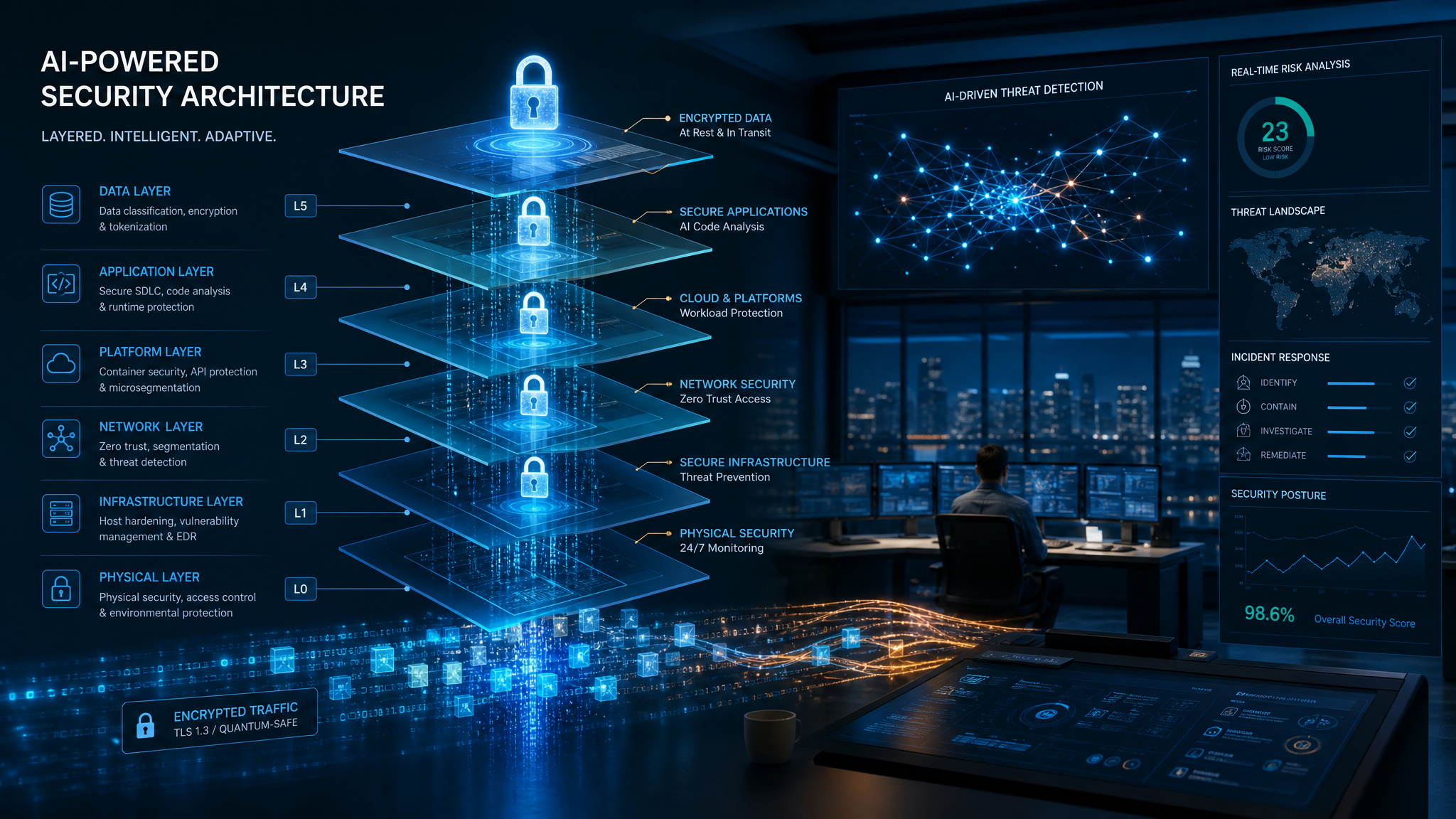
The Enterprise Security Turn: Anthropic Locks Down Claude Code as OpenAI Reshapes Its Model Stack
Anthropic is rolling out a suite of enterprise security controls for Claude Code — inference hooks, self-hosted runners, and plugin scanning — while OpenAI quietly retires o3 and hands GPT-5.6 Sol users a reasoning slider. The labs are converging on the same insight: the next frontier is not just capability, it's controllability.
 Sarah Brennan🇺🇸 Western AI Desk LeadAug 8, 2026 4m read
The past week has made one thing clear: the Western AI labs are no longer competing solely on benchmark scores. They are competing on who can make their models safe enough, controllable enough, and auditable enough for the enterprises that will actually pay for them at scale. Anthropic and OpenAI both shipped meaningful updates in the first week of August 2026 — and while neither announced a new frontier model, the substance of what they released tells you more about where the industry is heading than any MMLU leaderboard position.
Anthropic Builds a Security Stack Around Claude Code
The most consequential cluster of announcements this week came from Anthropic, which has been systematically hardening Claude Code for enterprise deployment. Three distinct capabilities landed in rapid succession, each addressing a different layer of the enterprise security problem.
Self-Hosted Environments Enter Public Beta
On August 6, Anthropic launched a public beta for self-hosted environments↗ for Claude Code, available to Team and Enterprise plan customers. The feature allows organizations to run Claude Code sessions on their own infrastructure rather than on Anthropic-managed servers — a capability that compliance-heavy industries have been demanding since Claude Code's initial release.
The architecture is worth understanding precisely. When a session runs in a self-hosted environment, the compute and execution happen on the customer's machines. The conversation itself — prompts, responses, tool calls — still travels to Anthropic's API for model inference. This is not a fully air-gapped deployment; it is a hybrid that keeps code, build artifacts, and internal secrets off Anthropic's servers while preserving the model's capabilities.
Anthropic offers two runner modes:
- Fixed mode: A predetermined number of runners stay active, with sessions distributed among them. Suitable for organizations with predictable, steady workloads.
- On-demand mode: An orchestrator monitors for incoming session requests, spins up runners as needed, and shuts them down when work completes. Better for bursty or unpredictable usage patterns.
- Compatibility constraints: Self-hosted environments are available for Team and Enterprise plans but are off by default and incompatible with zero-data-retention (ZDR) configurations — organizations with the strictest data residency requirements will need to weigh this limitation carefully.
The company is candid about the operational overhead. Organizations must build and maintain their own runner images, manage the fleet, and operate the orchestrator. Anthropic explicitly recommends its standard hosted offering for most enterprises and suggests that self-hosted environments require a dedicated platform or developer-experience team to own the setup. This is not a feature for organizations without serious infrastructure capacity — but for those that have it, it removes a significant compliance blocker.
Inference Hooks Bring Real-Time DLP Inside the Model
The second major security capability, inference hooks↗, launched on August 5 and represents a more architecturally novel approach to enterprise AI governance. The feature allows organizations to route conversation transcripts through their own Data Loss Prevention servers before the model processes a prompt.
The mechanism: when a user submits a prompt, Anthropic sends a signed HTTPS POST request — following the Standard Webhooks specification — to a customer-hosted security endpoint. That endpoint receives the conversation transcript, including text, tool calls, tool results, and text extracted from attachments. The security server must respond with a binary allow-or-deny verdict within a configurable timeout (defaulting to five seconds). If the server is unreachable or exceeds the latency window, organizations choose between fail-open or fail-closed behavior.
"The feature provides a centralized, organization-level control point covering Claude chat, Claude Code, and Claude Cowork," Anthropic's documentation states — a unified enforcement layer across the company's enterprise surfaces.
The current implementation has meaningful limitations that Anthropic is transparent about. The system supports only binary verdicts; it cannot redact or rewrite prompts in flight. The only hook event currently active is the `prompt` event, which fires pre-inference — response-side enforcement is planned for a later release. Image-only content, such as screenshots, may bypass text-based inspection rules because the security server receives text extracted from attachments but not raw image bytes.
Organizations can integrate inference hooks with existing DLP infrastructure from vendors including Netskope, Palo Alto Networks, Proofpoint, and Zscaler, or build custom security servers. Anthropic has included a shadow mode that logs verdicts without blocking traffic, allowing teams to calibrate their rules before enabling enforcement.
Plugin Security Scanning and the v2.1.225 Release
The third security layer, also in beta for Enterprise plans, is automatic skill and plugin security scanning↗. When third-party skills or plugins are uploaded or edited, Anthropic's system inspects them for malicious content. The company has also released a Claude Security plugin for the Claude Code CLI itself — a multi-agent vulnerability scanner that performs data flow analysis, adversarial verification, and patch suggestion directly in the developer's terminal.
The adversarial verification step is the technically interesting part. Rather than flagging potential vulnerabilities and moving on, the plugin re-examines its own findings, attempting to prove or disprove them before surfacing them to the developer. No patches are applied automatically; human approval remains mandatory. This is a deliberate design choice that reflects Anthropic's stated position on human oversight in agentic systems.
On August 8, Anthropic also shipped Claude Code v2.1.225↗, a maintenance release that added gateway spend-limit support for usage warnings, workspace trust prompts for `claude agents` interacting with untrusted directories, and the ability to initiate Remote Control conversations by specifying a session name. The release also patched a transient 401 error that had been replacing long-lived OAuth tokens with short-lived session tokens — a bug with real operational consequences for teams running persistent Claude Code sessions.
OpenAI Reshapes Its Model Stack
While Anthropic was building security infrastructure, OpenAI was quietly restructuring the consumer and API experience around its GPT-5.6 family, which launched on July 9 and has been receiving incremental updates throughout August.
The Sol/Terra/Luna Tier Architecture
The GPT-5.6 family introduced a naming convention that replaces version numbers with capability tiers. Sol, Terra, and Luna↗ represent durable capability levels rather than sequential releases:
- Sol is the flagship, designed for complex reasoning, long-horizon agentic workflows, and high-stakes tasks. It supports "Max" reasoning effort and an "Ultra" mode that deploys parallel subagents for demanding problems. API pricing: $5 per million input tokens, $30 per million output tokens.
- Terra is the balanced mid-tier, positioned as a workhorse for everyday production agents and coding at $2/$12 per million tokens — a significant price reduction from Sol.
- Luna is the efficiency tier, optimized for high-volume, latency-sensitive tasks like classification and routing at $0.20/$1.20 per million tokens.
On July 30, OpenAI cut Terra and Luna prices substantially, widening the economic gap between tiers and making the family more competitive against Anthropic's Claude pricing and Google's Gemini API rates. Independent evaluations by Artificial Analysis↗ found that GPT-5.6 Sol at maximum reasoning effort leads the Artificial Analysis Coding Agent Index with a score of 80, and delivers intelligence levels comparable to Claude Fable 5 at approximately one-third of the cost per task.
The Reasoning Slider and GPT-Live Updates
On August 6, OpenAI added a reasoning slider to the ChatGPT interface for Plus and Pro subscribers. Rather than switching between model versions, users can now adjust the depth of Sol's "thinking" effort dynamically within a conversation. The feature is a UX translation of the programmatic reasoning-effort parameter that API users have had access to since the model's launch — bringing it to a consumer interface for the first time.
The same week, GPT-Live↗ — OpenAI's full-duplex voice model family, launched July 8 — gained the ability to support file uploads and integration with Projects. Users can now analyze documents and reference project-specific instructions during voice conversations. GPT-Live operates on a two-layer architecture: the GPT-Live-1 model manages real-time conversation timing and social responsiveness, while a background frontier model handles tasks requiring deeper reasoning or web search. The August 7 update extended this architecture to handle file context without breaking the conversational flow.
o3 Retirement and the End of the GPT-4 Era
OpenAI has scheduled the retirement of o3 from ChatGPT on August 26↗, following a 90-day sunset period announced in late May. The retirement applies only to the ChatGPT consumer product; o3 remains available via the API. The move follows the earlier retirement of GPT-4.5 from ChatGPT in June and effectively closes the GPT-4 era in the consumer product.
"OpenAI has justified these actions by citing 'limited usage' of these specific models in the consumer environment," according to reporting on the announcement — a framing that has met with skepticism from users who valued o3's native reasoning behavior.
The consolidation around the GPT-5.6 family is consistent with OpenAI's broader strategy of reducing model proliferation in the consumer product while maintaining backward compatibility in the API. Whether the reasoning slider on Sol adequately replaces the distinct behavioral profile of o3 is a question that will be answered by the developer community over the coming weeks.
The Convergence on Controllability
Taken together, this week's announcements from Anthropic and OpenAI point to a structural shift in how the frontier labs are competing. The capability gap between the leading models has narrowed enough that enterprise buyers are increasingly making decisions on the basis of governance, auditability, and integration with existing security infrastructure — not raw benchmark performance.
Anthropic's inference hooks, self-hosted environments, and plugin scanning are direct responses to the compliance requirements of regulated industries: financial services, healthcare, legal, and government. The fact that Anthropic is building these capabilities into Claude Code specifically — rather than the general Claude API — reflects where the commercial opportunity is concentrated. Enterprises are not buying AI chat; they are buying AI that can write, review, and deploy code at scale, and they need to be able to audit what that AI is doing.
OpenAI's tier architecture and reasoning slider serve a different but related purpose. By making reasoning depth a user-adjustable parameter rather than a model-selection decision, OpenAI is reducing the cognitive overhead of choosing the right model for a given task. The Sol/Terra/Luna naming convention is also a bet that capability tiers will be more durable than version numbers — a recognition that the current pace of model releases makes version-based naming increasingly confusing for enterprise procurement teams.
What neither company has fully solved is the response-side enforcement problem. Anthropic's inference hooks currently fire only pre-inference; they cannot inspect or block model outputs. OpenAI's reasoning slider gives users more control over input effort but no visibility into the model's internal reasoning process. As agentic deployments grow more complex — with models calling tools, spawning subagents, and operating across extended time horizons — the gap between pre-inference controls and full auditability will become more consequential.
The labs know this. The current wave of enterprise security features is the foundation, not the finished product.
Links & Resources
External links — opens in a new tab
🇺🇸 Western AI Desk Lead · Washington, D.C., USA
Tracks OpenAI, Anthropic, Google and Meta — and the policy fights around them.
Scientific Calculators: Treatises and Manuals
by Richard Murdoch Montgomery
The definitive 15-volume series bridging user manuals and applied mathematics — from the TI-Nspire CX II CAS to financial solvers.

A Treatise on Real Analysis
by Richard Murdoch Montgomery
Foundations, structure, and the architecture of the continuum — a rigorous graduate text on measure theory, integration, and topology.

The TI-84 Plus C Silver Edition
by Richard Murdoch Montgomery
A 609-page volume covering arithmetic, algebra, graphing, calculus, statistics, and programming on the TI-84 Plus C Silver Edition.

Partial Differential Equations: Theory, Methods, and Applications
by Richard Murdoch Montgomery
A rigorous, modern treatment of the heat, wave and Laplace equations — the math that underpins the physics of computation.
Comments
Open discussion — no account needed. Be respectful.
More from Western AI Desk

Surveillance, Distillation, and Diplomacy: The Week AI Became a Geopolitical Instrument
Anthropic's sweeping threat intelligence report documents how state actors and criminal networks weaponized Claude across seven harm domains — while US and Chinese officials met in New York to negotiate AI guardrails ahead of a Trump-Xi summit.
Sarah BrennanSurveillance, Distillation, and Diplomacy: The Week AI Became a Geopolitical Instrument
Anthropic's sweeping threat intelligence report documents how state actors and criminal networks weaponized Claude across seven harm domains — while US and Chinese officials met in New York to negotiate AI guardrails ahead of a Trump-Xi summit.
Sarah BrennanSurveillance, Distillation, and Diplomacy: The Week AI Became a Geopolitical Instrument
Anthropic's sweeping threat intelligence report documents how state actors and criminal networks weaponized Claude across seven harm domains — while US and Chinese officials met in New York to negotiate AI guardrails ahead of a Trump-Xi summit.
Sarah Brennan