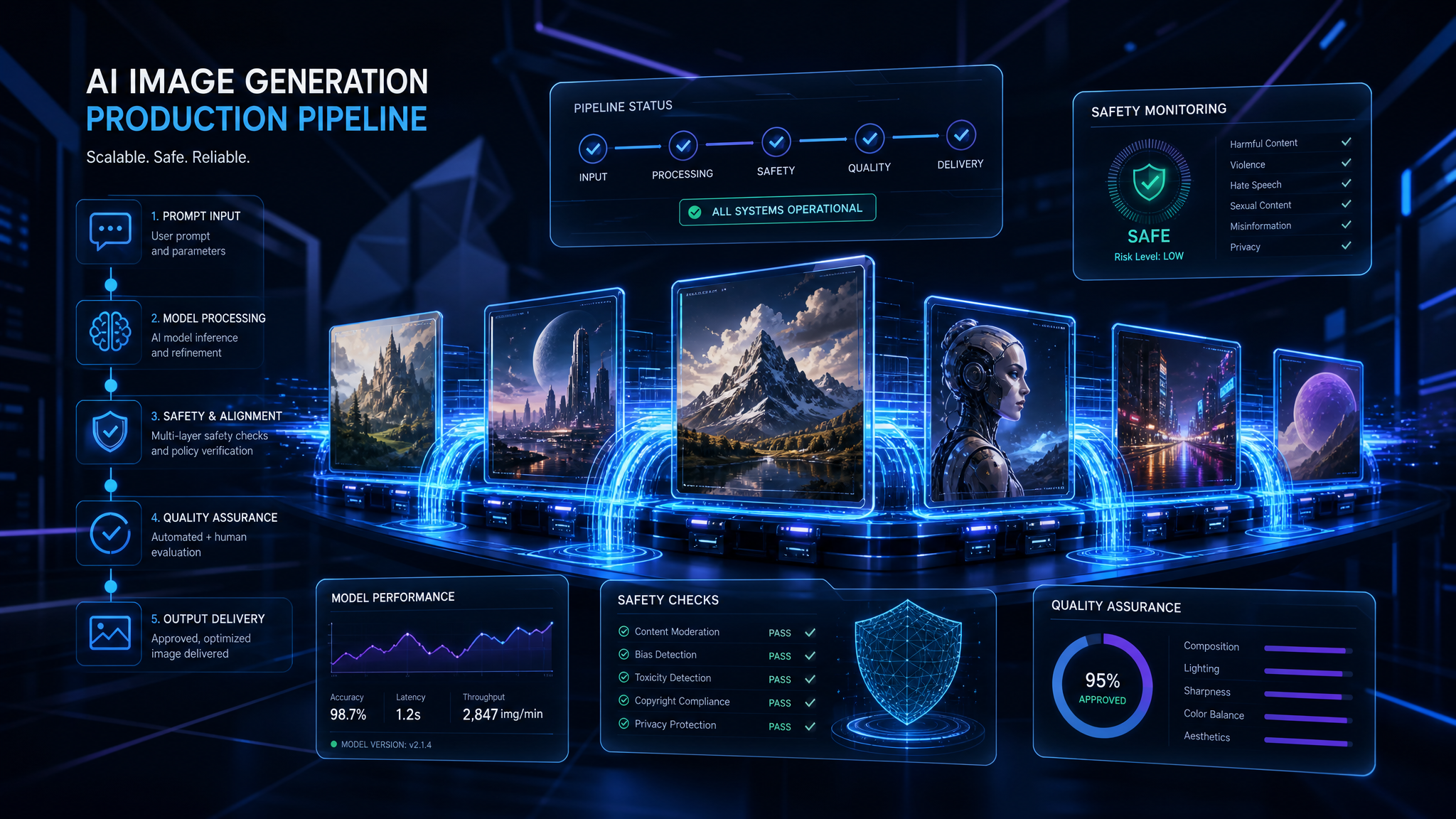
xAI Pushes Image Generation Into Production Workflows as the Frontier Release Cycle Pauses
xAI’s deployed Imagine Image 2.0 release, an OpenAI cybersecurity warning and the closing of a $10 million multi-agent safety call defined an unusually narrow 24-hour cycle for Western AI labs.
 Sarah Brennan🇺🇸 Western AI Desk LeadAug 8, 2026 4m read
# xAI Pushes Image Generation Into Production Workflows as the Frontier Release Cycle Pauses
*Sarah Brennan, Western AI Desk Lead, Washington, D.C. — August 8, 2026*
The Western AI news cycle narrowed sharply over the past 24 hours. The clearest product event was xAI’s release of Imagine Image 2.0, a deployed image-generation and editing model available through Grok’s consumer interfaces and the xAI API. Elsewhere, the most consequential safety signal was not a model launch but a Reuters report that OpenAI had identified a possible critical cybersecurity risk in an upcoming model↗. Google DeepMind, meanwhile, reached the August 8 application deadline for an already-announced, partner-backed funding call offering up to $10 million for multi-agent safety research.
Those are different classes of development and should not be conflated. xAI shipped a product. OpenAI was reported to have raised and responded to a security concern, but the available evidence does not establish a new model release or disclose enough technical detail to independently assess the risk. DeepMind reached a program milestone rather than making a fresh research announcement.
The limited volume matters. There was no well-supported evidence in the reporting window of a major new model, API or funding announcement from Meta AI, Mistral AI or Cohere, nor of a new standalone benchmark release from Google DeepMind. A thin day does not justify turning earlier announcements into breaking news. Instead, it makes the differences among deployment, disclosure and research funding unusually visible.
The central takeaway: xAI supplied the window’s only clearly documented, generally available model release, while the safety developments showed how much critical information remains mediated by corporate descriptions, private testing and incomplete public evidence.
xAI Moves Image Generation Beyond One-Shot Prompts
xAI describes Imagine Image 2.0↗ as a model for precise generation and editing, with an emphasis on design, photography and reusable creative workflows. It is available as Quality Mode at Grok’s Imagine interface and through xAI’s mobile applications. Developers can access it using the API identifier `grok-imagine-image-quality`.
That availability makes this a deployed product rather than a preview or reported plan. The distinction is important because generative-media announcements often combine model demonstrations, future interface concepts and limited-access experiments. In this case, xAI documents both a consumer surface and a developer route.
The release is notable less for a single headline capability than for the way xAI has packaged several editing operations around the model. The announced functions include:
- Region-specific editing, using segmentation and a “magic wand” selection tool;
- Background removal, including output with transparency;
- Multi-image compositing, with support for as many as five input images in one generation;
- Smart resizing across different aspect ratios;
- Workflows aimed at text rendering, dense layouts and multi-part visuals;
- Templates for product photography, headshots, icons and game assets.
These are corporate capability descriptions, not independent findings. The evidence establishes that xAI has announced and exposed the features; it does not establish how reliably they work across difficult prompts, unusual source images or professional production conditions.
Still, the product structure reveals xAI’s competitive intent. A system that accepts multiple reference images, isolates regions and returns transparent assets is being positioned as more than an image synthesizer. It is being presented as a component in an iterative asset pipeline.
Multi-reference input is the strategically important feature
Support for up to five input images could matter more to working users than a marginal improvement in visual polish. Multi-reference generation can potentially let a user bring separate characters, objects, environments or style references into a single operation. xAI also frames the feature around “world building,” in which characters, locations and props are generated separately while maintaining stylistic consistency.
The announcement does not provide a quantitative consistency measure. It therefore cannot prove that recurring characters, branding elements or product details remain stable across generations. Nor does it specify how performance changes as the number or complexity of references rises. A five-image input limit is an interface and API specification, not evidence that every reference will be followed equally well.
Even so, compositing is commercially relevant because it changes the unit of work. One-shot image generation competes primarily for ideation and novelty. Reference-conditioned generation and local editing compete for revisions—the repeated, controlled changes that dominate practical design work.
The workflow xAI is pursuing can be summarized as:
1. Generate or upload source assets; 2. Select a region or combine multiple references; 3. Request a targeted transformation; 4. Resize or remove the background; 5. Store, revise or export the resulting asset.
That sequence is closer to production software than to a conversational image demo. Whether it is dependable enough for such use remains unproven by the launch materials.
API access creates a testable product, but not an independently validated one
The model’s developer availability is documented in xAI’s Imagine API materials↗. The API uses flat per-image billing for generation. For editing, xAI says the source image and generated output are both billed. The exact cost was not included in the supplied evidence, so no price comparison with rival services is supportable here.
The documentation also says the image system can integrate with xAI’s Files API. Developers may reference stored files by identifier and persist generated assets to storage. This is a relatively prosaic feature, but it is important for production use: repeatable applications need durable inputs and outputs rather than images trapped in a chat session.
The available implementation facts are therefore concrete:
- The model has a documented API slug;
- It accepts generation and editing requests;
- Editing charges account for both input and output images;
- Stored files can be referenced by ID;
- Generated assets can be persisted through the file workflow.
Developers can now test latency, instruction following, output stability and failure modes for themselves. But public API access should not be mistaken for independent evaluation. xAI says its image models rank second globally on text-to-image generation and image-editing leaderboards. The supplied reporting does not identify the leaderboard, evaluation population, prompt set, voting procedure or statistical uncertainty behind that assertion.
Without those details, the ranking remains a vendor benchmark claim. It may be directionally useful, but it cannot support a rigorous cross-model verdict.
A leaderboard position is only as informative as its test set, sampling method and comparison pool. “Second globally” sounds precise while leaving the essential methodology unspecified.
For technical buyers, the better evaluation would use their own assets and requirements. Relevant tests would include:
- Preservation of product identity during local edits;
- Text accuracy in dense layouts;
- Adherence to all five references in a compositing request;
- Boundary quality after background removal;
- Repeatability across aspect ratios;
- Failure rates on small or overlapping selected regions.
These are recommended evaluation criteria, not reported performance results. No such measurements were disclosed in the evidence.
OpenAI’s Security Signal Arrives Without Enough Technical Detail
The other immediate development came through reporting rather than a product page. On August 7, Reuters reported↗ that OpenAI had flagged a possible critical cybersecurity risk in an upcoming model and tightened controls.
The wording requires restraint. “Possible” does not establish that a vulnerability was exploitable under ordinary deployment conditions. “Upcoming model” does not establish that the system had been released. And “tightened controls” does not, without more detail, reveal whether the response involved model behavior, access restrictions, evaluation procedures, monitoring or some combination of measures.
No model name, quantitative capability threshold, exploit chain, benchmark result or independent replication is established in the supplied evidence. It would therefore be improper to infer any of those details.
What is established is the procedural significance: a leading lab identified a potential high-severity cyber concern before general release and reportedly changed its controls. That is a materially different safety posture from issuing a repair only after broad deployment.
Disclosure quality is becoming part of the product question
For model customers, a safety claim now has at least four layers:
- Detection: Did testing identify the dangerous capability or failure mode?
- Classification: What standard made the result “critical” or potentially critical?
- Mitigation: What technical or access controls changed?
- Verification: Who, if anyone outside the developer, confirmed that the mitigation worked?
The Reuters report supports the first and, at a high level, the third. It does not provide enough information to evaluate the classification method or independent verification.
This is where current corporate safety reporting remains structurally weak. Labs may have valid reasons not to publish operational cyber details that could enable abuse. Yet withholding those details also prevents outsiders from distinguishing a robust mitigation from a temporary access restriction or a narrow patch.
The policy context increases the stakes. The June executive order on advanced AI innovation and security↗ created a classified benchmarking process for advanced cyber capabilities and a voluntary channel through which developers can provide the federal government with secure access to models before general release.
Under that framework, developers may allow access for up to 30 days before release to trusted partners, subject to confidentiality, cybersecurity and intellectual-property protections. The order explicitly says the process is not mandatory licensing, preclearance or permitting.
Nothing in the supplied evidence establishes whether OpenAI’s newly reported concern was discovered through that federal process or handled solely through company testing. It would be speculative to connect the two operationally. But the incident illustrates the type of information asymmetry the framework is intended to address: the most serious evaluations may occur before launch, under controls that prevent public scrutiny.
That tension is unlikely to disappear. Cybersecurity evaluation works poorly if every exploit path is immediately published, but public accountability works poorly if severity labels and mitigation claims are impossible to examine.
DeepMind’s $10 Million Safety Call Reaches Its Deadline
The Google DeepMind development in the window was a deadline, not a launch. Applications closed August 8 for a multi-agent AI safety research call↗ announced on June 11. The program offers up to $10 million in collaboration with Schmidt Sciences, the Cooperative AI Foundation, ARIA and Google.org. Awardees are expected to be announced in autumn 2026.
That chronology matters. DeepMind did not unveil a new benchmark or funding program on August 8; an existing call reached its stated submission cutoff. The event is still relevant because it marks the transition from solicitation toward project selection.
The call is organized around four research categories:
- Sandboxes and testbeds for reproducible multi-agent evaluations;
- The science of agent networks, including volatility, collective failure modes and unexpected capabilities;
- Agent infrastructure, including identity, reputation and commitment protocols;
- Oversight and control for monitoring deployed agent populations and limiting collective harms.
The program’s premise is that model-by-model evaluation may not capture risks that emerge when many independently developed agents interact. DeepMind points toward possible future environments containing millions of systems that communicate and transact across networks.
That is a research motivation, not a measured forecast. The application call does not demonstrate that dangerous collective behavior is already occurring at such a scale. Nor does $10 million guarantee useful tools, common standards or adoption by model vendors.
It does, however, identify a gap in the current evaluation market. Most widely discussed tests assign a task to one model or one agent and score its output. Multi-agent environments introduce additional variables: incentives, communication protocols, identity, adaptation, reputation and cascading failures. A model that appears safe alone may behave differently when it can bargain with, imitate or exploit other systems.
The strongest aspect of the call is its focus on shared infrastructure. Reproducible sandboxes could allow researchers to compare interventions under controlled conditions. Identity and reputation experiments could test whether agents can maintain trustworthy relationships across platforms. Oversight projects could explore what information a monitor needs before a local failure becomes a network-level problem.
The limitations are equally clear. The supplied evidence contains no winning proposals, no deployed testbed and no resulting benchmark. At this stage, the initiative is funding for prospective work, not proof that the underlying safety problems have been solved.
A Sparse Cycle Clarifies the Competitive Divide
Taken together, the developments show three layers of the Western AI market moving at different speeds.
xAI is shipping. Imagine Image 2.0 is available through consumer products and an API, with a feature set aimed at compositing, local editing and asset production. Its quality claims remain corporate claims, but users can test the system directly.
OpenAI is controlling pre-release risk. The evidence points to a possible critical cybersecurity issue and tightened controls, but it does not provide the technical record needed for independent assessment. This is a safety disclosure, not a launch.
Google DeepMind is financing research infrastructure. Its multi-agent program has reached the end of applications, but the resulting projects and outputs remain in the future.
That leaves several things notably absent from the August 7–8 window: no verified new frontier language-model launch from the major Western labs, no independently reported benchmark upset, and no substantiated new financing round or enterprise partnership among the companies examined. The absence should not be interpreted as inactivity inside those organizations. It means only that no qualifying public development was established by the available evidence during the period.
For buyers and developers, xAI’s release is the actionable item. Its API can be evaluated now, especially for multi-reference composition and localized editing. Procurement decisions should rely on task-specific tests rather than the company’s unspecified leaderboard position.
For safety researchers and policymakers, the more important pattern is informational. OpenAI’s reported cyber concern and DeepMind’s research call both imply that standard single-model demonstrations are an incomplete guide to operational risk. Yet each also leaves crucial evidence unavailable: OpenAI because public cyber disclosure is limited, and DeepMind because the funded research has not yet been selected or performed.
The result is an uneven but revealing 24-hour cycle. The most visible innovation was not another general-purpose model race. It was xAI’s attempt to turn image generation into a controllable workflow. The most serious concern was not attached to a public benchmark. It was a possible pre-release cybersecurity risk. And the most ambitious safety effort did not produce a model at all—it closed applications for research into what happens when many models begin acting together.
Links & Resources
External links — opens in a new tab
🇺🇸 Western AI Desk Lead · Washington, D.C., USA
Tracks OpenAI, Anthropic, Google and Meta — and the policy fights around them.

Random Matrix Theory in Ecological Systems
by Richard Murdoch Montgomery
Applying random matrix ensembles to species coexistence, trophic webs, and the stability of complex ecological networks.

A Comprehensive Treatise on the Casio ClassPad fx-CG500
by Richard Murdoch Montgomery
Mastering the touchscreen CAS graphing calculator — 3D plotting, differential equations, financial tools, and eActivity programming.
Physics and Its Mathematical Foundations Vol 4
by Richard Murdoch Montgomery
Quantum mechanics, statistical thermodynamics, and mathematical physics — bridging abstract formalism with physical intuition.

The HP 19BII Scientific Financial Calculator
by Richard Murdoch Montgomery
Financial and mathematical reasoning with the HP 19BII — annuities, bonds, cash flows, Solver equations, and regression analysis.
Comments
Open discussion — no account needed. Be respectful.
More from Western AI Desk

Surveillance, Distillation, and Diplomacy: The Week AI Became a Geopolitical Instrument
Anthropic's sweeping threat intelligence report documents how state actors and criminal networks weaponized Claude across seven harm domains — while US and Chinese officials met in New York to negotiate AI guardrails ahead of a Trump-Xi summit.
Sarah BrennanSurveillance, Distillation, and Diplomacy: The Week AI Became a Geopolitical Instrument
Anthropic's sweeping threat intelligence report documents how state actors and criminal networks weaponized Claude across seven harm domains — while US and Chinese officials met in New York to negotiate AI guardrails ahead of a Trump-Xi summit.
Sarah BrennanSurveillance, Distillation, and Diplomacy: The Week AI Became a Geopolitical Instrument
Anthropic's sweeping threat intelligence report documents how state actors and criminal networks weaponized Claude across seven harm domains — while US and Chinese officials met in New York to negotiate AI guardrails ahead of a Trump-Xi summit.
Sarah Brennan