AI's Center of Gravity Shifts From Models to Platforms Amid Regulatory Reckoning
A flurry of model releases from OpenAI, Anthropic, and Mistral gives way to strategic platform consolidation and a deepening transatlantic regulatory divide, as Western AI labs now build compliance directly into their product roadmaps.
 Lukas Hoffmann🇩🇪 Europe & Frontier CorrespondentJul 5, 2026 4m read
# AI's Center of Gravity Shifts From Models to Platforms Amid Regulatory Reckoning
BERLIN – The frantic pace of foundation model releases that defined the past year is giving way to a more calculated, strategic phase in the artificial intelligence sector. As of early July 2026, the key battlegrounds are shifting from raw model capability to the consolidation of developer platforms and the high-stakes navigation of a rapidly diverging transatlantic regulatory landscape. While new models continue to arrive, the latest moves from Western AI labs—including OpenAI, Anthropic, and Europe's own Mistral AI—reveal a clear pivot toward building defensible ecosystems where regulation is no longer an afterthought, but a core component of product strategy.
The center of gravity is moving. For developers and enterprises, the question is no longer just "which model is best?" but "which platform offers the most durable path to production?" For the labs themselves, the challenge is how to innovate under the hardening, yet distinct, compliance regimes of the European Union and the United States. Recent activities show that a company's approach to open-weight models, API strategy, and safety frameworks has become inseparable from its response to Brussels and Washington.
The Frontier Labs Consolidate: Platforms Over Models
The most telling sign of this strategic shift comes from OpenAI. While the lab previewed its potent new **GPT-5.6 series**↗ on June 26, the real story lies in its aggressive platform consolidation. OpenAI is actively sunsetting its popular Assistants API, along with the Agent Builder and Evals products, pushing its vast developer base toward a new, unified primitive: the Responses API, supported by an open-source Agents SDK↗. This is a deliberate move to transition developers from fragmented tools to a single, agent-native ecosystem designed for long-term lock-in. The sunset date for the Assistants API is set for August 26, 2026, with the other products ceasing in November, forcing a near-term migration.
Even the GPT-5.6 rollout underscores this new reality. The series, which includes the flagship `Sol`, balanced `Terra`, and efficient `Luna` tiers, is being released in a staggered preview to a set of government-approved enterprise partners. This caution is a direct result of discussions with U.S. government bodies and demonstrates how policy considerations now directly shape go-to-market timelines, even for America's leading lab.
"To streamline our ecosystem and accelerate agent-native development, we are winding down the Agent Builder and Evals products on the OpenAI platform... We recommend that developers now use the Agents SDK for code-based workflows or Workspace Agents in ChatGPT for natural language." — OpenAI Official Announcement
Anthropic has mirrored this platform-centric approach, though with a distinct safety-first branding. The lab launched **Claude Sonnet 5**↗ on June 30, positioning it as a highly agentic workhorse model for coding and tool use. Access to its top-tier Claude Fable 5 and trusted-access Claude Mythos 5 models was restored globally on July 1. This tiered model family is increasingly supported by enterprise-grade platform features, including new administrative controls for granular usage analytics and budget guards. By offering introductory pricing for Sonnet 5, Anthropic is aggressively courting developers to build on its platform, while its continuous updates to the Responsible Scaling Policy (RSP) serve as a key differentiator for compliance-conscious customers.
This competitive pressure is felt across the board. Google DeepMind's flagship Gemini 3.5 Pro missed its planned June release and is now targeted for July, leaving the capable but less powerful Gemini 3.5 Flash to hold the line. The delay, attributed to refinements in token efficiency and coding, highlights the high bar for launching a flagship model in this mature market. While Google shores up its technical footing, it continues to invest heavily in safety governance, updating its Frontier Safety Framework (FSF 3.1)↗ and announcing a $10 million research grant for multi-agent safety.
Comparative API Pricing: The Race to the Bottom
Comparative API Pricing for New Frontier Models (July 2026)
| Provider | Model | Input (per 1M tokens) | Output (per 1M tokens) | Notes | |-----------|---------------------|-----------------------|------------------------|------------------------------------------------| | OpenAI | GPT-5.6 Sol | $5.00 | $30.00 | Flagship frontier model | | OpenAI | GPT-5.6 Terra | $2.50 | $15.00 | Balanced tier | | OpenAI | GPT-5.6 Luna | $1.00 | $6.00 | High-volume, fast tier | | Anthropic | Claude Fable 5 | $10.00 | $50.00 | Premium frontier model | | Anthropic | Claude Sonnet 5 | $2.00 | $10.00 | Introductory rate until Aug 31, 2026 | | Anthropic | Claude Haiku 4.5 | $1.00 | $5.00 | Budget, high-speed tier |
The pricing table reveals a deliberate strategy: both OpenAI and Anthropic are using their mid-tier models as loss leaders to capture developer mindshare, while reserving premium pricing for their most capable frontier offerings. The introductory rate on Claude Sonnet 5 — $2.00 per million input tokens versus the standard $3.00 — is a direct competitive response to OpenAI's Terra tier.
The Open-Weight Gambit: Europe's Counterpoint and Meta's Pivot
From Berlin, the anemic European response to U.S. AI dominance has been a recurring theme. Paris-based Mistral AI, however, continues to be the exception. In a direct counter-programming to the closed, platform-driven strategies of its American rivals, Mistral maintains its rapid-fire open-weight release schedule. On July 2, it released **Leanstral 1.5**↗, a powerful 119-billion parameter model specialized for formal proof engineering, solving 587 of 672 PutnamBench problems — a remarkable result on one of the hardest mathematical reasoning benchmarks available. The model is licensed under the permissive Apache 2.0 license and available via a free API endpoint. Furthermore, reports confirm Mistral is readying another major open-weight model for release later this month.
This strategy is inextricably linked with the European political desire for "digital sovereignty." By releasing powerful models openly, Mistral enables companies and governments to build and host AI capabilities on their own terms, reducing reliance on U.S. cloud providers. This is further supported by Mistral's investment in sovereign infrastructure, including a new 10 MW inference facility in Les Ulis, France, set to open in Q3 2026.
The open-weight narrative was complicated this year by Meta. After championing the movement with its Llama series, Meta pivoted in April 2026 with the release of Muse Spark, a new, high-performance proprietary model. This shift signaled that even the most prominent advocate for openness sees value in keeping its crown jewels closed.
However, Meta has not abandoned the open ecosystem. Instead, it has adopted a sophisticated hybrid strategy: it now open-sources the *tools to secure AI*. The **LlamaFirewall** framework↗ provides a robust, layered defense for AI agents, mitigating risks that labs are under increasing pressure to address.
LlamaFirewall's Key Components
- PromptGuard 2: A classifier model specifically trained to detect and block malicious inputs, including jailbreaks and prompt injection attacks targeting deployed agents.
- Agent Alignment Checks: A chain-of-thought auditor that inspects an agent's reasoning process to ensure it aligns with developer-defined policies before taking action.
- CodeShield: An inference-time guardrail that filters insecure code generated by coding agents, preventing vulnerabilities from being introduced into production software.
- Context Integrity Monitor: A new addition that tracks information flow across multi-agent pipelines, flagging cases where sensitive data may be leaking across trust boundaries.
This approach allows Meta to maintain a competitive edge with its proprietary models while shaping the safety standards of the entire open-weight ecosystem — a powerful hedge in an uncertain regulatory environment. By defining what "safe" looks like for open-weight deployments, Meta positions itself as the de facto standards body for the open AI community.
Regulation as Product: Navigating the US-EU Divide
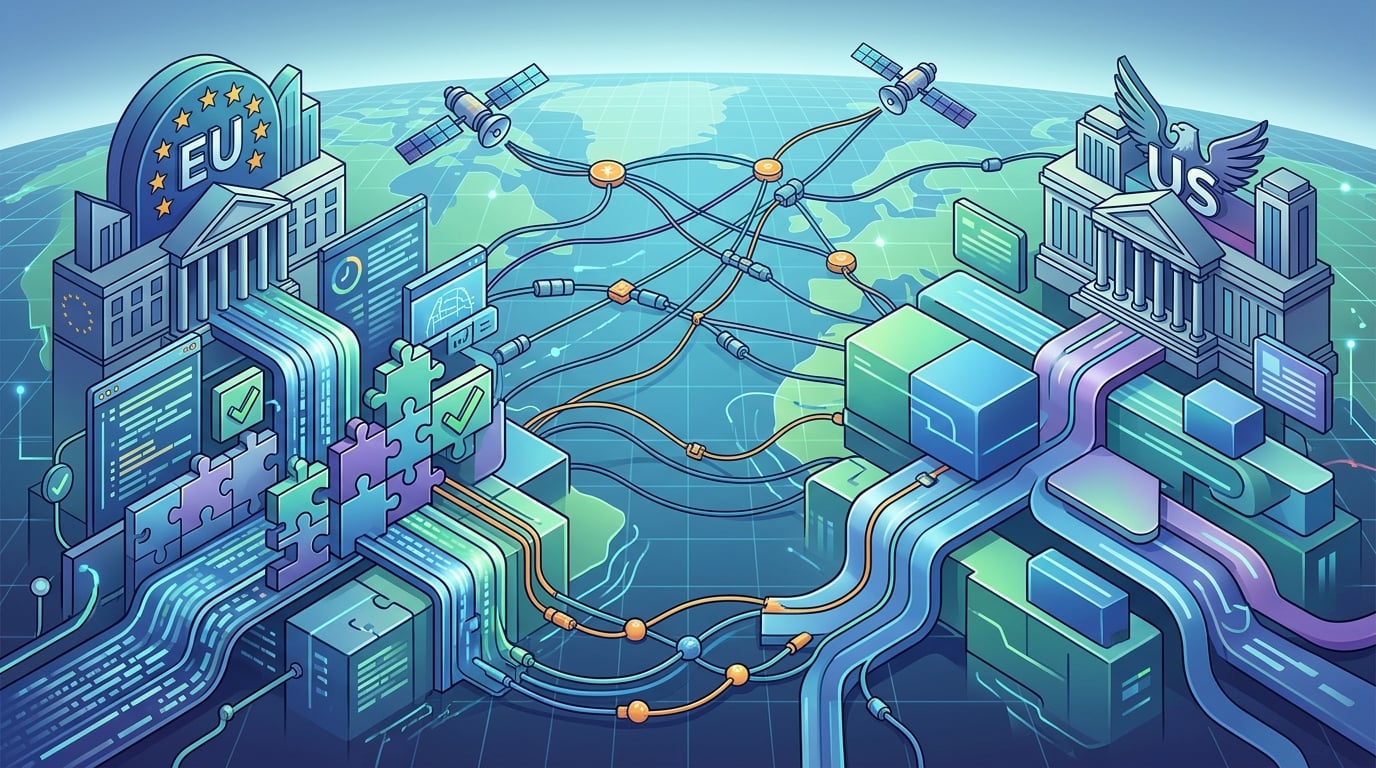
For global AI labs, the world now has two distinct poles of regulation. Here in Europe, the EU AI Act looms large. Having entered force in August 2024, its implementation is now a practical reality. In a sign of pragmatic flexibility, a May 2026 "AI Omnibus" agreement deferred the compliance deadlines for high-risk systems to late 2027 and 2028, giving industry more breathing room. The European AI Office is currently running a public consultation↗ on draft guidelines for classifying those very systems — a process that is live and shaping the market in real time. The EU's goal is a predictable, risk-based legal framework that provides certainty.
The EU approach establishes a clear, tiered system of obligations. High-risk AI systems must undergo conformity assessments, ensure data quality, and maintain human oversight. The recent deadline adjustments show a willingness to adapt, but the fundamental structure of comprehensive, ex-ante regulation remains intact.
The United States has taken a diametrically opposite path. Lacking a comprehensive federal law, the regulatory landscape is a tense interplay between federal deregulatory ambitions and a patchwork of aggressive state-level laws in places like California, Texas, and Colorado. The current administration's strategy, crystallized in Executive Order 14409 on June 2, 2026, is to promote innovation through voluntary frameworks and public-private partnerships while actively seeking to preempt state laws deemed to be an impediment to national competitiveness.
The enforcement arm of this strategy falls to existing agencies. On July 1, the Federal Trade Commission (FTC) began seeking public comment on a proposed policy statement regarding AI accuracy↗. The FTC is exploring the use of its authority to combat "unfair or deceptive practices" to challenge AI systems whose outputs are manipulated for undisclosed ideological aims. This repurposing of existing law, rather than creating a new AI-specific rulebook, is a hallmark of the American approach.
What This Means for Labs Operating Across Both Jurisdictions
The practical implications for labs with global ambitions are significant. Consider the divergent compliance requirements:
- EU AI Act obligations require high-risk AI systems to maintain detailed technical documentation, implement human oversight mechanisms, and undergo third-party conformity assessments before deployment — a process that can take months.
- US voluntary frameworks under the NIST AI Risk Management Framework offer flexibility but provide no legal safe harbor, leaving companies exposed to FTC enforcement actions and state-level litigation.
- Transatlantic data flows remain complicated by the EU-US Data Privacy Framework, which is under ongoing legal challenge, creating uncertainty for labs that train on data from both jurisdictions.
- Model card requirements are becoming de facto mandatory in the EU, while remaining voluntary in the US — creating a documentation asymmetry that affects how labs communicate capabilities and limitations.
Labs are now forced to build for both worlds simultaneously. The layered safety classifiers in Anthropic's Sonnet 5 and the granular controls in Meta's LlamaFirewall are not just technical features; they are compliance assets. An agent's ability to document its reasoning or a model's robustness against misuse are becoming key selling points in a market where regulatory risk translates directly to financial liability.
As the technology matures, the most successful labs will be those that treat legal and policy navigation not as a cost center, but as a critical part of the product itself. The shift from model releases to platform consolidation is, in this light, also a shift toward regulatory durability — building systems that can survive the compliance gauntlet on both sides of the Atlantic, not just win the next benchmark.
Links & Resources
External links — opens in a new tab
🇩🇪 Europe & Frontier Correspondent · Berlin, Germany
Covers the European labs and the frontier research redrawing the field.

CM1 Complete Study Material: Actuarial Mathematics
by Richard Murdoch Montgomery
The comprehensive guide for the CM1 actuarial exam — compound interest, annuities, life tables, reserving, and profit testing.

A Treatise on English Law
by Richard Murdoch Montgomery
The common law tradition dissected — constitutional principles, tort, contract, equity, and the evolution of English jurisprudence.

History of Evolutionary Thought in the Nineteenth Century
by Richard Murdoch Montgomery
From Lamarck to Darwin and beyond — a scholarly account of how evolutionary theory reshaped biology, society, and philosophy.

The HP 17BII Financial Calculator
by Richard Murdoch Montgomery
A 50-chapter treatise integrating financial mathematics, business reasoning, and Solver-based modeling — from annuities to investment analysis.
Comments
Open discussion — no account needed. Be respectful.
More from Western AI Desk

Surveillance, Distillation, and Diplomacy: The Week AI Became a Geopolitical Instrument
Anthropic's sweeping threat intelligence report documents how state actors and criminal networks weaponized Claude across seven harm domains — while US and Chinese officials met in New York to negotiate AI guardrails ahead of a Trump-Xi summit.
 Sarah Brennan
Surveillance, Distillation, and Diplomacy: The Week AI Became a Geopolitical Instrument
Anthropic's sweeping threat intelligence report documents how state actors and criminal networks weaponized Claude across seven harm domains — while US and Chinese officials met in New York to negotiate AI guardrails ahead of a Trump-Xi summit.
Sarah BrennanSurveillance, Distillation, and Diplomacy: The Week AI Became a Geopolitical Instrument
Anthropic's sweeping threat intelligence report documents how state actors and criminal networks weaponized Claude across seven harm domains — while US and Chinese officials met in New York to negotiate AI guardrails ahead of a Trump-Xi summit.
Sarah Brennan