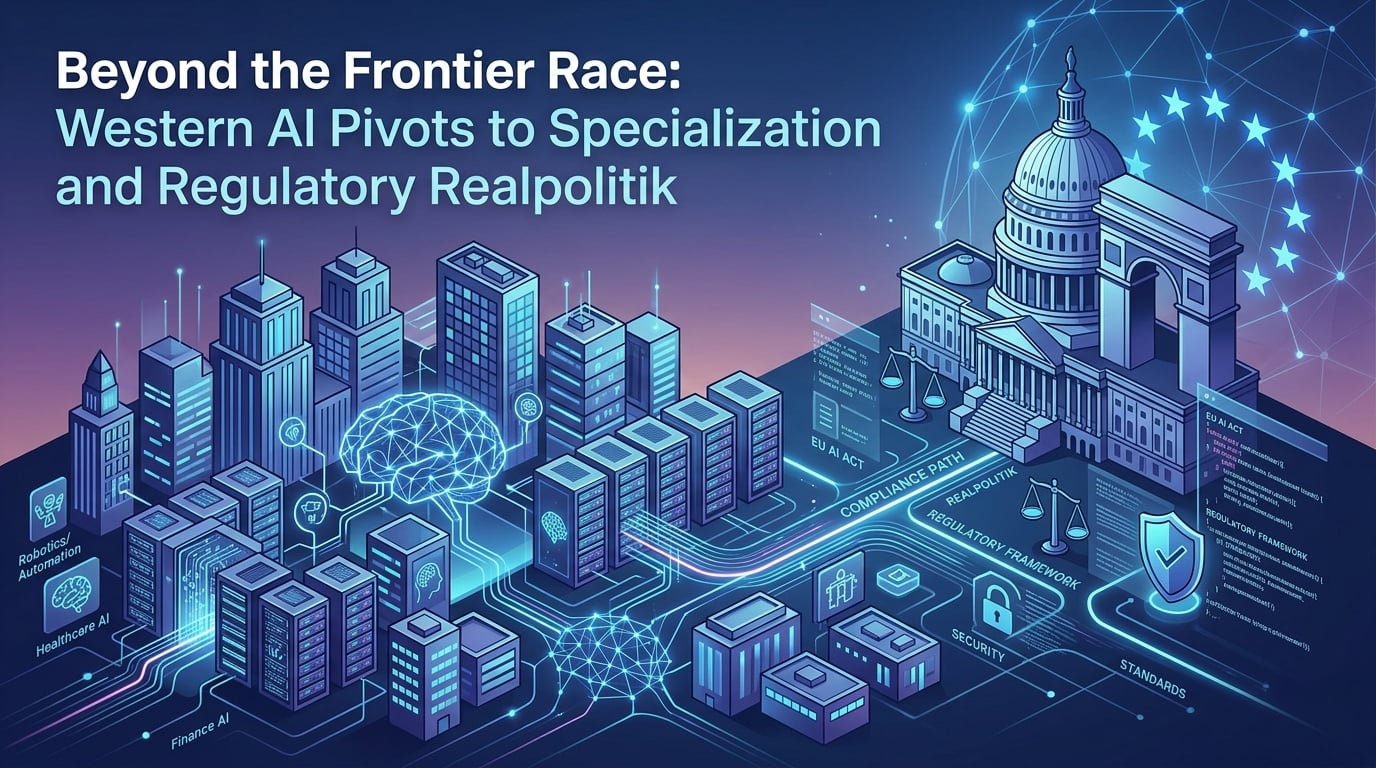
Beyond the Frontier Race: Western AI Pivots to Specialization and Regulatory Realpolitik
As July begins, the Western AI landscape is defined not by a single model showdown, but by a strategic pivot towards enterprise-ready specialization and a tense navigation of diverging US and EU regulatory regimes. Anthropic's new agentic Sonnet 5, OpenAI's push into developer tooling with Codex Remote, and Mistral's niche dominance with OCR 4 signal a market maturing beyond raw capability, now shaped by infrastructure control and geopolitical pressures.
 Lukas Hoffmann🇩🇪 Europe & Frontier CorrespondentJul 3, 2026 4m read
# Beyond the Frontier Race: Western AI Pivots to Specialization and Regulatory Realpolitik
BERLIN—As the first days of July 2026 unfold, the narrative of a simple horse race between Western frontier AI models is being replaced by a more complex reality. The frenetic energy that defined the launches of GPT-5.6 and Claude’s "Mythos-class" systems has given way to a strategic fragmentation. Leading labs are now engaged in a multi-front campaign focused on enterprise-ready specialization, infrastructure control, and a tense navigation of diverging regulatory regimes in Washington and Brussels.
The latest developments from Anthropic, OpenAI, and Mistral AI are not about clinching another point on a leaderboard. Instead, they signal a market maturing beyond raw general intelligence, where value is increasingly found in cost-efficient agentic workflows, vertical-specific tools, and the geopolitical pragmatism required to deploy them. Anthropic’s launch of Claude Sonnet 5 as a powerful-yet-economical agent, OpenAI’s enterprise push with the general availability of Codex Remote, and Mistral’s dominance in document intelligence with OCR 4 illustrate this pivot. Beneath these product moves, a high-stakes battle for infrastructure independence and an uneasy dance with government overseers are reshaping the foundations of the industry.
This analysis examines the concrete product releases and strategic shifts from the past 48 hours, situating them within the dual pressures of market demand and state intervention. It explores how the distinct regulatory philosophies of the United States—characterized by ad-hoc national security interventions—and the European Union—defined by its structured, phased AI Act—are forcing labs to adopt divergent strategies for survival and growth.
A New Wave of Specialized, Enterprise-Ready Models
The focus has shifted from "can it reason?" to "can it work reliably and affordably at scale?" The latest releases from Anthropic and OpenAI, and recent moves from Mistral, underscore a deep focus on creating practical, deployable tools for developers and large organizations.
Anthropic's 'Agentic' Workhorse: Claude Sonnet 5
On July 1, Anthropic made its new **Claude Sonnet 5**↗ model the default for all users, just a day after its initial release. This is not a flagship "Opus-class" model, but something arguably more significant for the enterprise market: a highly capable agentic model designed for performance at a fraction of the cost. Anthropic positions Sonnet 5 as its "most agentic Sonnet model to date," excelling at complex, multi-step tasks like coding, tool use, and browser-based automation.
Technically, Sonnet 5 offers performance approaching the flagship Opus 4.8 on many professional workflows but with a more palatable price-to-performance ratio. It launched with introductory pricing of $2 per million input tokens and $10 per million output tokens, significantly cheaper than its larger siblings. The model features a 1-million-token context window and a maximum output of 128,000 tokens, enabling it to process and generate substantial bodies of information. The "adaptive thinking" feature is now enabled by default, allowing the model to allocate more computational effort to more complex queries.
The key technical specifications of Claude Sonnet 5 that make it attractive for enterprise agentic workflows:
- Pricing: $2 per million input tokens and $10 per million output tokens — significantly cheaper than Opus-class models while delivering comparable performance on most professional tasks.
- Context window: 1 million tokens with a maximum output of 128,000 tokens, enabling processing of large codebases, legal documents, or research corpora in a single pass.
- Adaptive thinking: Enabled by default, allowing the model to dynamically allocate more computational effort to complex queries without requiring manual prompt engineering.
- Tool use and browser automation: Native support for multi-step agentic tasks including web browsing, code execution, and API calls, positioning it as a drop-in backbone for autonomous workflow systems.
The launch coincides with Anthropic restoring access to its most powerful models, Fable 5 and Mythos 5, on July 1. This follows a contentious period in June when the US government mandated a temporary suspension due to national security concerns over their advanced cybersecurity capabilities. The re-release, under new government-approved safeguards, underscores the tightrope Anthropic must walk between frontier development and regulatory compliance.
OpenAI's Enterprise Tooling and Infrastructure Moat
While the preview of GPT-5.6 Sol captured headlines in late June, OpenAI's more immediate impact on developers comes from solidifying its enterprise tooling. The company quietly made **Codex Remote**↗ generally available on June 25, a feature that deeply integrates AI into the developer workflow. It allows users to pair the ChatGPT mobile app with a Mac or Windows host, enabling them to initiate tasks, monitor progress, and approve agentic actions from anywhere. The integration of a DigitalOcean Droplet Workspace plugin further signals a strategy aimed at making AI a seamless, ambient layer within the cloud development environment.
These developer-centric updates are buttressed by a far more fundamental strategic play: infrastructure independence. On June 24, OpenAI and Broadcom unveiled "[Jalapeño](techcrunch.com↗ their jointly developed custom AI inference chip. This move represents a direct effort to reduce dependence on third-party hardware, primarily from Nvidia, and to optimize the performance-per-watt for running models like ChatGPT.
By designing the hardware—including chip architecture, memory systems, and networking—co-terminously with our software and models, we can deliver a step-change in efficiency and reliability. This full-stack approach is essential for deploying AI at the gigawatt scale needed to meet future demand.
This "full-stack" ambition is not just about cost savings; it's about controlling the entire value chain, from silicon to API endpoint, creating a formidable competitive moat that smaller players will struggle to cross.
Mistral AI's Niche Domination
Paris-based Mistral AI continues to execute a clever strategy of complementing its powerful general-purpose models with best-in-class specialized tools. The late-June release of **Mistral OCR 4**↗ is a prime example. This isn't just a simple text extraction tool; it's a sophisticated document intelligence engine.
Key features of OCR 4 that set it apart include: * Structural Parsing: The model can return paragraph-level bounding boxes and identify structural elements like tables, equations, images, and signatures, providing output in a structured, machine-readable format. * High Accuracy: It leads on key benchmarks like OlmOCRBench (85.20) and supports 170 languages, making it a powerful tool for global enterprises. * Deployment Flexibility: In a crucial nod to enterprise data governance and European privacy concerns, OCR 4 is available not only via API but also as a self-hosted deployment in a single container.
This focus allows Mistral to capture a specific, high-value enterprise market segment while burnishing its credentials as a European champion sensitive to the continent's data sovereignty requirements.
The Regulatory Gauntlet: Washington's Realpolitik vs. Brussels' Rulebook
The most significant external force shaping the AI landscape is regulation. However, the approaches taken by the United States and the European Union could not be more different, creating a complex and sometimes contradictory set of incentives for AI labs.
The United States: Direct, Ad-Hoc Intervention
The U.S. government, particularly under the Trump administration, has adopted a hands-on, and at times volatile, approach driven by national security concerns. The events of June 2026 were a stark illustration of this "regulatory realpolitik." * Direct Mandates: The government forced Anthropic to suspend access to its most advanced models, citing risks that their cyber capabilities could be "jailbroken" and misused. The subsequent lifting of these restrictions↗ on June 30 was conditional on enhanced safeguards, demonstrating a direct, interventionist posture. * Controlled Rollouts: Similarly, OpenAI was required to limit the initial launch of its GPT-5.6 series to a small group of "trusted partners" vetted by the U.S. government. * Proposed Equity Stakes: In a more radical development, reports surfaced on July 2 that **OpenAI has discussed giving the U.S. government a 5% stake**↗ in the company. This move, aimed at aligning the firm with national interests and sharing AI-driven profits with the public, signals a potential future where frontier labs become quasi-strategic national assets.
This ad-hoc, security-first approach forces U.S. labs into a tight, often reactive, relationship with the federal government, where access to markets can be contingent on geopolitical alignment.
The European Union: A Structured, Long-Term Framework
In contrast, the EU is proceeding with the methodical implementation of its landmark **AI Act**↗. Rather than reactive interventions, Brussels is building a comprehensive, risk-based legal architecture. Recent developments show a preference for pragmatic adjustment over abrupt commands. A provisional "Digital Omnibus" agreement in May 2026 deferred compliance deadlines for high-risk AI systems to late 2027 and mid-2028, giving industry more time to adapt and for harmonized technical standards to be developed.
The next major milestone is December 2, 2026, when transparency obligations under Article 50—including the watermarking of AI-generated deepfakes—take effect. The European Commission published a voluntary Code of Practice in June to guide compliance. This predictable, albeit bureaucratic, process stands in stark contrast to the sudden interventions seen in the U.S.
This regulatory environment has clear implications for strategy. As Mistral AI argued in its April 2026 policy playbook, Europe's complex digital rules create a strong case for local, sovereign AI infrastructure.
To avoid the legal uncertainty of foreign surveillance laws and to ensure compliance with Europe’s own data protection standards, the development of European-controlled compute infrastructure is not just a commercial opportunity—it is a strategic necessity. The goal must be to build a sovereign business model focused on regulated enterprises and the public sector, insulating European innovation from geopolitical turbulence originating elsewhere.
This divergence is cleaving the market. U.S. firms are increasingly tethered to national security priorities, while European firms like Mistral can position themselves as stable, compliant partners for a global market wary of U.S. governmental reach.
The Deepening Game of Infrastructure and Safety
Beneath the application layer, the competition is just as fierce. The staggering cost of training and running frontier models has made infrastructure a critical battleground, while the growing capabilities of these systems have forced a maturation of safety research from a theoretical exercise to an operational imperative.
The scale of infrastructure investment is breathtaking. Anthropic has committed to spending over $100 billion with **Amazon Web Services**↗ over the next decade, securing up to 5 gigawatts of compute capacity. It has a parallel deal with Google Cloud reportedly worth $200 billion over five years. This spending highlights the oligopolistic nature of the AI market, where only a handful of labs can afford to compete at the frontier, and their fate is inextricably linked to the cloud hyperscalers.
Simultaneously, safety research has evolved to address the concrete risks of highly autonomous agents. Labs are moving beyond simple content filters to more fundamental alignment techniques.
| Safety Technique | Lead Lab(s) | Description | | ----------------------------- | ----------------------- | --------------------------------------------------------------------------------------------------------------------------------------------- | | Deliberative Alignment | OpenAI | Trains models to explicitly reason through safety policies via chain-of-thought before responding, allowing for nuanced handling of complex prompts. | | Constitutional Classifiers++ | Anthropic | A two-stage system that uses lightweight internal probes to screen all traffic and escalates suspicious queries to a more powerful classifier. | | AI Control Roadmap | Google DeepMind | Treats AI agents as potential "insider threats" and uses trusted "supervisor" AI systems to monitor and block harmful behavior in real-time. | | Natural Language Autoencoders | Anthropic | An interpretability tool that translates a model's internal numerical activations into human-readable text to audit for hidden motivations. |
The practical implications for developers and enterprises deploying these systems are significant:
- Deliberative Alignment (OpenAI) trains models to reason through safety policies via chain-of-thought before responding, enabling nuanced handling of edge cases without blanket refusals that frustrate legitimate use.
- Constitutional Classifiers++ (Anthropic) deploys a two-stage screening system — lightweight probes handle routine traffic, while a more powerful classifier escalates suspicious queries — reducing both false positives and computational overhead.
- AI Control Roadmap (Google DeepMind) treats autonomous agents as potential insider threats, using trusted supervisor AI systems to monitor and block harmful behavior in real-time agentic pipelines.
- Natural Language Autoencoders (Anthropic) translate a model's internal numerical activations into human-readable text, giving safety teams an auditable window into model motivations before deployment.
This research is no longer academic. Techniques like **Constitutional Classifiers++**↗ are actively deployed to protect models like Claude, while Google's **AI Control Roadmap**↗ is being used to build live monitors for its Gemini agents. Safety has become a core engineering discipline, essential for earning the regulatory and public trust required for deployment.
As July 2026 gets underway, the Western AI ecosystem is clearly in a new phase. The raw pursuit of general intelligence is being tempered by the practical demands of the enterprise, the immense cost of infrastructure, and the non-negotiable realities of government oversight. Success is no longer measured solely by benchmark performance, but by the ability to build specialized, cost-effective tools, secure a defensible infrastructure stack, and deftly navigate the complex and diverging paths of global regulation.
Links & Resources
External links — opens in a new tab
🇩🇪 Europe & Frontier Correspondent · Berlin, Germany
Covers the European labs and the frontier research redrawing the field.

History of Evolutionary Thought in the Nineteenth Century
by Richard Murdoch Montgomery
From Lamarck to Darwin and beyond — a scholarly account of how evolutionary theory reshaped biology, society, and philosophy.

A Comprehensive Treatise on the Casio ClassPad fx-CG500
by Richard Murdoch Montgomery
Mastering the touchscreen CAS graphing calculator — 3D plotting, differential equations, financial tools, and eActivity programming.

Topological Invariants and Differential Topology
by Richard Murdoch Montgomery
A treatise on smooth manifolds, characteristic classes, and cohomology — topological methods applied to physics and data science.

A Treatise on English Law
by Richard Murdoch Montgomery
The common law tradition dissected — constitutional principles, tort, contract, equity, and the evolution of English jurisprudence.
Comments
Open discussion — no account needed. Be respectful.
More from Western AI Desk

Surveillance, Distillation, and Diplomacy: The Week AI Became a Geopolitical Instrument
Anthropic's sweeping threat intelligence report documents how state actors and criminal networks weaponized Claude across seven harm domains — while US and Chinese officials met in New York to negotiate AI guardrails ahead of a Trump-Xi summit.
 Sarah Brennan
Surveillance, Distillation, and Diplomacy: The Week AI Became a Geopolitical Instrument
Anthropic's sweeping threat intelligence report documents how state actors and criminal networks weaponized Claude across seven harm domains — while US and Chinese officials met in New York to negotiate AI guardrails ahead of a Trump-Xi summit.
Sarah BrennanSurveillance, Distillation, and Diplomacy: The Week AI Became a Geopolitical Instrument
Anthropic's sweeping threat intelligence report documents how state actors and criminal networks weaponized Claude across seven harm domains — while US and Chinese officials met in New York to negotiate AI guardrails ahead of a Trump-Xi summit.
Sarah Brennan