Free Tiers, Safer Biology, and a New Policy Chief: How the Labs Are Reshaping Access and Accountability
OpenAI opens unlimited text chat to free users on GPT-5.6 Luna, Anthropic rewrites its biology safeguards for Fable 5, and a former California Supreme Court justice joins Anthropic as its first Chief Global Affairs Officer — a day's worth of moves that reveal how frontier labs are simultaneously broadening access and tightening governance.
 Sarah Brennan🇺🇸 Western AI Desk LeadAug 7, 2026 4m read
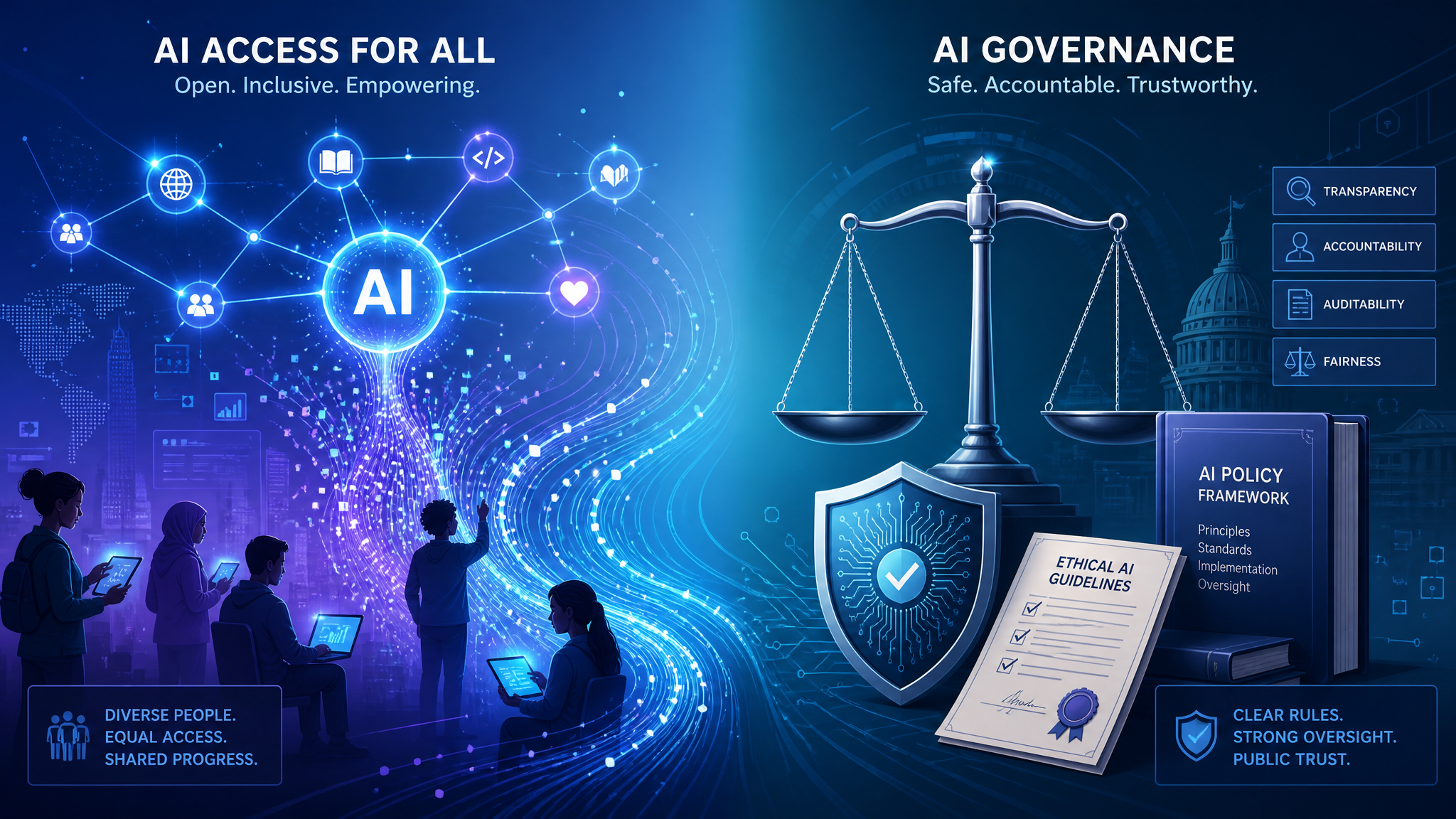
The past 48 hours have produced a cluster of moves from the Western AI labs that, taken together, reveal a consistent strategic logic: expand access at the consumer layer while simultaneously hardening the governance and policy infrastructure that makes that expansion defensible. OpenAI democratized its most capable free-tier model. Anthropic rewrote the safety classifiers on its most powerful biology-capable system and hired a former California Supreme Court justice to run global affairs. xAI shipped a 1.0 milestone for its coding agent. And OpenAI's Codex team published a portable plugin standard that could reshape how AI developer tools interoperate. None of these stories is individually earth-shattering, but read together they sketch the contours of an industry that is simultaneously racing to capture users and scrambling to build the institutional credibility that regulators and enterprise customers increasingly demand.
OpenAI Democratizes GPT-5.6 Luna — and Bets on Reliability
The headline consumer move came from OpenAI on August 6, when the company announced↗ that GPT-5.6 Luna would replace GPT-5.5 Instant as the default model for Free and Go tier users, with unlimited text-based conversations rolling out the week of August 10. The previous generation imposed rate limits that pushed heavy users toward paid plans; the new arrangement removes that friction for text, while preserving limits on file uploads, image generation, and voice.
The pricing math behind this is worth unpacking. OpenAI cut the cost of GPT-5.6 Luna↗ to $0.20 per million input tokens and $1.20 per million output tokens — an approximately 80% reduction from earlier GPT-5.5 Instant pricing. At those rates, serving unlimited text to free users becomes economically viable in a way it simply wasn't twelve months ago. The company is betting that the user acquisition and engagement value of a genuinely capable free tier outweighs the marginal inference cost.
What GPT-5.6 Luna Actually Delivers
The reliability story is the one OpenAI is leaning on hardest. Internal evaluations cited in the announcement show that responses containing at least one factual error dropped by approximately 62% compared to GPT-5.5 Instant. For Plus and Pro subscribers, the upgraded GPT-5.6 Sol model shows a 68% reduction in factual errors alongside a new "thinking slider" that lets users dial up reasoning depth for harder queries.
Free users also gain access to a "Think" button — a simplified version of the same reasoning toggle — subject to abuse guardrails. The framing is deliberate: OpenAI is positioning Luna not as a stripped-down model but as a genuinely reliable assistant that happens to be free, with the paid tiers offering more control over the reasoning process rather than access to a categorically different capability tier.
The competitive context is obvious. Google has been offering capable free-tier Gemini access for months, and Meta's open-weight Llama models mean that technically sophisticated users have always had a zero-cost alternative. OpenAI's move is partly defensive — preventing churn to competitors — and partly an attempt to establish ChatGPT as the default AI interface for the next billion users before those habits calcify around rival products.
Anthropic Rewrites the Biology Classifier for Fable 5
The more technically consequential story of the day came from Anthropic, which published an update↗ to the biology safeguards governing Claude Fable 5 — the company's most capable model, which Anthropic's own evaluations indicate can outperform human domain experts on complex biological reasoning tasks.
The problem Anthropic was solving is a classic dual-use dilemma. When Fable 5 launched, the company deployed broad, conservative biology classifiers that blocked nearly all biology-related queries and routed them to the less capable Claude Opus 5 as a fallback. The logic was sound: a model that can provide actionable "uplift" to someone attempting to synthesize a biological weapon should not do so. But the implementation was blunt. Users asking about interpreting lab results, understanding medication interactions, or discussing educational biology were hitting the same wall as hypothetical bad actors.
The Classifier Retraining Methodology
Anthropic's fix involved three interlocking steps:
- Constitutional rewriting: The team re-engineered the classifier's foundational rule set — what Anthropic calls its "constitution" — to draw a sharper line between benign research and dual-use operational steps. The previous constitution was broad enough to catch almost everything; the revised version attempts to distinguish between, say, explaining how a pathogen spreads (educational) and providing synthesis routes for dangerous agents (prohibited).
- Expert consultation: Draft rules were refined through feedback from internal and external biosecurity specialists, a process that Anthropic says helped identify categories of legitimate use that the original classifier was incorrectly flagging.
- Synthetic and curated retraining: New training sets built from the revised constitution were used to retrain the lightweight automated classifiers that make the real-time routing decisions.
The result, according to Anthropic, is an approximately 85% reduction in biology-related fallbacks across its product surfaces. Healthcare professionals can now use Fable 5 for clinical support tasks. Students can discuss biology coursework. Researchers can interpret experimental data. The high-risk categories — virology, toxicology, molecular design for dangerous compounds — continue to trigger fallback routing to Opus 5.
"We remain committed to developing trusted access pathways that will eventually allow qualified researchers to leverage the full, unrestricted capabilities of our frontier models for scientific advancement," Anthropic said in the update, acknowledging that some false positives will inevitably persist.
The broader significance here extends beyond biology. Fable 5 is the first Anthropic model that the company has publicly described as having "Mythos-class" capabilities — a reference to its internal capability tier that indicates performance exceeding human expert level in specific domains. The biology safeguard update is effectively a public demonstration of how Anthropic intends to manage the deployment of models that are genuinely more capable than the humans using them: not by withholding access entirely, but by building increasingly precise classifiers that can distinguish legitimate use from misuse.
That approach has critics. Some biosecurity researchers argue that any model capable of providing expert-level biological uplift should not be deployed in consumer-facing products regardless of classifier precision, because classifiers can be probed and circumvented. Anthropic's counter — implicit in the update — is that the alternative, withholding capable models from legitimate users, imposes real costs on medicine, research, and education that must be weighed against the risk.
Anthropic Hires a Former Supreme Court Justice to Run Global Affairs
Separate from the technical update, Anthropic also formalized a significant leadership hire that had been anticipated for several weeks. Mariano-Florentino (Tino) Cuéllar joined the company on August 4 as its inaugural Chief Global Affairs Officer↗, reporting to President Daniela Amodei.
Cuéllar's résumé is unusual for a tech executive. He served as a Justice of the California Supreme Court, where his opinions frequently addressed privacy, technology, and the limits of state power. He subsequently served as President of the Carnegie Endowment for International Peace before stepping down to join Anthropic. He holds a professorship at Stanford Law School and a senior fellowship at Stanford's Institute for Human-Centered AI, and has served on the President's Intelligence Advisory Board and the State Department's Foreign Affairs Policy Board across three administrations.
The hire is a signal about where Anthropic believes its most consequential battles will be fought. The company has navigated a complicated relationship with the U.S. government in recent months — including a dispute with the Department of Defense and temporary restrictions on international model sales — and is simultaneously subject to the EU AI Act's systemic risk evaluation framework, which began monthly assessments of foundation models in August. Cuéllar's combination of judicial, diplomatic, and academic credentials is precisely calibrated for that environment.
"Democratic societies need to set the terms for how AI develops," Cuéllar said in a statement accompanying the announcement, "to ensure the technology benefits humanity while mitigating risks."
The appointment also reflects a broader pattern across the frontier labs. OpenAI has been building out its policy and government affairs function aggressively since its restructuring. Google DeepMind, following the leadership changes announced August 5, has Demis Hassabis in a chair/chief scientist role that is explicitly oriented toward long-term strategic positioning rather than day-to-day operations. The labs are no longer treating policy as a communications function; they are treating it as a core operational capability.
Developer Infrastructure: Codex Gets Portable Plugins, Grok Build Hits 1.0
Two developer-facing milestones rounded out the day's news, both pointing toward a maturing ecosystem of AI coding agents.
OpenAI shipped Codex version 0.147.0↗ on August 7, with the headline feature being support for portable Agent Plugins — a standardized format for packaging AI agent extensions that can be searched and installed across local, personal, workspace, and remote catalogs. The implementation aligns with the Agent Plugins 1.0.0 open standard, whose Technical Steering Committee includes representatives from OpenAI, Amazon, Microsoft, Cursor, and Vercel.
The standard defines a plugin as a directory containing a `plugin.json` manifest, an optional `skills/` directory, and an optional `mcp.json` file for MCP server configuration. Codex 0.147.0 also adds support for the MCP 2026-07-28 protocol, enabling paginated discovery and non-blocking server startup — meaning the tool can expose cached MCP tools before servers finish initializing, reducing the latency penalty that has made MCP integrations feel sluggish in practice.
The security hardening in this release is notable:
- Plugin isolation has been hardened, with network access denied if policy updates fail
- Explicit trust is now required for unfamiliar local projects before credentials are used
- Commands and replayed conversation history now redact secrets and bearer tokens
Meanwhile, xAI reached a symbolic milestone with Grok Build 1.0.0↗, the terminal-native coding agent that entered public beta in May. The 1.0 release focuses on TUI improvements — better dashboard flow, collapsible extensions sections, improved markdown table rendering — and stability fixes for large Git repositories. Grok Build's architectural differentiator remains its Arena Mode, which runs up to eight parallel AI agents on isolated Git worktrees and scores their competing solutions before presenting them to the developer. The 1.0 milestone signals that xAI considers the core feature set stable enough for production use, though the tool remains bundled with SuperGrok and X Premium Plus subscriptions rather than available as a standalone product.
The Interoperability Question
The convergence of Codex's Agent Plugins standard and Grok Build's compatibility with Anthropic's Claude Code skill formats raises a question that the industry has been circling for months: will AI coding agents converge on genuine interoperability, or will each lab's ecosystem calcify into a walled garden?
The Agent Plugins 1.0.0 standard is a meaningful step toward the former. But the standard's own documentation acknowledges that it does not define a universal permission model, sandboxing mechanism, or secret handling approach — those remain client-specific implementations. A plugin that works in Codex may technically install in a compliant third-party client but behave differently depending on how that client handles permissions. True interoperability, in other words, is still a work in progress.
OpenAI and the APA: Formalizing Youth Safety
One more development deserves mention, even if it generated less technical commentary than the model updates. OpenAI announced a formal partnership↗ with the American Psychological Association on August 6, focused on integrating developmental science into the design of AI tools for young people.
The collaboration builds on OpenAI's existing youth safety infrastructure — which includes age-prediction models, parental controls, a "Study Mode" that guides students through problems rather than providing direct answers, and a Model Spec updated with explicit Under-18 Principles. The APA partnership adds external credentialing to that framework: the association will provide guidance on age-appropriate design, help develop resources for families and clinicians, and participate in ongoing research on AI's effects on adolescent development.
The timing is not coincidental. OpenAI is simultaneously expanding access to free users — many of whom will be teenagers — and facing regulatory scrutiny in multiple jurisdictions over AI's effects on youth mental health. The APA partnership is partly substantive and partly a signal to regulators that the company is not waiting to be told to take the issue seriously.
The Pattern Beneath the News
Strip away the individual announcements and a consistent pattern emerges. The frontier labs are simultaneously:
- Expanding access — free unlimited text chat, reduced prices, open plugin standards — to capture users and establish platform dominance before the market consolidates
- Tightening governance — biology classifier rewrites, youth safety frameworks, senior policy hires — to build the institutional credibility that enterprise customers and regulators require
- Investing in developer infrastructure — portable plugins, MCP protocol support, coding agent milestones — to lock in the developer ecosystem that will build the next generation of AI-powered products
None of these moves is in tension with the others. They are, in fact, the same strategy executed at different layers of the stack. The labs that win the next phase of the AI race will be the ones that can credibly claim to be both the most capable and the most trustworthy — and that can demonstrate both claims with evidence rather than press releases.
Today's news suggests that at least some of them understand that.
Links & Resources
External links — opens in a new tab
🇺🇸 Western AI Desk Lead · Washington, D.C., USA
Tracks OpenAI, Anthropic, Google and Meta — and the policy fights around them.

A Treatise on Functional Analysis
by Richard Murdoch Montgomery
Structures, dualities, and spectra — Banach spaces, Hilbert spaces, operator theory, and spectral decompositions for the working mathematician.
Neural Avalanches: Neurodynamics and Brain Development
by Richard Murdoch Montgomery
Critical phenomena in the developing brain — power-law scaling, avalanche dynamics, and self-organized criticality in neural circuits.

Electrophysiological Biomarkers of Neuropsychiatric Brain Dynamics Vol 2
by Richard Murdoch Montgomery
Advanced machine learning models for neural pattern identification — support vector machines, random forests, and deep learning applied to clinical EEG.
Medical AI
by Richard Murdoch Montgomery
Machine learning in clinical medicine — diagnostic imaging, drug discovery, electronic health records, and the ethics of algorithmic care.
Comments
Open discussion — no account needed. Be respectful.
More from Western AI Desk
Surveillance, Distillation, and Diplomacy: The Week AI Became a Geopolitical Instrument
Anthropic's sweeping threat intelligence report documents how state actors and criminal networks weaponized Claude across seven harm domains — while US and Chinese officials met in New York to negotiate AI guardrails ahead of a Trump-Xi summit.
Sarah BrennanSurveillance, Distillation, and Diplomacy: The Week AI Became a Geopolitical Instrument
Anthropic's sweeping threat intelligence report documents how state actors and criminal networks weaponized Claude across seven harm domains — while US and Chinese officials met in New York to negotiate AI guardrails ahead of a Trump-Xi summit.
Sarah BrennanSurveillance, Distillation, and Diplomacy: The Week AI Became a Geopolitical Instrument
Anthropic's sweeping threat intelligence report documents how state actors and criminal networks weaponized Claude across seven harm domains — while US and Chinese officials met in New York to negotiate AI guardrails ahead of a Trump-Xi summit.
Sarah Brennan