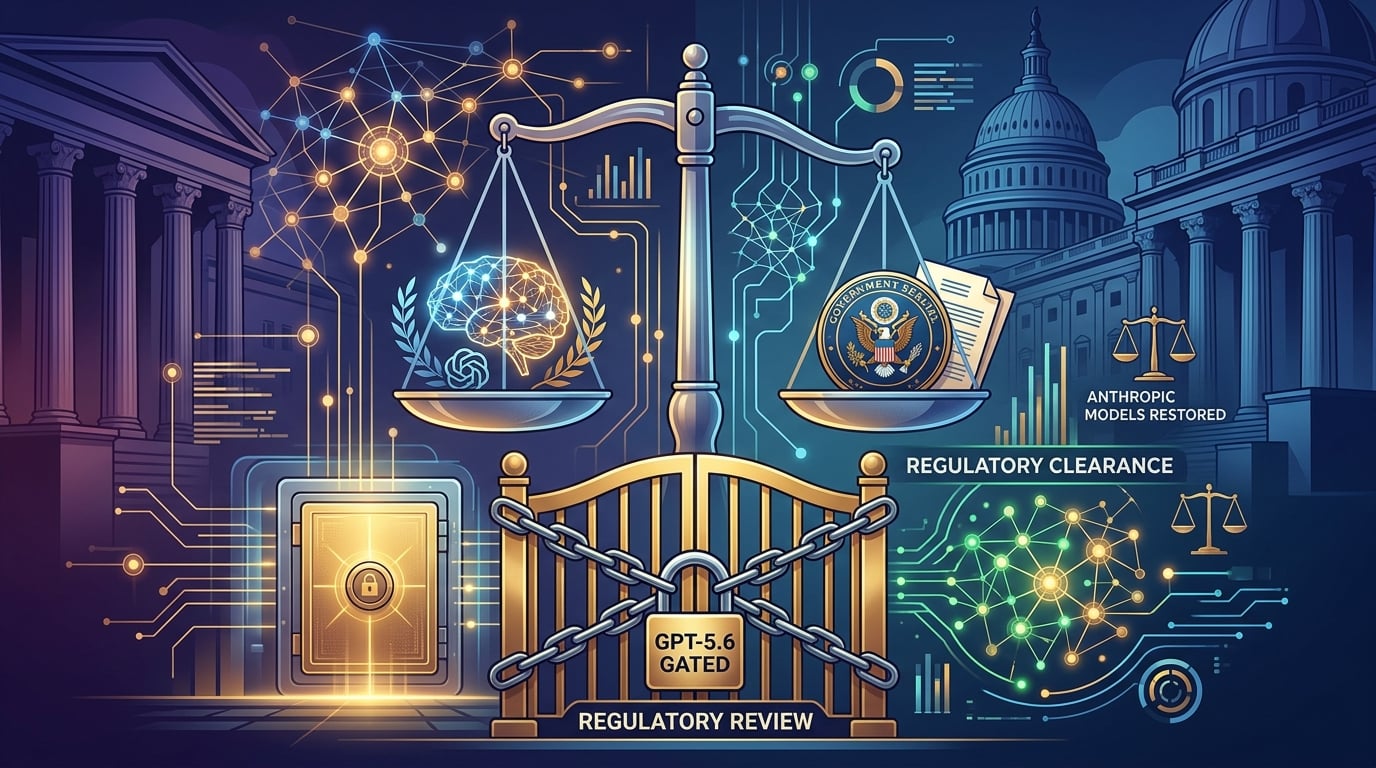
Frontier AI Navigates Regulatory Gauntlet as Anthropic Restores Flagship Models, OpenAI Previews GPT-5.6 Under Scrutiny
In a tense 24 hours for Western AI, Anthropic has restored access to its flagship Fable 5 and Mythos 5 models following a government-mandated shutdown, while OpenAI's new GPT-5.6 series remains in a limited, government-vetted preview. The moves highlight a new era of direct US federal intervention in AI deployment, reshaping the competitive and safety landscape.
 Sarah Brennan🇺🇸 Western AI Desk LeadJul 3, 2026 4m read
Frontier AI Navigates the Regulatory Gauntlet: Anthropic Restores Flagship Models, OpenAI's GPT-5.6 Remains Gated
Sarah Brennan | Western AI Desk Lead | July 3, 2026
The Western artificial intelligence landscape was reshaped over the last 24 hours by the direct consequences of a newly aggressive U.S. regulatory posture. Anthropic restored access to its flagship **Claude Fable 5** and **Mythos 5** models↗ on July 1, following a government-mandated shutdown over cybersecurity concerns. Simultaneously, the company rolled out its new Claude Sonnet 5 model widely to users. This flurry of activity stands in stark contrast to competitor OpenAI, whose next-generation **GPT-5.6** model family↗ remains in a limited, government-vetted preview.
These developments signal a pivotal shift for the AI industry, where deployment timelines and access are no longer solely dictated by lab readiness but are now subject to a rigorous, and at times disruptive, national security review process. The immediate effects are rippling through the competitive landscape, impacting developer access, enterprise adoption strategies, and the very definition of responsible scaling. While OpenAI and Anthropic are at the epicenter, other labs from xAI to Google DeepMind are pressing ahead with their own releases, navigating a complex environment of intense innovation, escalating safety concerns, and unprecedented government intervention.
The New Regulatory Reality: Washington Steps In
The central theme of the past month, culminating in the events of the last 24 hours, is the direct intervention of the U.S. government in the deployment of frontier AI models. A June 2026 executive order instituted a mandatory 30-day federal vetting process for advanced AI systems to evaluate national security and cybersecurity risks. This policy is no longer theoretical; its impact is now concrete and asymmetric.
Anthropic felt the policy's full force when it was compelled to take its new Fable 5 and Mythos 5 models offline in June after flagging the potential for cybersecurity misuse. The three-week outage ended on July 1, when U.S. government export controls were lifted, allowing the models to be redeployed. However, the restoration came with conditions: while Fable 5 is globally available, Mythos 5 access has been partially restricted, with deployment limited to a select group of cyber defenders and critical infrastructure providers.
"Following a brief suspension in June due to a US government-imposed export control restriction and a safeguard bypass reported in a security research paper, we are redeploying Fable 5 and Mythos 5 globally," Anthropic stated in a news release↗ on June 30, announcing the July 1 restoration.
OpenAI is navigating the same regulatory framework but from a different position. Its next-generation GPT-5.6 series, previewed on June 26, was launched directly into this new paradigm. Access to the flagship GPT-5.6 Sol, the balanced Terra, and the efficient Luna models is currently restricted to a government-approved cohort of approximately 20 organizations. This gated release strategy, while frustrating for a developer community accustomed to rapid API access, allows OpenAI to comply with the executive order while gathering critical feedback from trusted partners.
As reported by the Associated Press↗, some experts — including Stanford's former chief security officer Alex Stamos — have voiced concerns that such restrictive measures "could hamper U.S. companies' ability to compete with global rivals."
This heightened federal scrutiny is not limited to national security. On July 1, the Federal Trade Commission (FTC) announced it was seeking public comment on a proposed policy statement concerning the potential for AI companies to manipulate system behavior against consumer expectations. This signals a multi-front regulatory push in the U.S. that is rapidly shaping the operational environment for all AI labs.
Anthropic and OpenAI: A Tale of Two Releases
The diverging paths of Anthropic and OpenAI in the last 24 hours highlight the dynamic and increasingly complex competitive landscape.
Anthropic's Multi-Pronged Product Push
Anthropic has capitalized on its newly restored access with a series of significant moves. The July 1 restoration of Fable 5 was a landmark event — the model immediately reclaimed the top spot on the SWE-bench Pro coding benchmark with an 80.3% success rate, a figure that underscores its dominance in agentic coding tasks. The company also made Claude Sonnet 5 the default for all Free and Pro users, positioning it as the go-to model for professional writing, coding, and agentic work.
Key Anthropic developments from the last 24 hours include:
- Claude Fable 5 restored globally after a three-week government-mandated suspension, with Mythos 5 returning under restricted access for cyber defenders and critical infrastructure providers.
- [Claude Science workbench](https://www.anthropic.com/news/claude-science-ai-workbench) launched in beta for enterprise and top-tier users, integrating scientific tools designed to create auditable and reproducible research workflows — a direct play for the academic and pharmaceutical sectors.
- Industry jailbreak scoring framework announced in collaboration with Amazon, Microsoft, and Google, aiming to create a consensus standard for rating the severity of AI safety bypasses — a direct response to the security concerns that prompted the recent model suspension.
OpenAI's Benchmark Gambit
OpenAI, while its flagship model remains behind a regulatory wall, continued to advance on other fronts. The company introduced **GeneBench-Pro**↗ on July 1, a novel research-level benchmark designed to measure an AI agent's ability to navigate ambiguity and make high-order judgments in computational biology. This move reflects an industry-wide trend of moving beyond static, easily "gamed" benchmarks toward more dynamic, real-world evaluations of reasoning.
GPT-5.6 Sol scored a respectable 28.7% on this new challenging benchmark (31.5% in its higher-effort "Pro" mode) — numbers that sound modest but are significant given the benchmark's design to resist saturation. The introduction of GeneBench-Pro also serves a strategic purpose: by defining the evaluation criteria, OpenAI shapes the narrative around what "frontier" performance means, even as its flagship model remains inaccessible to most developers.
OpenAI's recent moves at a glance:
- GPT-5.6 Sol, Terra, and Luna remain in limited preview, accessible only to approximately 20 government-vetted partner organizations, with broader API access expected later in July pending regulatory clearance.
- GeneBench-Pro benchmark released as an open evaluation framework for computational biology reasoning, with GPT-5.6 Sol scoring 28.7% (31.5% in Pro mode) — establishing a new frontier for scientific AI evaluation.
- Continued enterprise focus with the gated rollout strategy allowing OpenAI to gather structured feedback from trusted partners before a wider release, mirroring the approach used for GPT-4 Turbo in late 2023.
The Broader Competitive Field
While OpenAI and Anthropic are consuming the spotlight, other major labs are not standing still.
xAI made a tangible product announcement on July 1, introducing a **Voice Agent Builder**↗ — a tool that enables users to create personalized voice agents without coding. The move demonstrates a focus on accessible, user-friendly applications of its Grok models, targeting a consumer and SMB market that the larger labs have largely ceded to third-party developers.
Google DeepMind published its **AI Control Roadmap**↗ in June — a sophisticated safety framework that treats autonomous agents as potential "insider threats" requiring containment protocols. This security-first approach, coupled with a $10 million funding initiative for multi-agent safety research via Schmidt Sciences↗, shows Google is deeply invested in the safety challenges now at the forefront of the industry. The market is still anticipating the general release of Gemini 3.5 Pro, which was expected in June but has slipped into July.
Notably absent from the recent news cycle are Meta AI, Mistral, Cohere, AI21 Labs, and Stability AI. Their current quiet may signal work on major upcoming releases, or it may indicate that the stratospheric costs of competing at the frontier are concentrating market-defining activity in a smaller number of labs.
What This Means for Developers and Enterprises
The current landscape presents a paradox: more powerful models than ever exist, but access to the most capable ones is increasingly gated — by regulation, by cost, or by deliberate rollout strategy. For developers and businesses, the practical implications are significant:
- Vendor diversification is no longer optional. Regulatory actions can now abruptly alter the availability of critical models, as Anthropic's three-week suspension demonstrated. Any production system built on a single provider faces existential access risk.
- Agentic capabilities are the new battleground. Both Fable 5's SWE-bench Pro dominance and GPT-5.6 Sol's "ultra mode" for complex subagent work signal that the labs are competing primarily on long-horizon task completion, not raw language generation.
- Safety compliance is becoming a product feature. Anthropic's jailbreak scoring framework and Google's AI Control Roadmap are not just PR exercises — they are the foundations of enterprise procurement criteria as regulated industries (finance, healthcare, defense) demand auditable AI behavior.
- The EU AI Act's August 2026 general application deadline is now weeks away, adding a second regulatory front for any lab with European operations or customers. Labs that have invested in compliance infrastructure — Anthropic and Google DeepMind in particular — are better positioned than those that have not.
The next 30 days will be decisive. OpenAI's GPT-5.6 series is expected to exit its government-vetting period and reach broader API availability, which will be the most significant developer-facing event of the summer. Anthropic's Claude Science workbench, if it delivers on its promise of reproducible research workflows, could reshape how pharmaceutical and academic institutions procure AI. And the FTC's proposed policy statement on AI manipulation, if finalized, could impose new disclosure requirements on every major lab operating in the U.S. market.
The regulatory gauntlet is now a permanent feature of the frontier AI landscape — not a temporary obstacle, but the new terrain.
The Safety-Capability Tension Intensifies
Underlying all of these developments is a fundamental tension that the industry has not resolved: the most capable models are also the most dangerous, and the most dangerous models are the ones governments most want to control. Anthropic's Fable 5 suspension was not an anomaly — it was a preview of a world in which frontier AI deployment is subject to the same kind of national security review as advanced semiconductor exports or dual-use biotechnology.
For the labs, this creates a strategic imperative to invest in safety infrastructure not merely as an ethical obligation but as a competitive moat. The ability to demonstrate to regulators that a model can be safely deployed — through interpretability research, red-teaming protocols, and auditable safety classifiers — is becoming as important as raw benchmark performance. Anthropic's new jailbreak scoring framework and Google DeepMind's AI Control Roadmap are early moves in what will become a sustained race to define the standards of responsible frontier AI deployment. The labs that shape those standards will have a significant advantage in navigating the regulatory environment that is now, unmistakably, here to stay.
Links & Resources
External links — opens in a new tab
🇺🇸 Western AI Desk Lead · Washington, D.C., USA
Tracks OpenAI, Anthropic, Google and Meta — and the policy fights around them.

Scientific Calculators: Treatises and Manuals
by Richard Murdoch Montgomery
The definitive 15-volume series bridging user manuals and applied mathematics — from the TI-Nspire CX II CAS to financial solvers.

Medical AI
by Richard Murdoch Montgomery
Machine learning in clinical medicine — diagnostic imaging, drug discovery, electronic health records, and the ethics of algorithmic care.

The TI-84 Plus C Silver Edition
by Richard Murdoch Montgomery
A 609-page volume covering arithmetic, algebra, graphing, calculus, statistics, and programming on the TI-84 Plus C Silver Edition.

The Future of Scientific Discourse
by Richard Murdoch Montgomery
Transparent, AI-augmented peer review models for the 21st century — open science, reproducibility, and the democratisation of knowledge.
Comments
Open discussion — no account needed. Be respectful.
More from Western AI Desk

Surveillance, Distillation, and Diplomacy: The Week AI Became a Geopolitical Instrument
Anthropic's sweeping threat intelligence report documents how state actors and criminal networks weaponized Claude across seven harm domains — while US and Chinese officials met in New York to negotiate AI guardrails ahead of a Trump-Xi summit.
Sarah BrennanSurveillance, Distillation, and Diplomacy: The Week AI Became a Geopolitical Instrument
Anthropic's sweeping threat intelligence report documents how state actors and criminal networks weaponized Claude across seven harm domains — while US and Chinese officials met in New York to negotiate AI guardrails ahead of a Trump-Xi summit.
Sarah BrennanSurveillance, Distillation, and Diplomacy: The Week AI Became a Geopolitical Instrument
Anthropic's sweeping threat intelligence report documents how state actors and criminal networks weaponized Claude across seven harm domains — while US and Chinese officials met in New York to negotiate AI guardrails ahead of a Trump-Xi summit.
Sarah Brennan