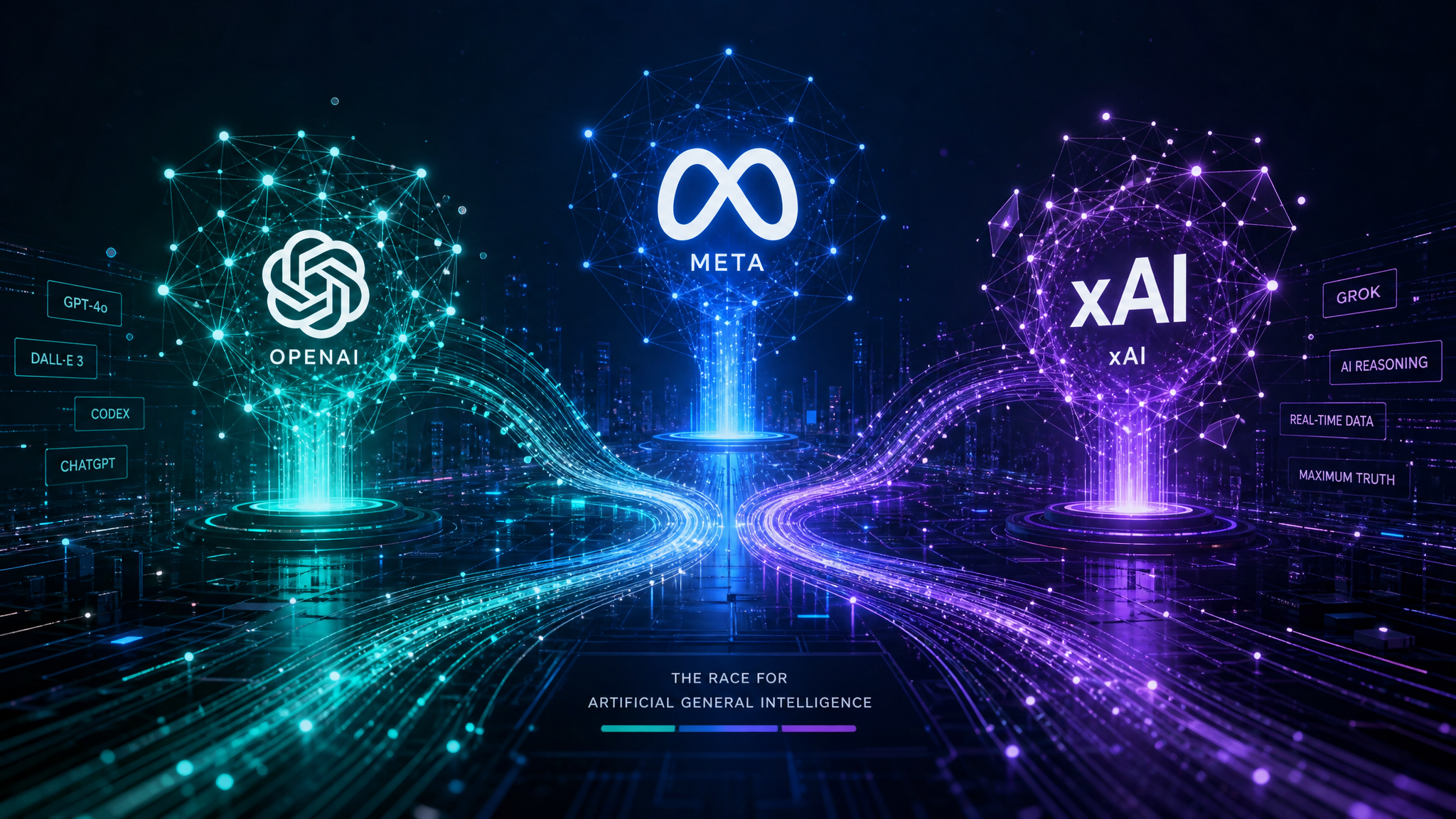
OpenAI, Meta, and xAI Flood the Zone: A 24-Hour Blitz Reshapes the AI Developer Landscape
In a remarkable 24-hour window, OpenAI launched its three-tiered GPT-5.6 family, Meta opened the Muse Spark 1.1 API to developers, and xAI released Grok 4.5 — a coordinated escalation that signals the AI arms race has entered a new phase defined by developer capture, agentic capability, and aggressive pricing.
 Sarah Brennan🇺🇸 Western AI Desk LeadJul 9, 2026 4m read
OpenAI, Meta, and xAI Flood the Zone: A 24-Hour Blitz Reshapes the AI Developer Landscape
The Western AI industry has a habit of moving in waves — a quiet stretch punctuated by a sudden surge of announcements that resets the competitive baseline. July 8–9, 2026 was one of those moments. In the span of roughly 24 hours, OpenAI launched its most ambitious product refresh in months, Meta made its first serious bid to become a paid API provider, and xAI released a model explicitly designed to eat into the lucrative software engineering market. Taken together, these moves signal that the arms race has entered a new phase — one defined less by raw benchmark supremacy and more by developer capture, agentic capability, and aggressive pricing strategy.
The timing was not coincidental. Each lab is acutely aware of the others' roadmaps, and the pressure to establish platform lock-in before the market consolidates is intensifying. For developers, the result is an embarrassment of riches — and a genuinely difficult set of trade-offs.
---
OpenAI's Three-Tier Gambit: GPT-5.6 Sol, Terra, and Luna
OpenAI's GPT-5.6 launch↗ is the most structurally significant of the three releases. Rather than a single flagship model, the company introduced a tiered family — Sol, Terra, and Luna — each targeting a distinct segment of the market.
Sol is the flagship: engineered for frontier reasoning, long-horizon agentic workflows, and complex professional tasks in coding, biology, and cybersecurity. It introduces a controllable `max` reasoning effort setting and an `ultra` mode that deploys parallel subagents to accelerate complex work. According to CNBC↗, CEO Sam Altman cited a 54% improvement in token efficiency for agentic coding tasks compared to previous iterations — a claim that, if it holds up under independent evaluation, would represent a meaningful cost reduction for enterprise deployments. Sol also set new state-of-the-art results on Terminal-Bench 2.1, a benchmark focused on real-world software engineering tasks.
Terra is the workhorse: performance competitive with GPT-5.5 at roughly half the cost, designed for everyday business applications where frontier reasoning is overkill. Luna is the speed tier: optimized for high-volume, latency-sensitive tasks like content moderation, simple chat, and classification pipelines.
All three models share a 1,050,000-token context window and a 128,000-token maximum output — specifications that put them in direct competition with Anthropic's Claude Sonnet 5 and Google's Gemini 3.5 Flash on the context front.
The tiered structure is a deliberate market segmentation play. OpenAI is trying to be the default choice across the full spectrum of AI workloads, from the most demanding frontier tasks to the most cost-sensitive production pipelines. The risk is complexity: a three-model family requires developers to make architectural decisions upfront, and switching costs accumulate quickly once a codebase is optimized for a specific tier.
The Government Coordination Question
The GPT-5.6 launch also surfaced an unusual wrinkle: reports emerged↗ that OpenAI coordinated the release with senior U.S. government officials, including Commerce Secretary Howard Lutnick and U.S. National Cyber Director Sean Cairncross. The White House subsequently denied granting any formal "green light," clarifying that the administration does not provide clearances for private AI releases. The episode nonetheless illustrates how deeply entangled frontier AI development has become with national security considerations — a dynamic that will only intensify as models grow more capable.
---
Meta's API Pivot: Muse Spark 1.1 and the OpenAI Compatibility Play
Meta's move is arguably the most strategically interesting of the three. The company's official blog↗ announced Muse Spark 1.1 — a rapid iteration on the original Muse Spark released in April 2026 — alongside the launch of the Meta Model API in public preview.
The technical specs are competitive:
- 1-million-token context window with advanced context management techniques for long, complex workflows
- Native multimodal support for text, images, video, and PDFs
- Designed for orchestrating multi-agent systems and autonomous computer interface navigation
- Significant improvements in real-world coding tasks, including bug diagnosis, feature implementation, and large-scale code migrations
Pricing is where Meta is making its most aggressive statement: $1.25 per million input tokens and $4.25 per million output tokens, with $20 in free credits for new accounts. As CNBC reported↗, this undercuts OpenAI's Sol pricing ($5.00 input / $30.00 output) by a substantial margin, though a direct comparison requires accounting for capability differences.
The most tactically shrewd element of the launch is the OpenAI-compatible API design. By mirroring OpenAI's API surface, Meta dramatically lowers the switching cost for developers already running on GPT-4 or GPT-5.x infrastructure. A migration that might otherwise require weeks of engineering work can, in theory, be accomplished with a few lines of configuration change. This is a direct play for developer loyalty at the infrastructure layer — the same layer where OpenAI has spent years building stickiness.
The Monetization Shift
Meta's decision to launch a paid API represents a meaningful strategic pivot. The company built its AI reputation on open-source releases — Llama, Code Llama, and their successors — and that strategy generated enormous goodwill in the developer community. Moving to a paid model for its frontier capabilities risks some of that goodwill, but the economics are hard to argue with: training and serving models at this scale requires revenue, and the open-source strategy alone cannot sustain it.
The company is also navigating internal turbulence. Mark Zuckerberg acknowledged at an internal town hall on July 2 that AI agent development had not accelerated as expected, and the company's May 2026 layoffs — approximately 8,000 employees — targeted integrity and cybersecurity teams while shielding AI infrastructure divisions. The Muse Spark 1.1 launch is, in part, a public signal that the AI division is delivering despite the organizational headwinds.
---
xAI's Grok 4.5: Engineering-First, Efficiency-Focused
xAI's Grok 4.5↗, released July 8, takes a different approach: rather than competing across the full market, it targets the high-value software engineering vertical with surgical precision.
The technical profile is distinctive:
- Mixture-of-Experts (MoE) architecture, trained on a 1.5-trillion-parameter foundation (V9)
- Training data includes trillions of tokens from real-world Cursor IDE user interactions — multi-turn coding sessions, tool usage, and internal engineering data from SpaceX and Tesla
- 83.3% on Terminal-Bench 2.1 and a 64.7% resolve rate on SWE-Bench Pro
- 500,000-token context window, smaller than the Meta and OpenAI offerings but sufficient for most software engineering tasks
- Inference speed of 80 tokens per second
- Priced at $2 per million input tokens and $6 per million output tokens
The SWE-Bench Pro result deserves particular attention. SWE-Bench Pro is a harder variant of the standard SWE-Bench benchmark, designed to test real-world software engineering capability rather than curated problem sets. A 64.7% resolve rate, if independently verified, would place Grok 4.5 among the top performers on this metric.
The Cursor Integration Advantage
Grok 4.5's integration into the Cursor IDE↗ — following xAI's acquisition of the AI coding startup — gives it a distribution channel that neither OpenAI nor Meta can easily replicate. Cursor has become one of the most widely used AI-assisted development environments, and having Grok 4.5 as a native option within that workflow creates a natural adoption path that bypasses the API comparison shopping that developers otherwise do.
The model is also available via the SpaceXAI API and Grok Build, xAI's own development environment. One notable limitation at launch: Grok 4.5 is not yet available in the EU, with regional access expected by mid-July 2026 — a gap that reflects the ongoing complexity of deploying frontier models under the EU AI Act's transparency and compliance requirements.
---
The Broader Competitive Context
These three launches do not exist in isolation. They land against a backdrop of significant moves from the other major Western labs.
Anthropic released Claude Sonnet 5↗ on June 30, positioning it as the most agentic model in the Sonnet class — approaching Opus 4.8 performance at a lower price point ($3 input / $15 output per million tokens, with an introductory discount through August 31). The model supports a 1-million-token context window and drops traditional sampling parameters like `temperature` and `top_p` in favor of default adaptive thinking. With annualized revenue reportedly approaching $30 billion, Anthropic remains the enterprise benchmark against which others are measured.
Google DeepMind is conspicuously absent from this week's launch cycle. Gemini 3.5 Pro has been delayed to July 17↗ after the company scrapped its existing architecture and initiated a full ground-up rebuild to address shortcomings in mathematical reasoning and visual tasks. The delay — combined with a reported talent exodus including Gemini co-lead Noam Shazeer — has cost Alphabet an estimated $225 billion in market capitalization. Gemini 3.5 Flash remains available and competitive on agentic benchmarks, but the absence of a Pro-tier flagship leaves Google on the defensive precisely when its rivals are most aggressive.
Mistral AI is pursuing a different path entirely. The French lab released Robostral Navigate↗ — an 8B embodied navigation model for autonomous robots — and Leanstral 1.5, an open-weight model for Lean 4 formal proof engineering. These are not general-purpose chatbot plays; they are high-value, specialized tools targeting markets where Mistral can compete on technical depth rather than scale. The company is also executing a €4 billion data center investment in France and Sweden, reinforcing its European sovereignty positioning.
The Regulatory Dimension
The EU AI Act's AI Omnibus package↗ — finalized in late June 2026 — has pushed compliance deadlines for high-risk AI systems to December 2027 and beyond, providing breathing room for labs navigating the European market. The European Commission's July 2026 Action Plan on Cybersecurity and AI adds another layer of scrutiny, with a secure testing platform for critical sectors expected by 2027. For xAI, the EU availability gap for Grok 4.5 is a concrete illustration of how regulatory complexity translates into real market access delays.
---
What This Means for Developers and Businesses
The practical implications of this 24-hour blitz are significant:
- Pricing pressure is real and accelerating. Meta's $1.25/$4.25 input/output pricing forces every other provider to justify its premium. Developers running high-volume workloads now have a credible, capable alternative that is dramatically cheaper than OpenAI's flagship tier.
- Agentic capability is the new baseline. All three models — Sol, Muse Spark 1.1, and Grok 4.5 — are explicitly designed for multi-step, tool-using, autonomous workflows. The era of the single-turn chatbot as the primary use case is effectively over for frontier models.
- API compatibility is becoming a competitive weapon. Meta's OpenAI-compatible API design is a direct attack on switching costs. Expect other providers to follow suit, which will ultimately benefit developers by reducing vendor lock-in.
- Specialization is a viable strategy. xAI's focus on software engineering, Mistral's robotics and formal verification work, and Anthropic's enterprise safety positioning all demonstrate that the market is large enough to support multiple distinct strategies — not just a single winner-take-all race.
"The question is no longer which model is smartest — it's which platform you can build a sustainable business on top of." — A framing that increasingly defines how enterprise buyers are approaching the current landscape.
"Meta's OpenAI-compatible API is the most interesting competitive move of the week. It's not about the model — it's about the switching cost." — Developer community reaction, widely circulated on technical forums following the launch.
The next few weeks will be telling. Google's Gemini 3.5 Pro launch on July 17 — if it delivers on its rebuilt architecture — could reset the competitive dynamic again. Anthropic's enterprise momentum shows no signs of slowing. And the question of whether Meta can convert its pricing advantage into genuine developer loyalty, rather than just opportunistic experimentation, remains open.
What is clear is that the pace of this competition is not slowing. For developers, businesses, and policymakers alike, the challenge is no longer keeping up with individual model releases — it is understanding the structural forces that are reshaping the entire AI platform landscape beneath them.
Links & Resources
External links — opens in a new tab
🇺🇸 Western AI Desk Lead · Washington, D.C., USA
Tracks OpenAI, Anthropic, Google and Meta — and the policy fights around them.

Electrophysiological Biomarkers of Neuropsychiatric Brain Dynamics Vol 1
by Richard Murdoch Montgomery
EEG-based biomarkers for schizophrenia and bipolar disorder — frequency band power, event-related potentials, and neural connectivity patterns.

Calculus I
by Richard Murdoch Montgomery
Limits, derivatives, integrals, and series — a first course in calculus with formal proofs, worked examples, and applications to physics and engineering.
Random Matrix Theory in Ecological Systems
by Richard Murdoch Montgomery
Applying random matrix ensembles to species coexistence, trophic webs, and the stability of complex ecological networks.

The TI-Nspire CX II CAS Treatise
by Richard Murdoch Montgomery
A comprehensive guide covering CAS programming, 3D graphing, calculus, linear algebra, and physics applications on the TI-Nspire.
Comments
Open discussion — no account needed. Be respectful.
More from Western AI Desk

Surveillance, Distillation, and Diplomacy: The Week AI Became a Geopolitical Instrument
Anthropic's sweeping threat intelligence report documents how state actors and criminal networks weaponized Claude across seven harm domains — while US and Chinese officials met in New York to negotiate AI guardrails ahead of a Trump-Xi summit.
Sarah BrennanSurveillance, Distillation, and Diplomacy: The Week AI Became a Geopolitical Instrument
Anthropic's sweeping threat intelligence report documents how state actors and criminal networks weaponized Claude across seven harm domains — while US and Chinese officials met in New York to negotiate AI guardrails ahead of a Trump-Xi summit.
Sarah BrennanSurveillance, Distillation, and Diplomacy: The Week AI Became a Geopolitical Instrument
Anthropic's sweeping threat intelligence report documents how state actors and criminal networks weaponized Claude across seven harm domains — while US and Chinese officials met in New York to negotiate AI guardrails ahead of a Trump-Xi summit.
Sarah Brennan