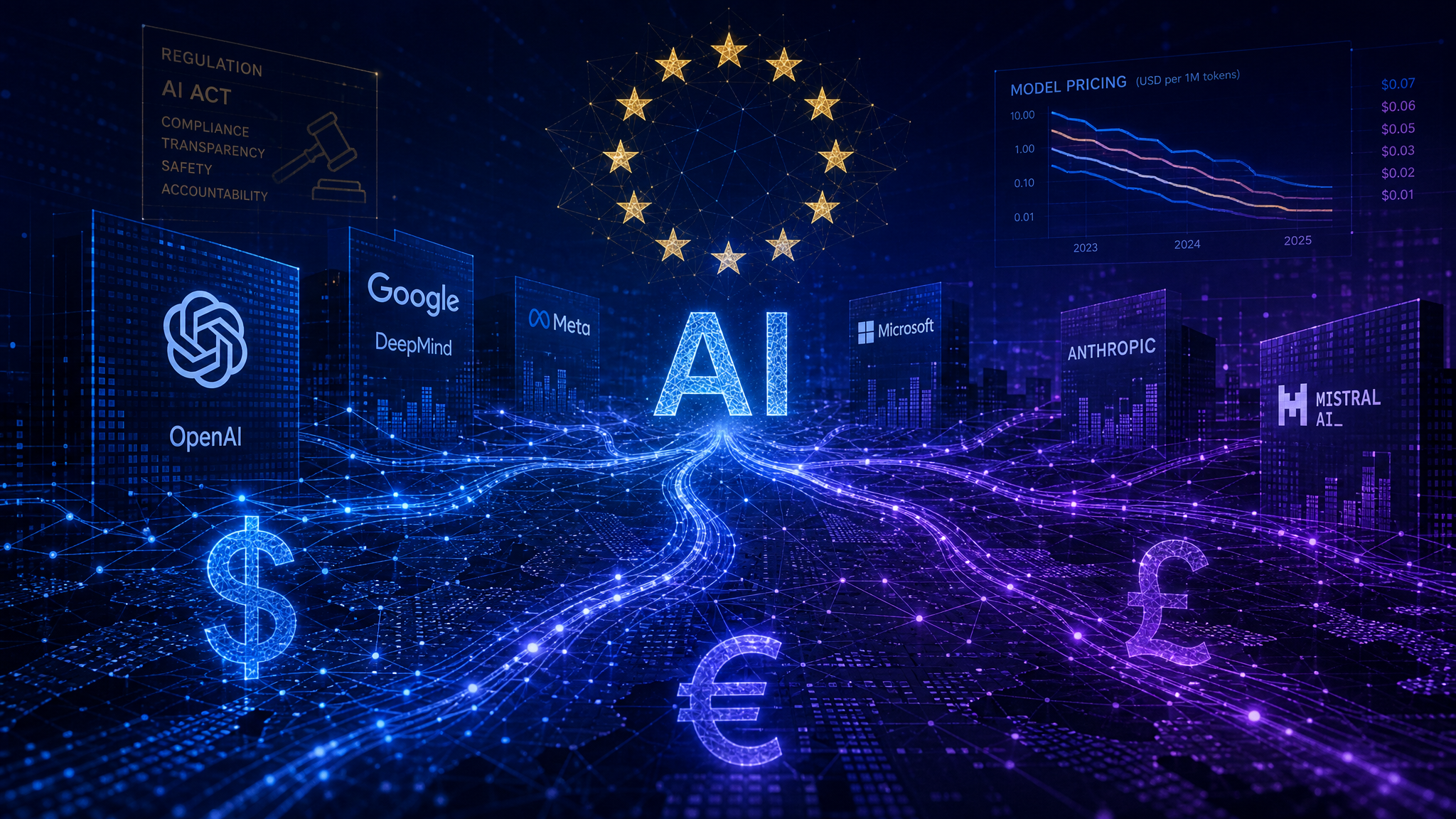
xAI Fires the Opening Shot in an AI Price War: Grok 4.5, GPT-Live, and the EU's August Deadline
xAI's Grok 4.5 lands with aggressive pricing that undercuts every major frontier rival, while OpenAI rolls out real-time voice and Anthropic tightens its safety policy — all against the backdrop of the EU AI Act's August enforcement deadline.
 Sarah Brennan🇺🇸 Western AI Desk LeadJul 9, 2026 10m read
xAI Fires the Opening Shot in an AI Price War: Grok 4.5, GPT-Live, and the EU's August Deadline
By Sarah Brennan | July 9, 2026
In one of the most consequential 24-hour stretches for the frontier AI race this year, xAI roiled the market by launching its much-anticipated Grok 4.5 model — challenging industry leaders not on raw benchmark supremacy but on an aggressive new front: cost-performance. The release, from the entity now widely referred to as SpaceXAI following its absorption by SpaceX, directly targets the economic calculus of enterprise AI deployment. It coincided with major product and policy moves from rivals: OpenAI unveiled its advanced real-time conversational model GPT-Live, and Anthropic reinforced its safety credentials with an updated Responsible Scaling Policy.
These rapid-fire developments are not occurring in a vacuum. They are set against the critical backdrop of the European Union's AI Act, with the European Commission set to activate significant enforcement and fining powers for general-purpose AI (GPAI) models on August 2, 2026. This fast-approaching regulatory deadline is already shaping market access and go-to-market strategies — as evidenced by xAI's decision to delay Grok 4.5's availability in the EU, a move that underscores the growing intersection of technological innovation, commercial competition, and geopolitical regulation.
xAI's Grok 4.5: A Strategic Play on 'Intelligence per Dollar'
SpaceXAI officially launched Grok 4.5↗ on July 8, 2026, making it available via API, the Grok Build CLI, and the Cursor IDE. While characterized by Elon Musk as an "Opus-class" model, the company's strategy appears less focused on topping every leaderboard and more on delivering elite performance in high-value domains at a disruptive price point.
The model is built on xAI's new 1.5-trillion-parameter V9 foundation architecture — a Mixture-of-Experts (MoE) design trained on tens of thousands of NVIDIA GB300 GPUs. A key element of its development was a deep partnership with the AI coding startup Cursor, which was acquired by SpaceXAI in June 2026↗, involving supplemental training on trillions of tokens of real-world developer interaction data. This has specifically optimized Grok 4.5 for coding, agentic workflows, and complex software engineering tasks.
Benchmarks: Competitive but Not Dominant
According to self-reported benchmarks from xAI, Grok 4.5 is highly competitive but does not uniformly outperform all rivals. The Decoder's analysis↗ of the numbers tells a nuanced story:
- On Terminal-Bench 2.1, a measure of terminal operation proficiency, Grok 4.5 scores 83.3% — just behind Anthropic's Fable 5 (84.3%) and OpenAI's GPT-5.5 (83.4%).
- On the complex software engineering benchmark SWE-Bench Pro, its 64.7% resolve rate surpasses GPT-5.5 (58.6%) but trails Anthropic's Opus 4.8 (69.2%) and the market-leading Fable 5 (80.4%).
- xAI claims the model is approximately 4.2× more token-efficient than Anthropic's Opus 4.8 on SWE-Bench Pro tasks — meaning it generates significantly less output to achieve comparable results, directly translating to lower costs and faster task completion.
All benchmark scores are self-reported by xAI and have not been independently verified. That caveat matters: the history of frontier model launches is littered with cherry-picked evals. Still, even if the efficiency claims are directionally correct, the pricing structure alone is a market-moving development.
The Price War Begins
At $2.00 per million input tokens and $6.00 per million output tokens, Grok 4.5 dramatically undercuts↗ the flagship models from its main competitors. Anthropic's Opus 4.8 runs at $15/$75 per million tokens; OpenAI's GPT-5.5 sits in a comparable premium tier. The gap is not marginal — it is structural.
"The question is no longer which model scores highest on a benchmark. It's which model delivers the most value per dollar at production scale. Grok 4.5 is betting that for most enterprise workloads, the answer is now obvious." — xAI positioning, per Reuters reporting
This "intelligence per dollar" strategy is designed to appeal to enterprises and developers struggling with the escalating costs of leveraging frontier AI at scale. If the efficiency claims hold up under independent scrutiny, xAI could force a repricing across the entire top tier of the market — a dynamic that would benefit developers but squeeze the margins of labs that have built their business models around premium pricing.
The model is available through the xAI console and third-party integrations with platforms including Notion, Vercel, Cloudflare, and Snowflake. However, its delayed launch in the European Union until mid-July is a clear signal of the caution labs are now exercising ahead of the August 2 enforcement date.
OpenAI Bets on Voice; Anthropic Doubles Down on Safety
While xAI focused on cost disruption, its primary rivals made significant moves to enhance user experience and formalize safety protocols — two very different competitive vectors.
GPT-Live: The Conversational Interface Matures
OpenAI launched GPT-Live↗ on July 8, a new generation of voice models powering ChatGPT. Featuring a full-duplex architecture, GPT-Live allows for truly interactive, real-time conversation where the AI can listen and speak simultaneously, enabling natural interruptions and back-and-forth dialogue. The system delegates complex reasoning or search tasks to the more powerful GPT-5.5 model in the background, decoupling the low-latency interaction layer from the heavy computational work.
This is a pure product play aimed at making human-AI interaction more seamless and intuitive — a key vector of competition that operates largely outside the benchmark wars. The practical implications for enterprise deployments are significant:
- Customer service applications can now handle genuinely conversational interactions rather than turn-based exchanges, reducing friction and improving resolution rates.
- Developer tooling integrated with voice interfaces becomes more viable for hands-free coding assistance and pair-programming scenarios.
- Accessibility use cases — for users with visual impairments or motor difficulties — become substantially more powerful with a truly real-time voice layer.
The full-duplex design is technically non-trivial. Earlier voice implementations from OpenAI and competitors required the model to wait for a complete utterance before responding, creating an unnatural cadence. GPT-Live's ability to process and respond while still receiving input represents a meaningful architectural advance, though OpenAI has not published the underlying technical details.
Anthropic's RSP 3.4: Policy as Product
On the same day, Anthropic announced an update to its Responsible Scaling Policy↗, releasing version 3.4. This is not a product launch — it is a policy move that reinforces the company's core branding and strategic differentiator.
The update refines the safety thresholds for automated R&D activities, adjusts requirements for the internal sharing of risk reports, and clarifies procedures for external safety reviews. Coming on the heels of the government-mandated suspension and subsequent redeployment of its Fable 5 and Mythos 5 models in late June and early July, this update signals Anthropic's commitment to demonstrable, verifiable safety protocols.
"Anthropic's RSP updates are increasingly functioning as a form of regulatory pre-compliance — a way of demonstrating to governments that the company can self-govern before external mandates force the issue." — industry analyst framing, per AI Weekly
This move, along with Anthropic's recent collaboration with Google, Microsoft, and Amazon on a "Jailbreak Severity Standard," is designed to position the company as the most trusted partner for safety-conscious enterprises and governments. In a market where regulatory risk is becoming a first-order concern for enterprise procurement, that positioning has real commercial value.
The EU's August Deadline: Regulation as Market Force
The flurry of product launches is taking place under the watchful eye of regulators. The EU AI Act's enforcement powers for GPAI models↗ are activated on August 2, 2026 — less than four weeks away. From that date, the European Commission can investigate providers, demand access to models for evaluation, and impose fines of up to 3% of global turnover for non-compliance.
The Compliance Landscape
The regulatory pressure has spurred major labs to shore up their compliance strategies. The key dynamics:
- OpenAI, Google, Anthropic, and Mistral AI have all signed the voluntary General-Purpose AI Code of Practice, which provides a "presumption of conformity" with the AI Act — effectively a legal safe harbor.
- Meta remains a notable holdout, arguing the rules could stifle open-source innovation. The company's position is increasingly isolated among major Western labs.
- xAI's EU delay for Grok 4.5 is the most concrete example yet of a lab actively managing its regulatory exposure by staging geographic rollouts.
Mistral AI is positioning itself as Europe's sovereign champion in this environment. While the French lab had no major flagship release on July 8, it recently announced that a new "fat but sparse" open-weight model family would enter early access for partners in July 2026. Combined with its consistent release of powerful open-weight models under the permissive Apache 2.0 license, this is a direct appeal to European enterprises prioritizing data sovereignty and freedom from US-based API-driven ecosystems. The specialized Robostral Navigate model for embodied robotics, released on July 8, further highlights Mistral's focus on diverse, agentic applications beyond the standard chat and coding use cases.
Mistral's strategy of providing auditable, self-hostable models is tailor-made for the European regulatory environment and represents a fundamentally different competitive approach to that of its US rivals. Where OpenAI and Anthropic sell access to opaque, cloud-hosted systems, Mistral offers transparency and control — precisely what the EU AI Act's compliance requirements reward.
What This Means for Developers and Enterprises
The events of July 8 crystallize several trends that will define the next phase of the frontier AI market:
- Pricing pressure is now structural. xAI's Grok 4.5 pricing is not a promotional rate — it reflects the underlying economics of a lab with access to SpaceX's compute infrastructure and a vertically integrated supply chain. If the model performs as claimed, competitors will face a choice between matching prices or justifying a premium through demonstrably superior capabilities.
- The interface layer is becoming a competitive moat. OpenAI's GPT-Live investment signals that raw model capability is no longer sufficient differentiation. The quality of the interaction experience — voice, latency, naturalness — is becoming a primary purchase criterion for consumer and enterprise buyers alike.
- Regulatory compliance is now a product feature. Anthropic's RSP updates and Mistral's open-weight strategy are not just legal housekeeping — they are deliberate product decisions designed to appeal to a specific buyer segment that treats regulatory risk as a first-order concern.
- Geographic fragmentation is accelerating. xAI's EU delay, Meta's holdout on the Code of Practice, and Mistral's European positioning all point toward a market that is increasingly segmented by jurisdiction, not just by capability tier.
The August 2 enforcement date will be the first real test of whether the EU AI Act has teeth. If the Commission moves quickly against a major non-compliant provider, it will send a signal that reshapes the entire industry's approach to geographic rollouts. If enforcement is slow or toothless, the voluntary compliance framework will lose credibility. Either outcome will have significant consequences for how labs structure their global go-to-market strategies in the second half of 2026.
For now, the frontier AI race has entered a new phase — one defined less by who can build the most capable model and more by who can deliver the right capability, at the right price, in the right jurisdiction, with the right compliance posture. xAI has made its opening move. The response from OpenAI, Anthropic, and Google DeepMind will define the competitive landscape for the rest of the year.
Links & Resources
External links — opens in a new tab
🇺🇸 Western AI Desk Lead · Washington, D.C., USA
Tracks OpenAI, Anthropic, Google and Meta — and the policy fights around them.

CM1 Complete Study Material: Actuarial Mathematics
by Richard Murdoch Montgomery
The comprehensive guide for the CM1 actuarial exam — compound interest, annuities, life tables, reserving, and profit testing.

Physics and Its Mathematical Foundations Vol 4
by Richard Murdoch Montgomery
Quantum mechanics, statistical thermodynamics, and mathematical physics — bridging abstract formalism with physical intuition.

The TI-84 Plus C Silver Edition
by Richard Murdoch Montgomery
A 609-page volume covering arithmetic, algebra, graphing, calculus, statistics, and programming on the TI-84 Plus C Silver Edition.
Medical AI
by Richard Murdoch Montgomery
Machine learning in clinical medicine — diagnostic imaging, drug discovery, electronic health records, and the ethics of algorithmic care.
Comments
Open discussion — no account needed. Be respectful.
More from Western AI Desk

Surveillance, Distillation, and Diplomacy: The Week AI Became a Geopolitical Instrument
Anthropic's sweeping threat intelligence report documents how state actors and criminal networks weaponized Claude across seven harm domains — while US and Chinese officials met in New York to negotiate AI guardrails ahead of a Trump-Xi summit.
Sarah BrennanSurveillance, Distillation, and Diplomacy: The Week AI Became a Geopolitical Instrument
Anthropic's sweeping threat intelligence report documents how state actors and criminal networks weaponized Claude across seven harm domains — while US and Chinese officials met in New York to negotiate AI guardrails ahead of a Trump-Xi summit.
Sarah BrennanSurveillance, Distillation, and Diplomacy: The Week AI Became a Geopolitical Instrument
Anthropic's sweeping threat intelligence report documents how state actors and criminal networks weaponized Claude across seven harm domains — while US and Chinese officials met in New York to negotiate AI guardrails ahead of a Trump-Xi summit.
Sarah Brennan