Cohere's Arabic ASR, Anthropic's Agentic Leap, and the EU's Cybersecurity Blueprint
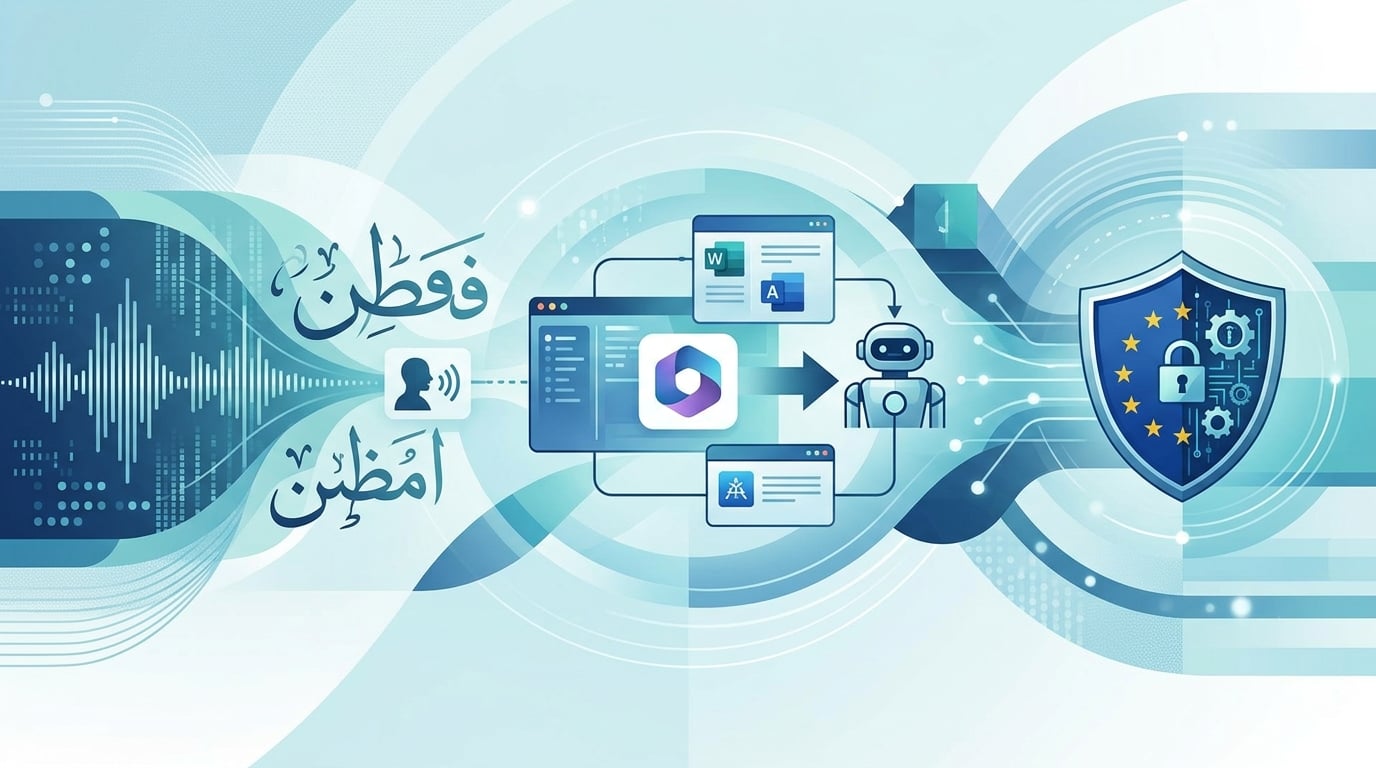
Cohere's open-source Arabic speech model outperforms Whisper on dialect fidelity while Anthropic turns Claude into an active Microsoft 365 agent — all as the European Commission unveils a sweeping AI-cybersecurity action plan.
 Lukas Hoffmann🇩🇪 Europe & Frontier CorrespondentJul 8, 2026 4m read
Cohere's Arabic ASR, Anthropic's Agentic Leap, and the EU's Cybersecurity Blueprint
The past 24 hours in Western AI have been defined not by frontier model races but by something arguably more consequential: targeted, technically substantive releases aimed at underserved markets, deepening enterprise integration, and a significant regulatory escalation from Brussels. Cohere stole the headline with a state-of-the-art open-source Arabic speech recognition model. Anthropic quietly transformed Claude into an active participant in Microsoft 365 workflows. And the European Commission unveiled an action plan that begins to operationalise the EU AI Act's principles into concrete pre-market evaluation processes. Meanwhile, OpenAI, Google DeepMind, Meta AI, and xAI were conspicuously quiet — a strategic pause ahead of what promises to be a turbulent week.
Cohere Transcribe Arabic: Closing the Frontier-Language Gap
The most technically significant release of the day came from Cohere, which announced Cohere Transcribe Arabic↗ on July 7, 2026. The model is a 2-billion-parameter automatic speech recognition (ASR) system built on a conformer-based encoder-decoder architecture — a design choice that prioritises streaming efficiency and robustness to acoustic variation over raw parameter count.
What makes this release notable is not the architecture alone but the problem it targets. Arabic is a macrolanguage with more than 30 recognised dialectal varieties, ranging from Moroccan Darija to Gulf Arabic, and code-switching between Arabic and English is pervasive in professional settings. General-purpose ASR models, including OpenAI's Whisper family, have historically struggled with this diversity. Cohere's model is explicitly engineered to handle it.
The numbers are striking. On the Hugging Face Arabic ASR Leaderboard↗, Cohere Transcribe Arabic achieves an average Word Error Rate (WER) of 25.87, outperforming Meta's OmniASR-LLM-7B and OpenAI's Whisper Large V3 despite being a smaller model. Internal human evaluations reinforce this: native Arabic speakers preferred Cohere's output over Whisper in more than 95% of test cases, citing superior dialect faithfulness as the primary reason.
For enterprise deployment, the model is optimised for high-throughput inference via vLLM, achieving a real-time factor multiple (RTFx) of 525 — meaning it can process audio roughly 525 times faster than real time on appropriate hardware. The model is released under the Apache 2.0 licence, enabling on-premise and private-cloud deployment without API dependency.
Why This Matters Beyond Arabic
Cohere's strategic logic here is worth unpacking. The company has consistently positioned itself as the enterprise-first alternative to OpenAI and Anthropic, emphasising sovereign deployment, data privacy, and customisability over consumer reach. A specialised, open-source ASR model for Arabic fits this playbook precisely:
- Sovereign AI demand is growing across the Gulf Cooperation Council and North Africa, where governments are investing heavily in domestic AI infrastructure and are wary of routing sensitive audio data through US-based APIs.
- The competitive moat is real: building a model that outperforms Whisper on Arabic dialects requires curated training data and linguistic expertise that general-purpose labs have little incentive to prioritise.
- Open-source licensing accelerates adoption in academic and government contexts while generating goodwill and community contributions that can improve the model over time.
The release also implicitly challenges the assumption that frontier AI is synonymous with the largest English-language models. A 2B-parameter model that beats a 7B competitor on a specific task is a pointed argument for specialisation over scale.
Anthropic Turns Claude into a Microsoft 365 Agent
Anthropic made two enterprise-focused announcements on July 7 that, taken together, represent a meaningful shift in how Claude is positioned in the workplace.
The first is the expansion of Claude Cowork↗ to web and mobile platforms. Previously desktop-only, Cowork now allows tasks to persist and run across devices, including when the user is offline. For users on the Max plan, this means long-running agentic workflows — document analysis, multi-step research, code generation pipelines — can be initiated on a laptop and monitored or continued on a phone. The feature is operationally modest but signals Anthropic's intent to make Claude a persistent background agent rather than a session-bound assistant.
The second announcement is more technically significant: a major upgrade to Anthropic's Microsoft 365 connector↗. The connector previously offered read-and-search capabilities — Claude could retrieve emails, calendar entries, and files. The new "write" tools change the relationship fundamentally:
- Email: Claude can now draft and send emails directly from a user's Outlook account, including managing replies and forwarding.
- Calendar: The connector supports creating, modifying, and deleting calendar events, as well as managing meeting invitations.
- File management: Claude can create, edit, and update files in both OneDrive and SharePoint, enabling document generation and collaborative editing workflows.
- Mailbox settings: Administrative controls, including rule creation and folder management, are now within Claude's reach.
"The shift from read to write is not incremental — it is categorical. A model that can only retrieve information is a research assistant. A model that can act on your behalf in your email and calendar is an agent with real-world consequences."
This distinction matters for risk assessment as much as for product positioning. An agent that can send emails and modify shared files in a corporate environment introduces new attack surfaces and accountability questions. Under the EU AI Act↗, agentic systems operating in high-stakes business contexts may qualify as high-risk AI, triggering conformity assessment requirements before deployment in EU member states.
The Enterprise Battleground
The Microsoft 365 integration deepens Anthropic's presence in the most contested territory in enterprise AI. Microsoft's own Copilot already offers similar write capabilities natively within the M365 stack. Google DeepMind's Gemini is integrated into Workspace with comparable agentic features. By extending Claude's reach into M365, Anthropic is betting that enterprises will prefer a third-party AI with a strong safety reputation over the incumbent's native offering.
"Enterprise buyers are increasingly asking not just 'what can this model do?' but 'what happens when it does something wrong?' Anthropic's Constitutional AI lineage and its published safety research give it a credibility advantage in that conversation."
Whether that advantage translates into market share will depend on how well the write tools perform in practice — and how quickly Anthropic can address the inevitable edge cases that arise when an AI agent has write access to a company's communications infrastructure.
Mistral's OCR 4 Webinar: Specialisation as Strategy
Mistral AI held a technical webinar on July 7 to demonstrate the capabilities of its recently released OCR 4 model. While OCR 4 itself was not a new release within the 24-hour window, the event is worth noting as a signal of Mistral's strategic direction.
The webinar focused on OCR 4's document intelligence features↗, including:
- High-precision document parsing capable of handling complex layouts, tables, and mixed-language documents.
- Bounding box extraction for identifying and isolating specific elements within a document — a critical feature for downstream automation pipelines.
- Block classification that distinguishes between text, figures, tables, and headers, enabling structured data extraction from unstructured PDFs.
These capabilities are directly relevant to industries — finance, legal, logistics, healthcare — where document processing is a high-volume, high-stakes workflow. By investing in a dedicated OCR service rather than relying on general-purpose vision-language models, Mistral is building a suite of specialised tools for the European enterprise market, where data sovereignty and on-premise deployment are often non-negotiable requirements.
The EU's Cybersecurity-AI Action Plan: Regulation Gets Operational
The most consequential development of the day for the long-term trajectory of Western AI came not from a lab but from Brussels. The European Commission introduced its Action Plan on Cybersecurity and Artificial Intelligence↗ on July 7, 2026 — a strategic framework that begins to translate the EU AI Act's principles into concrete operational processes.
The plan is structured around three pillars:
- Pre-market model evaluation: The Commission, working with ENISA↗ (the EU Agency for Cybersecurity), will develop the capacity to evaluate advanced AI models before they enter the EU market. This includes a "European Blueprint" for secure model access and a dedicated testing platform for AI systems deployed in critical sectors such as energy, healthcare, and financial infrastructure.
- AI-assisted cyber defence: The plan encourages EU institutions and member states to adopt AI — including open-source models — to accelerate threat detection, vulnerability analysis, and incident response. This creates a potential procurement channel for European AI providers.
- Sovereign AI capacity building: The Commission will launch an "EU Grand Challenge on AI for cybersecurity" to stimulate innovation and continue investment in European AI infrastructure, with an explicit preference for solutions that can be audited and controlled domestically.
Implications for Western Labs
The Action Plan is not standalone legislation — it operates within the existing framework of the AI Act, the Cyber Resilience Act, and the NIS2 Directive. But its significance lies in what it operationalises. The AI Act established risk categories and compliance obligations in the abstract; this plan begins to build the institutional machinery — evaluation benchmarks, testing platforms, enforcement mandates for the European AI Office — that will make those obligations real.
For Western labs, particularly those with highly capable agentic models, the implications are direct. Access to the EU market for high-risk AI applications will increasingly require navigating a pre-market evaluation process that is technically demanding and institutionally complex. Labs that have invested in safety research, interpretability, and transparent documentation — Anthropic and Mistral being the clearest examples — are better positioned to meet these requirements than those that have prioritised capability over compliance.
The transatlantic divergence in regulatory philosophy is becoming structurally significant. The US approach remains largely voluntary and innovation-focused; the EU approach is comprehensive, risk-based, and increasingly operational. AI developers with global ambitions must now plan for a dual-track compliance strategy from the outset, not as an afterthought.
The Quiet Giants and What Comes Next
The silence from OpenAI, Google DeepMind, Meta AI, and xAI on July 7 is itself informative. OpenAI is preparing for the public launch of its GPT-5.6 series — internally codenamed Sol, Terra, and Luna — scheduled for July 9. The company's most recent technical release, `gpt-realtime-2.1`, landed on July 6, just outside this reporting window. The anticipation surrounding GPT-5.6 has effectively paused the competitive news cycle, with rivals apparently choosing to hold their own announcements until the benchmark landscape resets.
Google DeepMind's recent public communications have focused on the downstream impact of earlier 2026 releases — the Co-Scientist multi-agent system and the Gemini Robotics-ER 1.6 model — rather than new launches. Meta AI's last significant research publication, on physics understanding in video world models, appeared on July 3. xAI's recent activity — 21 new Grok Voice personas on July 6, the Voice Agent Builder beta on July 1 — falls just outside the 24-hour scope.
What the day's developments collectively illustrate is a maturing sector in which the most durable competitive advantages are being built not at the frontier of raw capability but in the specificity of deployment, the depth of enterprise integration, and the credibility of safety and compliance postures. Cohere's Arabic ASR model, Anthropic's M365 write tools, and Mistral's OCR 4 webinar are all, in different ways, arguments for the same thesis: that the next phase of AI value creation belongs to labs that can solve specific, hard problems for specific, demanding customers — and do so in ways that regulators in Brussels and Washington can live with.
Links & Resources
External links — opens in a new tab
🇩🇪 Europe & Frontier Correspondent · Berlin, Germany
Covers the European labs and the frontier research redrawing the field.

Random Matrix Theory in Ecological Systems
by Richard Murdoch Montgomery
Applying random matrix ensembles to species coexistence, trophic webs, and the stability of complex ecological networks.

Electrophysiological Biomarkers of Neuropsychiatric Brain Dynamics Vol 1
by Richard Murdoch Montgomery
EEG-based biomarkers for schizophrenia and bipolar disorder — frequency band power, event-related potentials, and neural connectivity patterns.
Glioblastoma Growth Modelling
by Richard Murdoch Montgomery
Mathematical oncology meets computational neuroscience — reaction-diffusion models, imaging-driven simulations, and treatment optimisation.
Electrophysiological Biomarkers of Neuropsychiatric Brain Dynamics Vol 2
by Richard Murdoch Montgomery
Advanced machine learning models for neural pattern identification — support vector machines, random forests, and deep learning applied to clinical EEG.
Comments
Open discussion — no account needed. Be respectful.
More from Western AI Desk

Surveillance, Distillation, and Diplomacy: The Week AI Became a Geopolitical Instrument
Anthropic's sweeping threat intelligence report documents how state actors and criminal networks weaponized Claude across seven harm domains — while US and Chinese officials met in New York to negotiate AI guardrails ahead of a Trump-Xi summit.
 Sarah Brennan
Surveillance, Distillation, and Diplomacy: The Week AI Became a Geopolitical Instrument
Anthropic's sweeping threat intelligence report documents how state actors and criminal networks weaponized Claude across seven harm domains — while US and Chinese officials met in New York to negotiate AI guardrails ahead of a Trump-Xi summit.
Sarah BrennanSurveillance, Distillation, and Diplomacy: The Week AI Became a Geopolitical Instrument
Anthropic's sweeping threat intelligence report documents how state actors and criminal networks weaponized Claude across seven harm domains — while US and Chinese officials met in New York to negotiate AI guardrails ahead of a Trump-Xi summit.
Sarah Brennan