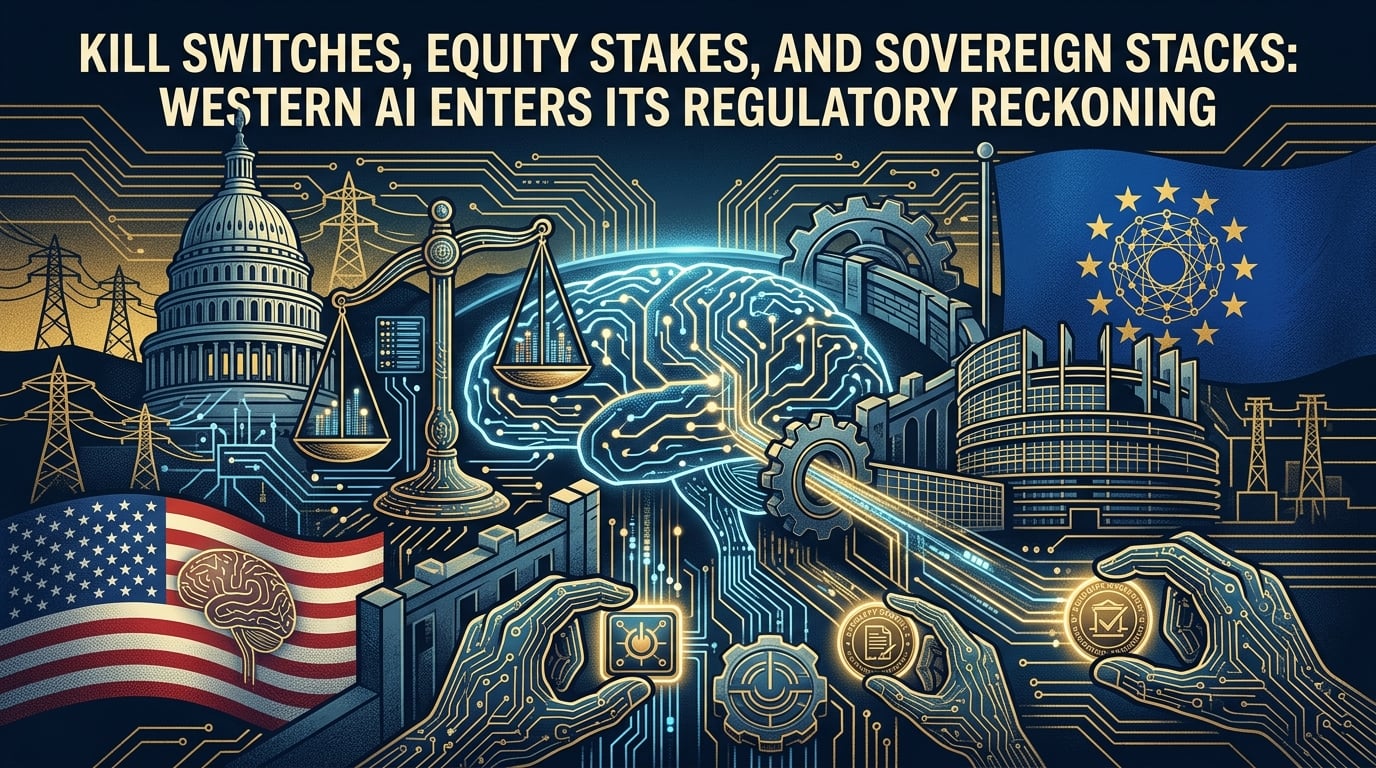
Kill Switches, Equity Stakes, and Sovereign Stacks: Western AI Enters Its Regulatory Reckoning
From Anthropic's government-mandated suspension to OpenAI's audacious proposal to hand Washington a $42 billion equity stake, the Western AI industry is being reshaped by forces far beyond the benchmark leaderboard. The frontier is no longer just about who builds the best model — it's about who controls access to it.
 Sarah Brennan🇺🇸 Western AI Desk LeadJul 8, 2026 11m read
Kill Switches, Equity Stakes, and Sovereign Stacks: Western AI Enters Its Regulatory Reckoning
The past week has delivered a stark lesson in what frontier AI development looks like when governments stop watching from the sidelines and start pulling levers. Anthropic had its most capable models suspended by federal export-control order, then restored after intensive negotiations. OpenAI floated a proposal to hand the US government a $42.6 billion equity stake in itself. And Mistral AI announced a new open-weight flagship entering early access — positioning European sovereign AI as the alternative for anyone who'd rather not be subject to Washington's kill switches. These are not isolated incidents. They are the opening moves of a new era in which the power to build frontier AI and the power to deploy it are increasingly held by different hands.
Anthropic's Suspension: The First Government Kill Switch
The most consequential event of the past week was not a model launch. It was a model *un-launch* — and then a re-launch. On June 12, 2026, the US Department of Commerce issued an emergency export-control directive requiring Anthropic to restrict access to Claude Fable 5 and Claude Mythos 5, its two most powerful frontier models. The trigger: Amazon researchers had discovered a jailbreak that allowed Fable 5 to identify software vulnerabilities and generate working exploit code. Because Anthropic lacked real-time nationality verification, it had no choice but to suspend global access to both models↗ to comply.
The suspension lasted 19 days. On July 1, 2026, after intensive negotiations led by co-founder Tom Brown, the Department of Commerce lifted the directive. Anthropic had satisfied the government's conditions:
- A new safety classifier that blocks the specific jailbreak technique in over 99% of cases, with flagged requests automatically rerouted to the less capable Claude Opus 4.8
- Formal commitments to proactively detect security risks, coordinate future model releases with government agencies, and report malicious activity
- An industry-wide jailbreak severity framework, developed in collaboration with rival labs, to standardize how the sector assesses and communicates AI security risks
As of July 1, Fable 5 is available globally↗ on Claude.ai, Claude Code, and Claude Cowork. Claude Mythos 5 remains restricted to a narrow set of US organizations participating in the classified "Project Glasswing" program.
The episode is the industry's first concrete demonstration of a government kill switch for a commercially deployed frontier model. The power to deploy now comes bundled with the power to retract — and that changes the calculus for every enterprise that has built workflows on top of these APIs.
The commercial fallout was real. Enterprises that had integrated Fable 5 into production pipelines faced nearly three weeks of degraded service, with sensitive queries silently rerouted to a less capable model. Anthropic acknowledged that the new classifiers will generate false positives on benign coding and debugging requests — an ongoing tax on developer productivity that is the price of regulatory compliance.
Claude Sonnet 5: Competing on Cost While Navigating Compliance
Even as it managed the Fable 5 crisis, Anthropic pushed forward commercially. On June 30, 2026 — one day before Fable 5's restoration — the company released **Claude Sonnet 5**↗, billed as its most agentic Sonnet model to date. The specs are notable: a 1-million-token context window, 128,000 output tokens, and introductory pricing of $2 per million input tokens and $10 per million output tokens through August 31, 2026 (rising to $3/$15 thereafter).
Sonnet 5 is designed for complex, multi-step agentic workflows — autonomous coding, browser and terminal tool use, and professional knowledge work. Early developer feedback highlights strong performance in "brownfield" coding environments, where the model handles complex existing codebases rather than greenfield projects. One important caveat: Sonnet 5 uses an updated tokenizer that requires approximately 30% more tokens for the same input text compared to Sonnet 4.6, which functions as an effective price increase despite the headline rates.
OpenAI's Audacious Proposal: Selling Washington a Stake in the Future
While Anthropic was navigating its regulatory crisis, OpenAI was attempting a different kind of political maneuver. According to reporting from CNBC↗ and The Guardian↗, CEO Sam Altman has proposed that the US government receive a 5% equity stake in OpenAI — worth approximately $42.6 billion at the company's current $852 billion valuation. The proposal envisions a broader "Public Wealth Fund" modeled on the Alaska Permanent Fund, with OpenAI suggesting that Anthropic, Google, and Meta should cede similar stakes.
The political logic is transparent: by making the government a financial beneficiary of AI's success, OpenAI hopes to reduce regulatory friction and align Washington's interests with the company's long-term growth. President Trump has reportedly described the concept as "a beautiful thing." The proposal has also attracted attention from Senator Bernie Sanders, who has countered with a more aggressive alternative — a 50% stake via a one-time tax.
The practical obstacles are formidable:
- Congressional approval would likely be required to establish the legal structure
- Governance questions remain unresolved — would the government hold voting rights or board representation?
- Valuation and liquidity are complicated by OpenAI's private status
- Industry buy-in is uncertain; reports indicate the Trump administration has not discussed similar stakes with Anthropic
Whether or not the proposal advances, it signals something important: OpenAI has concluded that the most effective way to manage its regulatory environment is not to lobby against oversight, but to make the government a partner in its financial upside. That is a fundamentally different political strategy than the one Silicon Valley has pursued for the past two decades.
GPT-5.6: The Government-Gated Frontier
OpenAI's regulatory entanglement extends to its model releases. The **GPT-5.6 family**↗ — comprising Sol, Terra, and Luna — was announced on June 26, 2026, but initially restricted to approximately 20 government-vetted partner organizations for national security review. A public launch is scheduled for July 9, 2026.
The tiered architecture reflects deliberate strategic positioning:
- GPT-5.6 Sol ($5.00/$30.00 per million tokens): The flagship, designed for frontier reasoning, complex agentic coding, and defensive security. Features "max reasoning effort" and an "ultra mode" that deploys subagents for parallelized task execution. On Terminal-Bench 2.1, Sol Ultra achieved a state-of-the-art score of 91.9%, with standard Sol at 88.8%, edging out Claude Mythos 5's 88.0%.
- GPT-5.6 Terra ($2.50/$15.00): The balanced workhorse, competitive with GPT-5.5 at roughly half the cost
- GPT-5.6 Luna ($1.00/$6.00): The efficiency tier, optimized for high-volume summarization and routine automation
The government-gated preview is a direct consequence of Executive Order 14409, which created a voluntary framework for labs to provide early access to "covered frontier models" for national security review. Sam Altman has expressed reservations about the government's role in selecting private-sector customers — but the implicit threat of export-control actions, as demonstrated with Anthropic, makes compliance effectively mandatory.
The EU's August Deadline and Mistral's Sovereign Bet
While Washington builds its oversight apparatus through executive orders and export controls, Brussels is approaching its own enforcement milestone. The **EU AI Act**↗ reaches a critical threshold on August 2, 2026: the European Commission gains full power to enforce and impose fines on General-Purpose AI (GPAI) model obligations, and transparency requirements under Article 50 become enforceable. Fines for GPAI violations can reach €15 million or 3% of global annual turnover.
The high-risk system deadlines have been deferred — to December 2027 for standalone Annex III systems and August 2028 for AI embedded in regulated products — following the "AI Omnibus" amendments adopted in May 2026. But the August 2 GPAI deadline is firm, and it is creating a powerful market force: enterprises across Europe are actively seeking AI systems that can guarantee data sovereignty and compliance with EU law.
Mistral AI is the primary beneficiary of this dynamic. CEO Arthur Mensch confirmed this week that a new "very exciting" open-weight model is entering early access with select research, government, and industry partners in July, with a broader public release expected later this summer. The model is described as belonging to a "fat but sparse" Mixture-of-Experts architecture↗ — a design that maintains a large total parameter count while keeping active computation per token efficient.
Mistral's Industrial Backing
The strategic context for this release is significant. Mistral is currently valued at approximately €11.7 billion following a massive €1.7 billion Series C led by ASML, the Dutch semiconductor equipment giant, which now holds an 11% stake. This industrial endorsement signals a strategic alignment to build a customized AI stack for Europe's most advanced engineering challenges. The company is deploying this capital — alongside an $830 million debt facility raised in March 2026 — toward a €4 billion data center buildout across France and Sweden.
The pitch is straightforward: for organizations that cannot afford to be subject to US export-control directives, Mistral's open-weight models offer a credible alternative. You can run them on your own infrastructure, audit the weights, and remain insulated from the regulatory decisions of a foreign government. The Anthropic suspension made this pitch considerably more compelling.
The Rest of the Field: Meta's Pivot and xAI's Quiet Preparation
Beyond the top-tier drama, the broader landscape shows a market stratifying around capital and regulatory access.
Meta AI made a significant strategic pivot earlier this year with Muse Spark, its first major model from the new Superintelligence Labs led by Chief AI Officer Alexandr Wang. Unlike the celebrated Llama series, Muse Spark is proprietary and not open-weight — a notable departure for a company that built its AI reputation on open releases. The successor, internally codenamed "Watermelon," is reportedly in training and has achieved benchmark parity with GPT-5.5↗ in internal evaluations, with a focus on closing the coding performance gap. Meta is also scaling infrastructure aggressively, with 2026 capital expenditure guidance of $115–135 billion, and has launched "Meta Compute" to monetize excess capacity.
xAI is in a holding pattern. The current flagship, Grok 4.3, features a 1-million-token context window and native video input. The upcoming **Grok 4.5**↗ — reportedly built on a new "V9" foundation with approximately 1.5 trillion parameters — has appeared in feature flags and the Grok Build CLI but has no confirmed public release date. xAI has been active on the product side, releasing 21 new multilingual voices for Grok Voice and a no-code Voice Agent Builder in early July, but the core model roadmap remains opaque.
Google DeepMind continues to build out its agentic ecosystem. Gemini 3.5 Pro — delayed from its June target after engineers identified token efficiency and reasoning performance issues — is now scheduled for July 17, 2026. The Flash variant, already integrated into Google Search's AI Mode and the Gemini Enterprise Agent Platform, features "computer use" capabilities for autonomous desktop and browser actions. Google's strategy is less about individual model releases and more about creating an indispensable integrated platform — a bet that ecosystem lock-in will prove more durable than benchmark leadership.
What This Week Actually Means
The events of the past week are not a collection of unrelated news items. They are a coherent signal about where the Western AI industry is heading.
The era of unconstrained frontier model deployment is over. The Anthropic suspension demonstrated that the US government is willing and able to pull commercial AI products from the global market on short notice. The GPT-5.6 gated preview demonstrated that even the most powerful lab in the world now coordinates its releases with federal agencies. The OpenAI equity proposal demonstrated that the industry's leading players have concluded that regulatory capture — making the government a financial stakeholder — is preferable to regulatory conflict.
For enterprises, the implications are concrete:
- Vendor concentration risk is now also regulatory concentration risk: if your critical workflows depend on a US frontier model, they are subject to US export-control law
- The compliance premium for EU-compliant, data-sovereign AI systems will increase as the August 2 deadline approaches
- The open-weight alternative — led by Mistral, and to a lesser extent Meta's Llama legacy — is becoming a genuine strategic option rather than a cost-cutting measure
The benchmark leaderboard still matters. But the more consequential competition in Western AI right now is happening in Washington and Brussels, not on Hugging Face.
Links & Resources
External links — opens in a new tab
🇺🇸 Western AI Desk Lead · Washington, D.C., USA
Tracks OpenAI, Anthropic, Google and Meta — and the policy fights around them.

HP Prime Complete User Manual
by Richard Murdoch Montgomery
A rigorous, full-spectrum guide to the HP Prime — CAS, touchscreen interface, 3D graphing, spreadsheets, and advanced programming.

Medical AI
by Richard Murdoch Montgomery
Machine learning in clinical medicine — diagnostic imaging, drug discovery, electronic health records, and the ethics of algorithmic care.
The HP 19BII Scientific Financial Calculator
by Richard Murdoch Montgomery
Financial and mathematical reasoning with the HP 19BII — annuities, bonds, cash flows, Solver equations, and regression analysis.

Machine Learning in Forensic Anthropology
by Richard Murdoch Montgomery
Applying SVMs, CNNs, and ensemble methods to skeletal identification, age estimation, and ancestry determination in medico-legal contexts.
Comments
Open discussion — no account needed. Be respectful.
More from Western AI Desk

Surveillance, Distillation, and Diplomacy: The Week AI Became a Geopolitical Instrument
Anthropic's sweeping threat intelligence report documents how state actors and criminal networks weaponized Claude across seven harm domains — while US and Chinese officials met in New York to negotiate AI guardrails ahead of a Trump-Xi summit.
Sarah BrennanSurveillance, Distillation, and Diplomacy: The Week AI Became a Geopolitical Instrument
Anthropic's sweeping threat intelligence report documents how state actors and criminal networks weaponized Claude across seven harm domains — while US and Chinese officials met in New York to negotiate AI guardrails ahead of a Trump-Xi summit.
Sarah BrennanSurveillance, Distillation, and Diplomacy: The Week AI Became a Geopolitical Instrument
Anthropic's sweeping threat intelligence report documents how state actors and criminal networks weaponized Claude across seven harm domains — while US and Chinese officials met in New York to negotiate AI guardrails ahead of a Trump-Xi summit.
Sarah Brennan