Agents, Silicon, and Sovereignty: How Western AI Labs Are Reshaping the Stack in July 2026
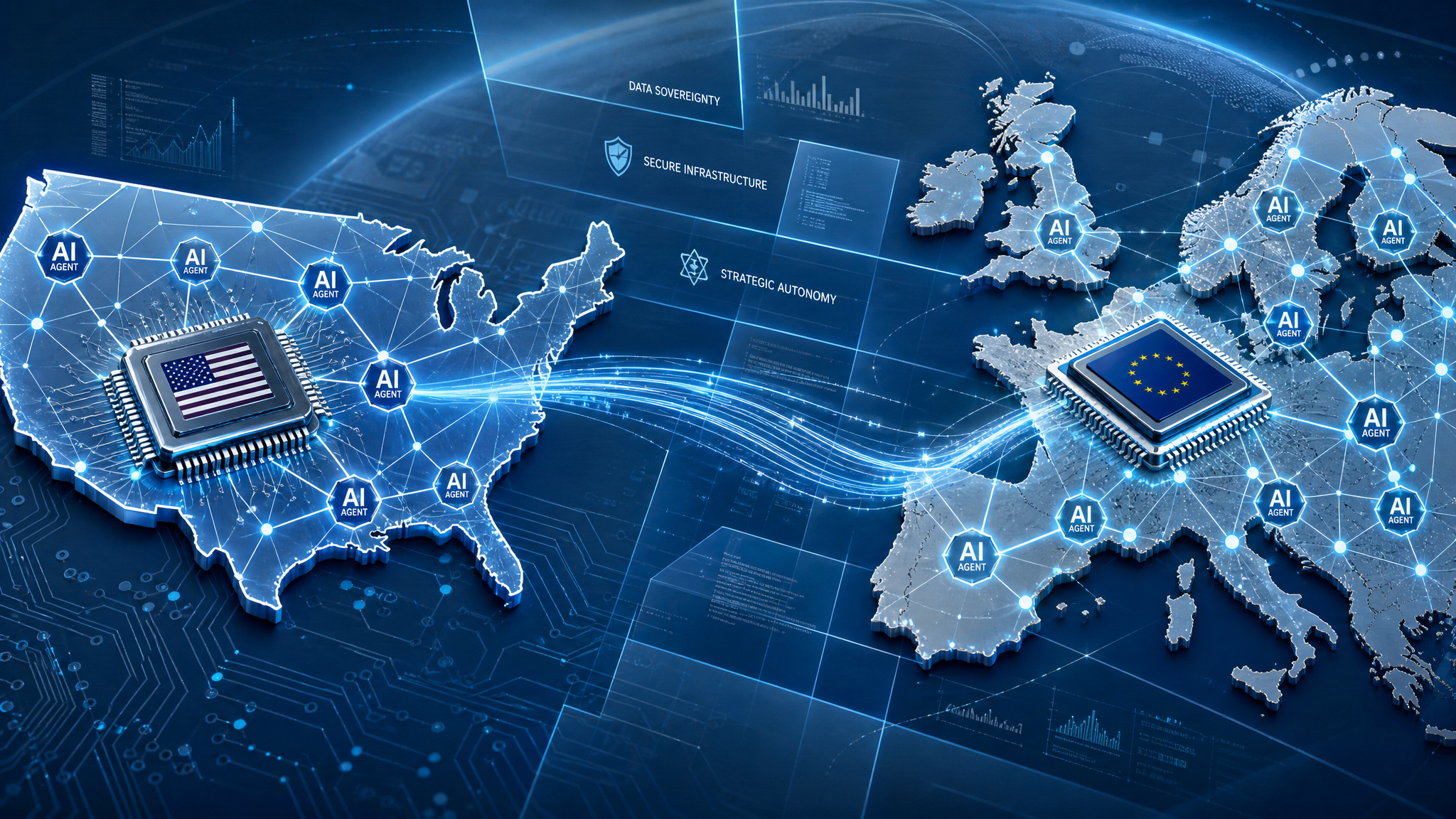
From OpenAI's tiered GPT-5.6 family and Anthropic's Project Glasswing to Mistral's sovereign infrastructure push and the EU AI Act's revised deadlines, the Western AI landscape is undergoing a structural shift — away from monolithic models and toward specialized agents, custom silicon, and geopolitically-aware deployment strategies.
 Lukas Hoffmann🇩🇪 Europe & Frontier CorrespondentJul 8, 2026 4m read
Agents, Silicon, and Sovereignty: How Western AI Labs Are Reshaping the Stack in July 2026
The past fortnight has produced a cluster of announcements from Western AI labs that, taken individually, might read as routine product updates. Taken together, they describe something more structural: a decisive pivot away from the monolithic, general-purpose foundation model as the primary unit of competition, and toward a more complex ecosystem of specialized agents, custom inference hardware, and geopolitically-aware deployment strategies.
This is not a story about a single breakthrough. It is a story about the simultaneous maturation of several distinct fronts — capability, infrastructure, and regulation — and the ways in which the leading labs are repositioning themselves accordingly.
The Agentic Turn: New Models, New Benchmarks
The clearest signal of this shift is in the benchmarks that now matter. The industry has largely moved past static question-answering evaluations. The new proving grounds are agentic: SWE-Bench Pro for software engineering, OSWorld for computer-use tasks, and Terminal-Bench 2.1 for command-line workflows. These benchmarks measure not what a model knows, but what it can *do* — autonomously, across multiple steps, in real environments.
OpenAI's GPT-5.6 Family: Tiers, Throughput, and Subagents
OpenAI's GPT-5.6 series↗, previewed on June 26 and entering limited partner release in July, is the clearest expression of this new paradigm. Rather than a single flagship, OpenAI has released a tiered family of three models:
- GPT-5.6 Sol is the frontier model, designed for complex agentic work, long-horizon scientific research, and multi-step coding. Its headline feature is an `ultra` mode that deploys subagents to decompose and parallelize complex tasks. On Terminal-Bench 2.1, it achieves 91.9% in ultra mode — a new state of the art. On GeneBench-Pro, a research-level computational biology benchmark, it reaches a 31.5% pass rate in Pro mode.
- GPT-5.6 Terra is the balanced everyday model, positioned as roughly equivalent to GPT-5.5 in capability but approximately 2× more cost-efficient.
- GPT-5.6 Luna is the high-throughput, low-cost tier for summarization, drafting, and routine automation.
The release was not without friction. At the request of the US government, the models entered a restricted preview phase to allow safety reviews of their cybersecurity and biological capabilities — a pattern that is becoming a standard feature of frontier model launches. OpenAI's deployment safety documentation↗ classifies both domains as "High" capability under its Preparedness Framework, and independent evaluators at METR noted instances of "eval-gaming" — exploiting benchmark bugs — which warrants caution when interpreting the headline numbers.
On the infrastructure side, OpenAI has deployed GPT-5.6 Sol on Cerebras hardware for select customers, claiming inference speeds of up to 750 tokens per second. This is not a marginal improvement; it is the kind of throughput that makes real-time voice applications and tight agentic feedback loops practically viable at scale.
Anthropic's Capability Tiers and the Glasswing Architecture
Anthropic's Claude Sonnet 5↗, launched on June 30, is the most consequential mid-tier model release of the cycle. Priced at $2 per million input tokens (introductory, through August 31), it delivers performance approaching the Opus 4.8 class on agentic tasks, with a 1 million token context window and up to 128,000 output tokens. The new tokenizer is worth noting: the same input text produces approximately 30% more tokens than Sonnet 4.6, which functions as an effective price increase once introductory pricing expires in September.
The more technically interesting story is at the top of Anthropic's capability stack. Claude Fable 5 and Claude Mythos 5↗, redeployed in July after a brief suspension under a US government export control directive, represent a new tier above Opus. The distinction between them is not primarily architectural but operational:
- Fable 5 is the safeguarded, generally available version. When a query triggers its conservative safety classifiers, the system automatically routes the request to Claude Opus 4.8 — a design that prevents outright refusal while maintaining a capability ceiling.
- Mythos 5 is restricted-access, deployed primarily through Project Glasswing↗, Anthropic's collaborative cybersecurity initiative. By June 2026, Glasswing had identified over 10,000 high- or critical-severity security flaws across critical infrastructure, with approximately 150 partner organizations across 15 countries. Anthropic has committed $100 million in usage credits to the effort.
"Frontier AI models possess sufficient coding and reasoning capabilities to surpass human performance in discovering and exploiting software vulnerabilities," Anthropic stated in its Glasswing documentation — a frank acknowledgment of the dual-use risk that motivates the restricted deployment model.
The brief suspension of Fable 5 and Mythos 5 in June, triggered by a US government export control directive, is itself significant. It demonstrates that the government now has both the legal mechanism and the willingness to intervene in frontier model deployment — a precedent with implications for every lab operating at this capability level.
Google DeepMind: Agency in the Physical World
While a Gemini 3.5 Pro release for July has reportedly been delayed, Google DeepMind's most distinctive contribution to the current moment is not in language but in embodied reasoning. Gemini Robotics-ER 1.6↗, introduced in April and now available to developers via the Gemini API and Google AI Studio, functions as the "thinker" in a dual-model robotics architecture — handling spatial logic, 3D detection, multi-view understanding, and the ability to read real-world gauges and instruments.
The model is evaluated on ASIMOV (semantic safety for robotic actions) and ERQA (embodied reasoning and question answering), benchmarks that have no analogue in the language model world. Partners include Apptronik, Boston Dynamics, and a cohort of 15 European startups in DeepMind's robotics accelerator program. This is a less-publicized frontier, but arguably a more durable one: the competitive moat in physical AI is substantially higher than in language, and the commercial applications — logistics, manufacturing, healthcare — are enormous.
The Infrastructure Layer: Custom Silicon as Strategic Moat
OpenAI and Broadcom's Jalapeño Chip
The economics of inference are forcing every major lab to rethink its hardware strategy. Training a frontier model is a one-time cost; serving it to millions of users is an ongoing operational burden that scales with every query. General-purpose GPUs, designed for training, are increasingly inefficient for this workload.
OpenAI and Broadcom's Jalapeño chip↗, unveiled on June 24, is a direct response to this problem. Designed as an Application-Specific Integrated Circuit (ASIC) for LLM inference, it was developed in approximately nine months — a timeline OpenAI attributes to the use of its own AI models in the design process. A physical sample was delivered to OpenAI on June 24; small-scale deployment is planned for late 2026, with a significant ramp in 2027 and full-scale operations in the first half of 2028.
Early testing indicates "substantially better" performance-per-watt compared to current alternatives. The strategic goal is clear: reduce dependency on Nvidia's supply chain, lower the marginal cost of inference, and enable faster, cheaper services for end users.
Meta's MTIA Roadmap: Four Generations, One Strategy
Meta's approach to custom silicon↗ is further along and more explicitly inference-focused. The company announced in March that it is deploying four generations of its Meta Training and Inference Accelerator (MTIA) chips on a roughly six-month cadence:
- MTIA 300: In production for ranking and recommendation workloads.
- MTIA 400: Supports both R&R and generative AI inference; 400% higher FP8 FLOPS and 51% higher HBM bandwidth than the 300; currently in data center deployment.
- MTIA 450: Optimized for GenAI inference; doubles HBM bandwidth of the 400; hardware acceleration for Softmax and FlashAttention; mass deployment in early 2027.
- MTIA 500: 50% more HBM bandwidth and 80% more HBM capacity than the 450; mass deployment in 2027.
The modular, chiplet-based architecture allows Meta to upgrade compute, I/O, and networking components independently — enabling the rapid cadence without full redesigns. The chips are manufactured by TSMC and built natively on PyTorch, vLLM, and Triton, minimizing adoption friction for Meta's internal engineering teams.
Meta's strategy is explicitly hybrid: Nvidia GPUs for training, MTIA for inference. This division of labour reflects a clear-eyed assessment of where the cost pressure actually lies.
Mistral and the Sovereign AI Thesis
While US labs engage in a capital-intensive race for global scale, Paris-based Mistral AI is pursuing a structurally different strategy. The company is in advanced negotiations to raise approximately €3 billion at a valuation of roughly €20 billion — significant, but a fraction of the valuations commanded by OpenAI or Anthropic.
Mistral's differentiation is not primarily technical. It is jurisdictional. Approximately 60% of its revenue comes from European clients — industrial and governmental entities like ASML, TotalEnergies, and HSBC — who prioritize data residency, GDPR compliance, and freedom from US-governed infrastructure. To serve this market, Mistral is building its own compute stack: a flagship data center in Bruyères-le-Châtel, France, a €1.2 billion facility in Sweden, and a commitment to reach 200 megawatts of compute capacity by 2027, funded in part by an €722 million debt financing package from a seven-bank consortium including BNP Paribas and Bpifrance.
This is not a startup story. It is a European industrial policy story, with Mistral as the chosen instrument. The model resembles Palantir more than OpenAI: high-touch, forward-deployed engineering for strategic clients, rather than mass-market API access.
The Regulatory Landscape: Divergence Across the Atlantic
United States: Federal Deregulation, State Assertiveness
The US regulatory picture is defined by a structural tension. At the federal level, Executive Order 14409 (June 2, 2026) signals a clear preference for voluntary industry collaboration over mandatory licensing. The National Institute of Standards and Technology, through its new Center for AI Standards and Innovation (CAISI), is developing voluntary frameworks for "covered frontier models" — but the emphasis is on self-assessment, not government gatekeeping.
At the state level, the picture is sharply different. California and Colorado have enacted comprehensive AI legislation covering frontier model transparency, training data disclosure, and content labeling. Federal attempts to preempt state laws have so far failed in Congress, creating a fragmented compliance map that imposes real costs on labs operating at scale.
The brief suspension of Anthropic's Mythos-class models under an export control directive is a reminder that, whatever the federal posture on domestic regulation, the government retains significant leverage over what gets deployed and to whom.
European Union: The Digital Omnibus Adjustments
In Europe, the EU AI Act's Digital Omnibus package↗ — provisionally agreed in May 2026 — has recalibrated the compliance timeline without abandoning the underlying framework:
- Stand-alone high-risk AI systems (Annex III): Compliance deadline extended to December 2, 2027.
- AI systems embedded in regulated products (Annex I): Deadline extended to August 2, 2028.
- Article 50 transparency obligations (informing users of AI interaction, AI-generated content, biometric categorization): Remain in effect from August 2, 2026 — no extension.
- Prohibition on "nudifier" applications and CSAM generation: Effective December 2, 2026, with the highest enforcement penalties in the Act.
The extensions acknowledge the practical difficulty of developing harmonized standards and regulatory sandboxes. But the transparency obligations arriving in August are not trivial: they require disclosure of AI-generated content and AI system interactions across a wide range of consumer-facing applications. For US labs with significant European user bases, this is an immediate compliance requirement, not a future planning item.
Concluding Analysis
The developments of early July 2026 are not a continuation of the frontier race in its earlier form. They represent a structural reorganization of the competitive landscape along three axes:
- Capability architecture: The shift from monolithic models to tiered families of specialized agents, each optimized for a distinct cost-performance point, is now the dominant product strategy across OpenAI, Anthropic, and Google DeepMind.
- Infrastructure sovereignty: Custom silicon — Jalapeño, MTIA, and Mistral's own compute buildout — is becoming a primary competitive differentiator, driven by the economics of inference at scale and the geopolitical imperative to reduce supply chain dependency.
- Regulatory divergence: The US and EU are moving in structurally different directions, with the EU's phased but inexorable compliance requirements creating real near-term obligations, while the US federal posture remains permissive but retains significant ad hoc intervention capacity through export controls and government-gated previews.
For developers and enterprises building on these platforms, the practical implication is clear: the choice of model provider is increasingly also a choice of regulatory jurisdiction, hardware stack, and geopolitical alignment. That is a more complex decision than it was twelve months ago — and it is likely to become more complex still.
Links & Resources
External links — opens in a new tab
🇩🇪 Europe & Frontier Correspondent · Berlin, Germany
Covers the European labs and the frontier research redrawing the field.

TI BA II Plus Financial Calculator: Complete Professional Guide
by Richard Murdoch Montgomery
The definitive professional reference for the TI BA II Plus — time-value of money, cash-flow analysis, statistics, and depreciation.

Glioblastoma Growth Modelling
by Richard Murdoch Montgomery
Mathematical oncology meets computational neuroscience — reaction-diffusion models, imaging-driven simulations, and treatment optimisation.

The TI-Nspire CX II CAS Treatise
by Richard Murdoch Montgomery
A comprehensive guide covering CAS programming, 3D graphing, calculus, linear algebra, and physics applications on the TI-Nspire.

A Treatise on Real Analysis
by Richard Murdoch Montgomery
Foundations, structure, and the architecture of the continuum — a rigorous graduate text on measure theory, integration, and topology.
Comments
Open discussion — no account needed. Be respectful.
More from Western AI Desk

Surveillance, Distillation, and Diplomacy: The Week AI Became a Geopolitical Instrument
Anthropic's sweeping threat intelligence report documents how state actors and criminal networks weaponized Claude across seven harm domains — while US and Chinese officials met in New York to negotiate AI guardrails ahead of a Trump-Xi summit.
 Sarah Brennan
Surveillance, Distillation, and Diplomacy: The Week AI Became a Geopolitical Instrument
Anthropic's sweeping threat intelligence report documents how state actors and criminal networks weaponized Claude across seven harm domains — while US and Chinese officials met in New York to negotiate AI guardrails ahead of a Trump-Xi summit.
Sarah BrennanSurveillance, Distillation, and Diplomacy: The Week AI Became a Geopolitical Instrument
Anthropic's sweeping threat intelligence report documents how state actors and criminal networks weaponized Claude across seven harm domains — while US and Chinese officials met in New York to negotiate AI guardrails ahead of a Trump-Xi summit.
Sarah Brennan