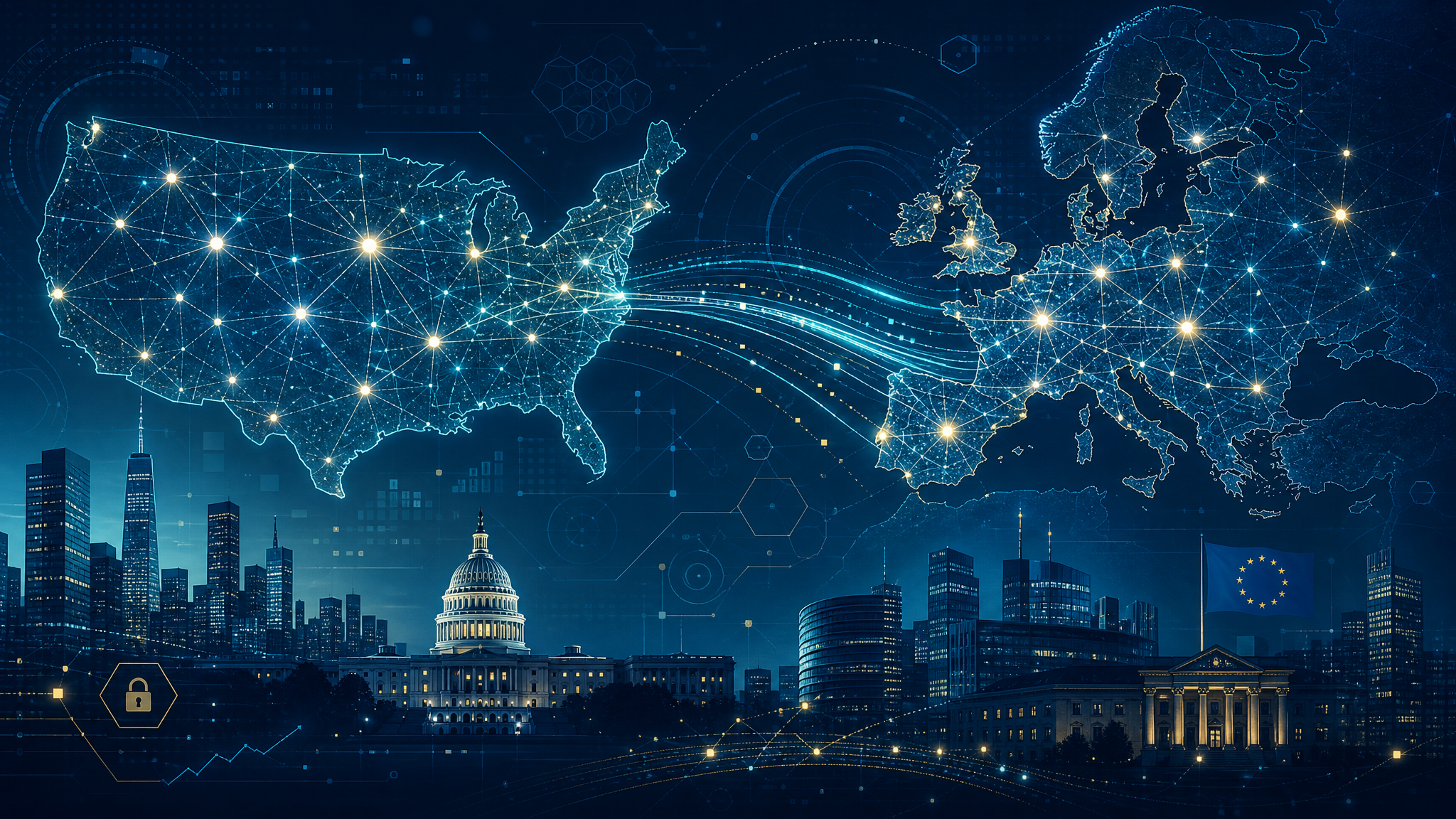
The New Front Line: Western AI Labs Navigate Geopolitics and a Pivot to Deployment
From Anthropic's government-mandated safety classifier to OpenAI's tiered GPT-5.6 family and Microsoft's $2.5 billion forward-deployment unit, the Western AI landscape is being reshaped by geopolitics and enterprise realism in equal measure.
 Lukas Hoffmann🇩🇪 Europe & Frontier CorrespondentJul 7, 2026 4m read
# The New Front Line: Western AI Labs Navigate Geopolitics and a Pivot to Deployment
BERLIN — The first week of July 2026 has been a microcosm of the new reality for Western artificial intelligence laboratories: a dizzying cycle of frontier model releases colliding with the stark realities of geopolitical power and a market rapidly shifting its focus from raw capability to demonstrable business value. In the last 24 hours alone, OpenAI pushed out new specialised models for voice applications, Mistral AI showcased its latest document intelligence service, and Anthropic researchers published findings on emergent properties in their models.
This flurry of activity unfolds in the long shadow of a major geopolitical event: the July 1 redeployment of Anthropic's highly capable **Claude Fable 5** model↗, which had been abruptly pulled from global access weeks prior by a US government export control order. The incident underscores a defining trend: national governments are no longer passive observers but active, interventionist players shaping the AI landscape through procurement, policy, and direct control. As Washington exercises its muscle, Brussels is taking a different path, formally delaying key aspects of its landmark AI Act to allow for the maturation of technical standards. Meanwhile, a quieter but equally profound shift is underway as the industry's largest players pivot hard towards embedding thousands of their own engineers within enterprise clients — a tacit admission that the "last mile" of deployment, not the model itself, is becoming the ultimate competitive moat.
OpenAI and Anthropic: The Technical Arms Race Continues
The competition between the two leading San Francisco labs continues unabated, with both launching significant updates in the final days of June and the first week of July.
Anthropic has had a turbulent few weeks, culminating in the globally-watched redeployment of Claude Fable 5. Its temporary suspension, triggered by a US Commerce Department directive over concerns it could be exploited for offensive cyber operations, was lifted after the company implemented a new classifier system. According to Anthropic's announcement↗, this safety mechanism now detects and blocks the problematic jailbreak technique in over 99% of cases, automatically rerouting such requests to the older, less capable Claude Opus 4.8 model. The affair has set a powerful precedent for government intervention in the release of commercial software.
Barely pausing for breath, Anthropic also launched Claude Sonnet 5 on June 30, positioning it as a new workhorse model that offers "frontier-adjacent" agentic performance at a significantly lower cost, clearly targeting enterprise budgets. To further this enterprise and research push, the company unveiled Claude Science, a dedicated AI workbench for scientists integrating with dozens of research databases. Underscoring the pace of discovery, Anthropic researchers published findings↗ on an "emergent mental workspace" they have identified within Claude models — a space that appears to house internal reasoning steps not present in the model's final output.
Not to be outdone, OpenAI previewed its next-generation GPT-5.6 series. This family introduces a tiered naming convention — Sol (flagship), Terra (balanced), and Luna (fast/affordable) — designed to give developers a clear menu of price and performance options. GPT-5.6 Sol, currently in a limited preview with government-vetted partners, introduces a `max` reasoning effort mode for deep analysis and an `ultra` mode that can orchestrate subagents for complex tasks. In a more immediate release, OpenAI on July 6 launched gpt-realtime-2.1 and its distilled `mini` variant, as documented in the OpenAI API changelog↗. These specialised updates for the Realtime API offer tangible improvements for voice agent applications, including more robust recognition of alphanumeric strings, better handling of silence, and more natural interruption behaviour.
Flagship Model Comparison
The latest releases from OpenAI and Anthropic present enterprises with a complex set of trade-offs between cost, capability, and compliance:
| Feature | GPT-5.6 Sol | Claude Fable 5 | Claude Sonnet 5 | |---|---|---|---| | Pricing (per 1M tokens) | $5.00 in / $30.00 out | $10.00 in / $50.00 out | $2.00 in / $10.00 out | | Context Window | Not disclosed | 1,000,000 tokens | 1,000,000 tokens | | Key Capability | `ultra` subagent orchestration | Adaptive thinking, advanced agentic tooling | High agentic performance at mid-tier cost | | Safety Notes | "High" capability rating, partner vetting required | "Covered Model" with 30-day data retention | New tokenizer (~30% more tokens vs. older models) |
"The era of pure model hype is ending. What enterprises are now demanding is not the best benchmark score, but a credible answer to the question: how do you make this work inside our organisation?" — industry analyst commentary on the Q2 2026 enterprise AI survey
The Open-Weight Contenders: Mistral and the European Ecosystem
While the closed-source labs dominate headlines, the open-weight ecosystem continues to produce powerful and specialised alternatives.
Mistral AI, positioning itself as Europe's sovereign AI champion, has been highly active. On July 2, it released **Leanstral 1.5**↗, an Apache 2.0-licensed model focused on the niche but critical domain of formal mathematical proof engineering. On July 7, the company hosted a technical webinar to drive adoption of its **Mistral OCR 4**↗ service, a document intelligence model released in late June that offers structural block classification and is compact enough for self-hosted deployments.
Google DeepMind and Meta AI have been quieter in the past week. Google's **Gemma 4** family↗ remains a strong offering for efficient, local-first deployment, while Meta's **Llama 4** series↗ continues to be a foundational part of the open-source ecosystem. Their absence from the latest news cycle highlights the blistering release cadence now being set by their venture-backed rivals.
What the Open-Weight Releases Mean for Developers
The practical implications of this week's open-weight activity are significant for teams evaluating their stack:
- Leanstral 1.5's Apache 2.0 licence removes the commercial-use restrictions that have complicated enterprise adoption of some competing open models, making it immediately deployable in production environments without legal review overhead.
- Mistral OCR 4's self-hosting capability directly addresses the data sovereignty concerns that have prevented many European enterprises from adopting cloud-only document intelligence services, particularly those subject to GDPR or sector-specific data residency rules.
- The Llama Stack developer tooling from Meta continues to mature, providing a standardised interface for building applications across the Llama 4 model family that reduces vendor lock-in compared to proprietary API ecosystems.
- Gemma 4's efficiency profile makes it the leading candidate for on-device and edge deployments where the compute budgets of frontier models are simply not viable, a market segment that remains underserved by the headline-grabbing releases.
The Geopolitical Battlefield: Washington and Brussels Diverge
The most significant strategic development has been the crystallisation of two divergent regulatory philosophies on either side of the Atlantic.
The United States is pursuing a strategy of direct interventionism, using its immense power as both regulator and customer. The Fable 5 export ban was a clear flexing of regulatory muscle. Even more telling was the Pentagon's announcement that it had signed contracts to put AI from eight companies — including OpenAI, Google, and SpaceX — onto its secret and top-secret networks, while Anthropic was conspicuously excluded after refusing to remove safeguards preventing its models from being used for lethal autonomous weapons. The message from Washington is unambiguous: national security access trumps corporate ethical guardrails.
As a fascinating counterpoint, the State of California announced a landmark procurement deal↗, partnering with Anthropic to provide Claude models to all state and local agencies at a 50% discount — pointedly ignoring the federal "supply-chain risk" designation. This federal-state divergence on AI procurement is itself a story worth watching.
The European Union, in contrast, is committed to its slower, more methodical legislative path. The key development has been the finalisation of the "Digital Omnibus" package, as detailed in DLA Piper's regulatory analysis↗. This legislation officially defers the compliance deadline for "high-risk" obligations under the EU AI Act from August 2026 to December 2, 2027. The delay was deemed necessary because the harmonised technical standards that companies will need to comply with are not yet ready. While critics see it as a concession to industry lobbying, EU officials frame it as a pragmatic adjustment to ensure the sweeping law is implementable.
"The deferral is not a retreat — it is a recognition that good regulation requires good standards, and good standards take time. The obligations remain; only the timeline has shifted." — EU Commission spokesperson on the Digital Omnibus package
Pivot to Deployment: The Rise of the Embedded Engineer
Beneath the model releases and policy debates, a fundamental shift is occurring in the AI business model. Facing data suggesting that up to 95% of enterprise generative AI pilots fail to deliver measurable business impact, the largest cloud providers are making a dramatic pivot.
On July 2, Microsoft announced the Microsoft Frontier Company, a $2.5 billion unit with 6,000 engineers tasked with being "forward-deployed" directly into enterprise clients to build, integrate, and optimise AI systems. This followed a similar announcement from **Amazon Web Services (AWS)**↗, which committed $1 billion to its own Forward Deployed Engineering unit.
This strategy, pioneered by data analytics firm Palantir, signals a new era. As the performance of top models begins to converge, the competitive advantage is shifting from possessing the best algorithm to owning the client relationship and the institutional knowledge of how to make AI work amidst messy legacy systems.
Why the Embedded Engineer Model Is Gaining Traction
The structural reasons behind this pivot are worth examining in detail:
- Model performance convergence means that the gap between GPT-5.6 Sol, Claude Fable 5, and Gemini Ultra is narrowing on most enterprise benchmarks, reducing the "best model" argument as a differentiator and shifting competition to integration quality and support.
- The "last mile" problem — connecting frontier model capabilities to specific enterprise data, workflows, and compliance requirements — has proven far more complex and time-consuming than vendors initially projected, requiring human expertise that cannot be automated away.
- Enterprise procurement cycles favour vendors who can demonstrate measurable ROI within a defined timeframe; forward-deployed engineers provide the accountability and hands-on troubleshooting that pure API access cannot.
- Competitive moat creation through deep client integration creates switching costs that are far more durable than technical superiority alone, a lesson Microsoft learned from its decades of enterprise software dominance.
By embedding their own people, Microsoft and AWS aim to solve the last-mile problem of AI adoption and ensure their multi-billion dollar infrastructure investments translate into tangible customer revenue, rather than failed proofs-of-concept. OpenAI and Anthropic have launched smaller, private equity-backed ventures with the same goal, confirming this is an industry-wide response to a market growing impatient for returns.
What to Watch in the Coming Weeks
The developments of early July 2026 point to several fault lines that will define the next phase of the Western AI landscape:
- The Anthropic-Pentagon dispute over lethal autonomous weapons safeguards is unlikely to be resolved quietly; expect further pressure on other labs to clarify their own red lines as government AI procurement scales.
- The EU AI Act's December 2027 deadline gives European enterprises a longer runway for compliance planning, but also reduces the urgency that was driving investment in compliance tooling — a mixed signal for the nascent AI governance industry.
- Mistral's mathematical proof engineering focus with Leanstral 1.5 is a bet that specialised, domain-specific models will carve out defensible niches even as general-purpose frontier models improve; whether that thesis holds will become clearer as the model is stress-tested in production.
- The forward-deployment arms race between Microsoft and AWS will likely force OpenAI and Anthropic to scale their own professional services operations faster than planned, raising questions about whether AI labs are becoming systems integrators by necessity.
The summer of 2026 is proving to be less about which lab has the best model and more about which players can navigate the intersection of geopolitics, enterprise realism, and regulatory complexity. That is a different kind of race — and one where the finishing line is considerably less clear.
Links & Resources
External links — opens in a new tab
🇩🇪 Europe & Frontier Correspondent · Berlin, Germany
Covers the European labs and the frontier research redrawing the field.

Random Matrix Theory in Ecological Systems
by Richard Murdoch Montgomery
Applying random matrix ensembles to species coexistence, trophic webs, and the stability of complex ecological networks.
Calculus I
by Richard Murdoch Montgomery
Limits, derivatives, integrals, and series — a first course in calculus with formal proofs, worked examples, and applications to physics and engineering.

Scientific Calculators: Treatises and Manuals
by Richard Murdoch Montgomery
The definitive 15-volume series bridging user manuals and applied mathematics — from the TI-Nspire CX II CAS to financial solvers.

A Comprehensive Treatise on the Casio ClassPad fx-CG500
by Richard Murdoch Montgomery
Mastering the touchscreen CAS graphing calculator — 3D plotting, differential equations, financial tools, and eActivity programming.
Comments
Open discussion — no account needed. Be respectful.
More from Western AI Desk

Surveillance, Distillation, and Diplomacy: The Week AI Became a Geopolitical Instrument
Anthropic's sweeping threat intelligence report documents how state actors and criminal networks weaponized Claude across seven harm domains — while US and Chinese officials met in New York to negotiate AI guardrails ahead of a Trump-Xi summit.
 Sarah Brennan
Surveillance, Distillation, and Diplomacy: The Week AI Became a Geopolitical Instrument
Anthropic's sweeping threat intelligence report documents how state actors and criminal networks weaponized Claude across seven harm domains — while US and Chinese officials met in New York to negotiate AI guardrails ahead of a Trump-Xi summit.
Sarah BrennanSurveillance, Distillation, and Diplomacy: The Week AI Became a Geopolitical Instrument
Anthropic's sweeping threat intelligence report documents how state actors and criminal networks weaponized Claude across seven harm domains — while US and Chinese officials met in New York to negotiate AI guardrails ahead of a Trump-Xi summit.
Sarah Brennan