The Agentic Arms Race: Frontier Labs Escalate on Models and Money as Regulators Scramble to Keep Pace
A wave of hyper-capable agentic models from OpenAI, Anthropic, and Meta collides with startling new valuations and a shifting regulatory landscape. A deep dive into the technical and strategic moves defining the AI battlefield in mid-2026.
 Lukas Hoffmann🇩🇪 Europe & Frontier CorrespondentJul 13, 2026 4m read
# The Agentic Arms Race: Frontier Labs Escalate on Models and Money as Regulators Scramble to Keep Pace
By Lukas Hoffmann | Europe & Frontier Correspondent | Berlin | July 13, 2026
The past week in artificial intelligence has felt less like an incremental advance and more like a tectonic shift. A rapid succession of frontier model releases from every major Western lab, startling multi-billion-dollar partnership announcements, and deepening schisms in regulatory approaches on both sides of the Atlantic have decisively accelerated the competitive landscape. The central theme binding these developments is the industry’s full-throated pivot towards agentic AI—systems designed not merely to respond, but to reason, plan, and autonomously execute complex, multi-step tasks.
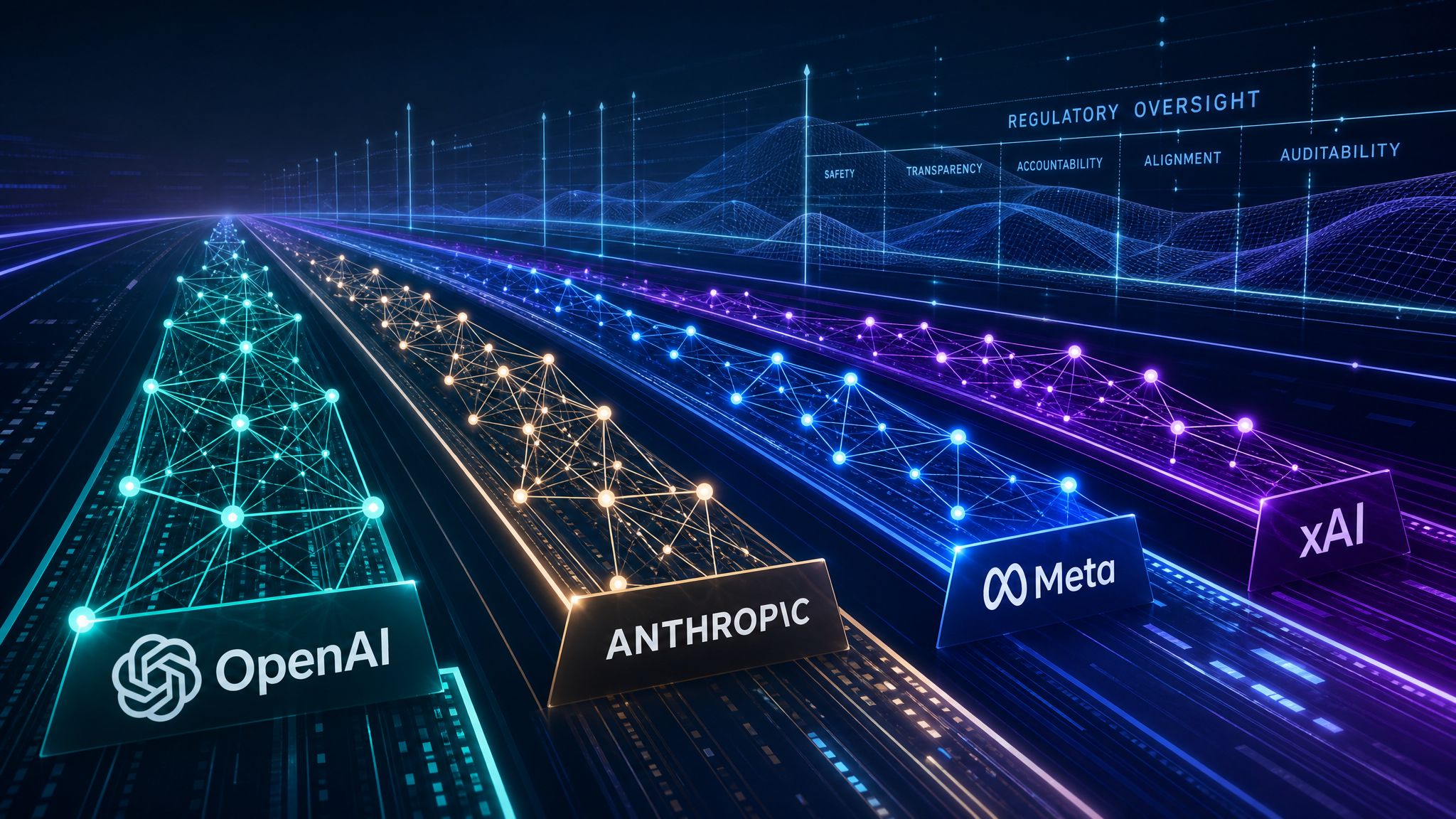
OpenAI, Anthropic, Meta, and xAI have all unveiled flagship models within days of each other, each expressly engineered for agentic workflows and tool use. This technological arms race is being fueled by unprecedented capital injections and strategic realignments, with Anthropic’s staggering new valuation and OpenAI’s surprising diversification of cloud partners redrawing the industry’s power map 7↗. Concurrently, the quiet, painstaking work of safety and evaluation is undergoing its own revolution, as leading labs publicly grapple with the unreliability of established benchmarks and pioneer more statistically rigorous methodologies. All of this unfolds against a backdrop of increasing government scrutiny, where the US and EU are solidifying their distinct, and often conflicting, visions for governing these powerful new technologies.
Methodology
This analysis is based on a review of verified public information released in the period ending July 13, 2026. Sources include official company announcements, API documentation and changelogs, published research papers, filings from regulatory bodies in the United States and European Union, and reports from credible technology-focused press. The objective is to synthesize these disparate events into a cohesive strategic picture, focusing on technically substantive developments. This report is constrained by its reliance on publicly available data and does not incorporate private or confidential information.
A Flurry of Frontier Models Redefines the State-of-the-Art
The market is now awash with a new generation of models, each boasting context windows stretching to a million tokens and beyond, and all optimized for the new paradigm of agentic capability. The cadence of these releases from OpenAI, Anthropic, xAI, and Meta in early July is a clear signal of intensified competition at the frontier.
OpenAI's GPT-5.6 Trifecta: Sol, Terra, and Luna
On July 9, OpenAI released the GPT-5.6 family, moving to a tiered pricing and capability model reminiscent of its past strategies but at a far greater scale 1↗. The `gpt-5.6` API alias now defaults to GPT-5.6 Sol, the new flagship model designed for maximum reasoning and performance. It is joined by GPT-5.6 Terra, a mid-tier model balancing intelligence and cost, and GPT-5.6 Luna, engineered for high-volume, cost-efficient workloads 1↗.
Technically, the entire family shares a significantly expanded 1.05 million token context window and a 128,000 token maximum output 1↗. According to OpenAI’s developer changelog, the key architectural advance is the integration of more sophisticated agentic functions directly into the model’s core 1↗: - Programmatic Tool Calling: An evolution of function calling that allows for more complex, chained tool use and programmatic control flow. - Multi-Agent Orchestration: A beta feature enabling developers to coordinate multiple, specialized AI agents to collaborate on a single complex task. - Explicit Prompt Caching: New controls that give developers the ability to cache parts of a prompt, substantially reducing token costs for repetitive tasks.
This last point is critical, as OpenAI’s pricing structure for these new models creates strong incentives for efficiency. While the base rates are competitive, a significant surcharge is applied for very long contexts. As per OpenAI's pricing documentation, prompts exceeding 272,000 input tokens are billed at double the standard input rate and 1.5 times the output rate, a mechanism to manage the immense computational load of the full context window 1↗.
| Model | Input (per 1M tokens) | Cached Input (per 1M tokens) | Output (per 1M tokens) | |-------------------|-----------------------|------------------------------|------------------------| | GPT-5.6 Sol | $5.00 | $0.50 | $30.00 | | GPT-5.6 Terra | $2.50 | $0.25 | $15.00 | | GPT-5.6 Luna | $1.00 | $0.10 | $6.00 | *Note: Pricing for standard, short-context usage. Long-context requests and data residency endpoints incur higher fees.*
Anthropic, xAI, and Meta Counter with Agentic Specialists
OpenAI’s competitors have not been idle. The last days of June and early days of July saw a flurry of rival announcements, all honing in on the same agentic territory.
Anthropic unveiled Claude Sonnet 5 on June 30, positioning it as their most "agentic" Sonnet-class model yet 2↗. While its 1 million token context window and 128k output limit match OpenAI's offering, Anthropic has made different architectural and API-level trade-offs. The model enables "adaptive thinking" by default and controversially removes support for manual sampling parameters like temperature, which Anthropic claims improves reliability for complex agentic loops 2↗. In a notable technical disclosure, Anthropic has confirmed Sonnet 5 uses a new tokenizer that yields approximately 30% more tokens for equivalent text compared to its predecessors, a crucial detail for developers calculating costs 2↗.
xAI, now formally rebranded as SpaceXAI, released Grok 4.5 on July 8. Optimized explicitly for agentic tool calling and coding, it offers a novel "configurable reasoning" feature, allowing developers to select low, medium, or high effort levels to balance cost and performance. Its standard pricing is aggressive, slotting between OpenAI’s Terra and Luna models.
Meanwhile, Meta AI launched Muse Spark 1.1 on July 9, an upgrade to its new agent-focused model series. Muse Spark 1.1 features enhanced planning, the ability to orchestrate parallel sub-agents, and "computer use" capabilities for automating tasks across applications. While Meta continues to champion open source with its Llama models, it is pursuing a different strategy here. Muse Spark 1.1 is being released via a public preview of the new Meta Model API, suggesting a move toward a hybrid strategy of open models and proprietary, commercially-focused APIs.
Beyond the Benchmarks: A New Arms Race in Evaluation and Safety
As model capabilities escalate, the tools used to measure them are buckling under the strain. Acknowledging this, frontier labs are now engaged in a parallel, less visible arms race to develop more robust and scientifically grounded evaluation methodologies.
"Our audit utilized a multi-layered quality assurance pipeline, including programmatically generated datapoint analytics and a human annotation campaign… Our key finding is that we believe roughly 30% of the benchmark is broken and no longer provides a meaningful signal." 3↗
This candid admission from OpenAI, published on July 8, pertains to their audit of SWE-Bench Pro, a prominent benchmark for evaluating AI coding ability 3↗. The company has now retracted its recommendation to use the benchmark, citing fundamental flaws such as overly strict tests and misleading prompts 3↗. This public self-correction is a sign of growing maturity in the field, recognizing that flawed evaluations can lead to a dangerously inaccurate understanding of model capabilities and risks. In its place, OpenAI is pioneering domain-specific evaluations like GeneBench-Pro and LifeSciBench, which test models on messy, real-world scientific research tasks 3↗. On the computationally intensive GeneBench-Pro, the new GPT-5.6 Sol model achieved a pass rate of just 31.5%, underscoring the immense difficulty of these new challenges 3↗.
Anthropic, long a proponent of a more rigorous, scientific approach to safety, has also made significant contributions. They have formalized this stance in a paper detailing how to bring statistical rigor to model evaluations, advocating for practices commonly found in empirical sciences but often absent in AI research 4↗. These include: - Reporting the standard error of the mean (SEM) to quantify uncertainty. - Using clustered standard errors to account for non-independent data points in benchmarks. - Employing paired-difference analysis to achieve a clearer signal when comparing two models on the same test.
This focus on statistical integrity is complemented by new tooling. Anthropic's Bloom is an open-source agentic framework designed to *automate* the creation of behavioral evaluations, allowing researchers to systematically test for traits like sycophancy, self-preservation, or sabotage 4↗. This marks a critical shift from static benchmarks to dynamic, reproducible, and targeted safety testing.
This inward-looking critique of evaluation methods is vital, as research continues to reveal the fragility of the popular "LLM-as-a-judge" paradigm. A recent paper highlighted that the subjective wording of a judge model’s prompt can dramatically alter safety assessments, with minor rephrasing causing harmful-response rates to swing by as much as 24.2 percentage points 8↗. This suggests that many of the safety scores reported across the industry may be more reflective of prompt engineering than true underlying model alignment.
The Diverging Paths of Governance
As labs race ahead, governments on both sides of the Atlantic are scrambling to implement durable governance frameworks, but their paths are diverging significantly.
In the European Union, the AI Act is moving into a critical implementation phase. The European Commission’s full enforcement powers for General-Purpose AI (GPAI) models will activate on August 2, 2026, granting it the authority to issue fines and demand model withdrawals 5↗. The focus in Brussels is on clarifying compliance pathways, with a public consultation on the classification of high-risk AI systems having just closed on July 23 5↗. This process, however, exists in tension with industry lobbying. A political agreement in May 2026 on "watered-down" rules was seen by some as a concession to Big Tech, and timelines for high-risk system compliance have been pushed back to late 2027 and mid-2028 to give companies more time to adapt 5↗.
The United States, by contrast, is cementing a pro-innovation, anti-licensing stance at the federal level. A June 2026 executive order, "Promoting Advanced Artificial Intelligence Innovation and Security," explicitly rejects mandatory governmental pre-clearance for AI models 6↗. Instead, it directs agencies to develop a *voluntary* framework with developers to identify frontier models and ensure secure access for trusted government partners 6↗. This "America First" policy leaves the bulk of regulatory action to individual states and federal agencies like the Federal Trade Commission (FTC).
This creates a complex patchwork. States like New York and California have enacted their own robust legislation. New York’s RAISE Act requires developers of large frontier models to report "critical safety incidents" within 72 hours.
"The divergence between US and EU AI governance is not merely a compliance headache — it is becoming a structural feature of the global AI market, forcing labs to architect their systems, data flows, and deployment strategies around fundamentally incompatible legal frameworks." — European AI Policy Forum, July 2026 California's Transparency in Frontier Artificial Intelligence Act (TFAIA) mandates the publication of detailed risk-mitigation frameworks. Meanwhile, the FTC is using its existing authority to pursue deceptive practices, recently opening a public comment period on a policy concerning the "suppression of accuracy," targeting AI companies that may be distorting model outputs to achieve undisclosed ideological goals.
This transatlantic regulatory divergence presents a significant challenge for the very AI labs at the center of this maelstrom. While they are building globally accessible models on globally distributed infrastructure—like OpenAI's recent landmark partnership with AWS for its "Frontier" enterprise platform—they must navigate a balkanized and increasingly contradictory set of rules. The agentic arms race is not just about who can build the most capable model; it's also about who can successfully navigate the global chessboard of capital, compute, and compliance.
Links & Resources
External links — opens in a new tab
🇩🇪 Europe & Frontier Correspondent · Berlin, Germany
Covers the European labs and the frontier research redrawing the field.

Artificial Intelligence: Origins and Developments
by Richard Murdoch Montgomery
A comprehensive survey of AI from Turing machines to deep learning — neural networks, expert systems, and the philosophical debates that shaped the field.

The Casio fx-CG50: A Comprehensive Academic Treatise
by Richard Murdoch Montgomery
A 223-page deep dive into hardware architecture, statistical analysis, matrix operations, and Casio BASIC programming.
A Treatise on Real Analysis
by Richard Murdoch Montgomery
Foundations, structure, and the architecture of the continuum — a rigorous graduate text on measure theory, integration, and topology.

The TI-84 Plus C Silver Edition
by Richard Murdoch Montgomery
A 609-page volume covering arithmetic, algebra, graphing, calculus, statistics, and programming on the TI-84 Plus C Silver Edition.
Comments
Open discussion — no account needed. Be respectful.
More from Western AI Desk

Measuring What Matters: Arena's Alignment Index, Anthropic's Haiku 5.5, and Google's Universal Agent Reframe the AI Evaluation Debate
As AI agents proliferate across enterprise workflows, a new benchmark from Arena exposes a troubling gap between raw capability and reliable behaviour — while Anthropic and Google each make their own bets on what 'good enough' actually means.
Lukas Hoffmann
Cheaper Agents, Smarter Interfaces, and a Trillion-Parameter Wildcard: The October 7–8 AI Dispatch
Anthropic slashed agent costs with Claude Haiku 5.5, OpenAI turned ChatGPT into a dynamic interface engine with GPT-6's Intelligent UI, Google open-sourced a multimodal on-device embedding model, and Mistral previewed a 1.05-trillion-parameter behemoth — all within 48 hours.
 Sarah Brennan
GPT-6 Rewires ChatGPT's Interface, Mistral Drops a Trillion-Parameter Bomb, and Anthropic Makes Reasoning a Dial
In a dense 48-hour window, OpenAI shipped GPT-6 with a generative UI layer, Anthropic released Claude Haiku 5.5 with workload-tunable reasoning, and Mistral unveiled a 1.05-trillion-parameter open-weight model it calls 'Le Chonk' — each move staking out a distinct theory of what frontier AI should look like in production.
Lukas Hoffmann